You see an ad for sneakers on a digital screen while walking through a busy subway station, scroll past the same brand on Instagram during your commute, then search for reviews when you get home. Three days later, you finally buy them. Which touchpoint actually convinced you?
Most advertising platforms would claim full credit for that sale. Facebook says their ad did it. Google points to the search click. The subway vendor highlights the initial awareness moment. Everyone’s taking credit, but nobody’s telling the whole truth.
This is the core problem that multi-touch attribution (MTA) advertising tries to solve. When customers interact with multiple ads before buying, how do you figure out which ones actually mattered? The answer shapes how businesses spend millions of dollars, yet most companies are measuring it wrong.
What MTA advertising actually measures
Multi-touch attribution in advertising tracks how customers interact with your ads across different channels before they buy something. Instead of giving all the credit to the last ad someone clicked, MTA tries to recognize that customers usually see multiple ads before making a purchase decision.
This matters for marketers, revenue teams, and anyone making decisions about where to spend advertising budgets. MTA isn’t about building complex systems or diving into technical implementation details. It’s about understanding which ads are actually influencing purchases and which are just taking credit at the finish line.
The key distinction: MTA shows you correlation and influence patterns, not pure cause and effect. It helps you see which touchpoints appear in successful customer journeys, but it can’t prove those touchpoints caused the sale. Think of it as descriptive analytics that help inform decisions rather than definitive answers about what works.
How MTA sees the customer journey
When you look at advertising through an MTA lens, several patterns become visible that traditional reporting completely misses. Multi-touch attribution:
- Tracks ad interactions across paid channels, owned properties, and earned media where possible
- Shows how customers move between awareness, consideration, and purchase in non-linear ways
- Maps digital engagement patterns while accounting for offline or assisted interactions when data allows
- Separates ads that introduce your brand from those that reinforce it and those that close the sale
- Reveals where customers interact across multiple channels in ways that siloed reporting can’t capture
- Identifies buying patterns that play out over weeks or months instead of hours
- Makes influence visible in places where last-click models completely erase it
How credit gets assigned across touchpoints
Multi-touch attribution models are just rule-based systems that decide how much credit each ad touchpoint gets for a sale. These models represent assumptions about how customers make buying decisions. Different models produce different conclusions about which ads are working.
The model you choose matters more than most advertisers realize. What looks like a winning channel under one model might look mediocre under another. Understanding the model is more important than obsessing over which model is “best.”
The most common multi-touch attribution models
| Model | What it prioritizes | When it’s useful | Core limitation |
| Linear | Equal weight to all touches | Simple performance overviews | Ignores role and timing |
| Time-decay | Touches closer to conversion | Long sales cycles | Devalues early influence |
| U-shaped | First touch + lead creation | Lead-driven funnels | Oversimplifies journeys |
| W-shaped | Adds opportunity creation | B2B with CRM structure | Still uses rule-based assumptions |
| Full-path | All interactions | End-to-end analysis | Heavy data dependency |
| Custom | Business-defined logic | Mature marketing teams | Bias gets baked into design |
Each model is trying to interpret historic behavior, not predict outcomes. They all depend completely on what data actually gets captured. Attribution modeling gives you direction, not definitive truth.
What attribution models get right and wrong
Models help you move beyond last-click thinking and start recognizing that multiple ads contribute to sales. That’s valuable. But they’re still just mathematical interpretations of correlation patterns in your data.
The big limitation: models interpret what happened, they don’t explain why it happened. A model might show that email consistently appears in conversion paths, but it can’t tell you whether email is actually driving those sales or just happening to be present. Without understanding what the model assumes about customer behavior, you’re essentially flying blind.
MTA vs. last-click (and why the difference matters)
Last-click attribution is exactly what it sounds like: the last ad someone clicked before buying gets 100% of the credit. It’s the default in most advertising platforms because it’s simple and makes their numbers look good.
The problem is that last-click fundamentally misrepresents how advertising actually works. It rewards channels that are good at closing deals while making channels that create demand look ineffective. This leads companies to make terrible budget decisions based on incomplete information.
Key differences that affect budget decisions
1. Last-click rewards closers; MTA rewards influence
When you only look at the last click, retargeting ads and branded search appear incredibly strong. Those channels do play an important role, but they wouldn’t have anyone to retarget or any branded searches to capture without upper-funnel advertising creating awareness in the first place.
MTA at least tries to recognize that awareness ads contribute to sales even when they don’t get the final click. The difference shows up in your budget allocation: last-click systems systematically overfund bottom-funnel channels and starve the top of the funnel.
2. Last-click hides awareness impact; MTA exposes it
Display advertising, video ads, and other awareness-focused channels look weak under last-click attribution. Few people see a display ad and immediately buy something. But those ads are often what put your brand on someone’s radar in the first place.
MTA shows you when awareness channels are contributing to sales that happen days or weeks later. This visibility matters when you’re deciding whether to maintain or cut awareness spending.
3. Last-click encourages short-term thinking; MTA supports full-funnel strategy
Last-click measurement pushes companies to optimize purely for immediate conversions. That works until you run out of existing demand to capture. Then you’re left wondering why new customer acquisition is getting more expensive.
MTA helps you see the longer arc of how customers actually come to buy from you. It supports planning that balances demand creation with demand capture, which is what you need for sustainable, scalable growth.
4. Last-click simplifies truth; MTA complicates it productively
Simple metrics feel safer and easier to act on. That’s why last-click attribution remains popular despite being obviously incomplete. But choosing simplicity over accuracy leads to bad decisions when millions of dollars are on the line.
MTA acknowledges that the truth about advertising effectiveness is complicated. That complexity produces better decisions if you’re willing to engage with it.
5. Last-click leads to overfunding bottom-funnel channels
The natural end state of last-click optimization is that companies pour money into retargeting and branded search while cutting the awareness advertising that actually creates new customers. This works until the pool of customers to retarget starts shrinking.
Then growth plateaus and costs spike because you’ve built a system that only captures existing demand without creating new demand. MTA gives you visibility into this problem before you hit the wall.
Cookies, privacy, and the reality of attribution today
For years, MTA advertising relied on cookies (small pieces of code that track people across websites and connect their various interactions). Third-party cookies were the identity glue that allowed attribution systems to say “this person saw these five ads before buying.”
That system is breaking down. Apple’s iOS updates limited tracking across apps. Browsers like Safari and Firefox block third-party cookies by default. Chrome keeps delaying but will eventually phase them out. Privacy regulations like GDPR and CCPA put limits on what data companies can collect and how they can use it.
The result: MTA still works, but the quality of the data it depends on has degraded significantly. Some channels are now much harder to measure than others, which creates new blind spots in attribution.
Where MTA struggles without cookies
Identity continuity across devices is weaker than it used to be. When someone sees your ad on their phone but buys on their laptop, attribution systems now have a harder time connecting those dots.
- Cross-device matching gets less accurate as tracking becomes more limited
- Identity connections become probabilistic rather than deterministic, introducing more uncertainty
- The ability to stitch together a complete customer path degrades when key interactions are hidden
- Overall attribution accuracy declines as signal loss increases across channels
Where MTA still works well
Some advertising environments maintain strong identity signals because they operate within single ecosystems. Google, Meta, and Amazon can still track user behavior within their own properties with reasonable accuracy.
- Logged-in environments like Facebook, YouTube, and Amazon preserve identity continuity
- First-party data that businesses collect directly from their customers remains usable
- CRM-connected customer journeys can still be tracked when companies properly instrument their systems
- Email and owned media channels maintain clear attribution as long as proper tagging is in place
The uneven impact of privacy changes means some channels now have much better measurement than others, which itself creates attribution challenges.
When MTA stops being enough (and what fills the gap)
MTA advertising helps you understand which paths customers take to reach a purchase. That’s valuable information, but it has clear limits. MTA explains behavior patterns; it doesn’t directly tell you which advertising actually drives business results or what would happen if you changed your budget allocation.
This is where marketing mix modeling (MMM) comes in. While MTA tracks individual user paths, MMM measures business-level outcomes. MTA operates at the user level trying to connect ad touches to conversions. MMM operates at the aggregate level trying to connect overall ad spend to overall revenue.
The two approaches answer different questions, and many companies now use both to get a complete picture. For a detailed comparison of these methodologies, see our guide on marketing mix modeling.
MTA vs MMM comparison
| MTA answers | MMM answers |
| Which path users take | What drives revenue |
| Channel sequence | Channel impact |
| Touchpoint behavior | Incremental impact |
| User-level attribution | Business-level optimization |
| Digital-first | Omnichannel |
Why modern teams use both
MTA gives you tactical visibility into customer journeys and helps you understand which touchpoints appear in successful paths to purchase. That’s useful for optimizing campaigns and understanding how customers interact with your advertising.
MMM gives you strategic measurement of what actually moves business outcomes. It answers questions like “how much revenue did this channel actually generate?” and “what would happen if we increased this budget by 20%?” Those are the questions that matter when you’re trying to optimize millions in advertising spend. (Prescient, unlike other MMMs, measures down to the campaign level, giving you campaign forecasting and optimization without MTA.)
The best measurement systems combine user-level truth from attribution with business-level truth from mix modeling. That integration gives you both the granular insight to optimize tactics and the business-level clarity to guide strategy.
How modern platforms like Prescient make attribution usable
MTA gives you visibility into customer paths, but visibility alone doesn’t tell you what to do. The real question is: which of these touchpoints are actually driving results versus which ones are just present in the data?
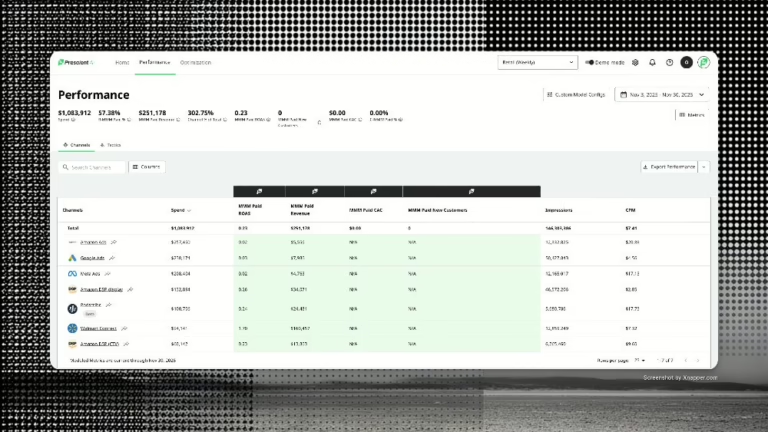
Prescient bridges the gap between attribution signals and business outcomes. Instead of assuming that correlation in your MTA data represents causation, Prescient validates attribution signals against actual business performance using marketing mix modeling. This combination shows you which channels and campaigns are truly moving revenue versus which ones are just taking credit.
The platform doesn’t just measure what happened, it helps you understand what drives results and how to improve them:
- Measures halo effects that show how awareness advertising influences other channels
- Reveals saturation points where additional spend starts delivering diminishing returns
- Identifies efficiency curves that show optimal budget levels for each channel
- Validates attribution signals against actual revenue outcomes to separate signal from noise
- Connects online advertising to offline revenue sources that traditional attribution misses
- Optimizes budget allocation based on true business impact rather than last-click assumptions
Attribution systems tell you where customers interact with your advertising. Prescient tells you which interactions actually matter. That distinction shapes whether you spend money on channels and campaigns that look good in reports or ones that actually drive growth.
Understanding how customers move through awareness and consideration is valuable. Knowing which advertising investments actually generate profitable growth is what allows businesses to scale. For more on how attribution fits into broader marketing measurement, see our article on measuring marketing after iOS privacy changes.
Book a demo and see how Prescient AI helps teams measure what truly drives growth.
MTA advertising FAQs
What is MTA in advertising?
MTA stands for Multi-Touch Attribution. It’s a methodology that assigns credit to multiple touchpoints in a customer’s journey rather than giving all credit to the last interaction before purchase. MTA tries to measure influence across the entire funnel instead of only rewarding the final click.
What does MTA mean in advertising?
MTA is short for Multi-Touch Attribution. The purpose is to show how different advertising channels work together to drive conversions. Instead of treating each ad in isolation, MTA acknowledges that customers usually interact with several ads before buying something and tries to give appropriate credit to each interaction.
What is MTA in email marketing?
In email marketing, MTA recognizes email as an assist channel within a broader customer journey rather than treating it as a standalone conversion driver. Attribution reveals email’s contribution even when someone doesn’t click the email and immediately buy. For example, someone might read your email about a product, then later search for your brand and purchase. MTA can show that the email played a role in that sale even though it didn’t get the last click.
What does MTA mean in business?
In business contexts, MTA refers to the practice of measuring how different marketing touchpoints contribute to customer acquisition and revenue. Leadership teams use MTA insights to inform budget strategy and understand which marketing investments are actually working. The goal is to connect advertising spend to business outcomes with more accuracy than simple last-click attribution allows, though MTA has limits that often require complementary measurement approaches like MMM.

The Prescient Team often collaborates on content for the Prescient blog, tapping into our decades of experience in marketing, attribution, and machine learning to bring readers the most relevant, up-to-date information they need on a wide range of topics.