



What actually drives direct and organic traffic?
Direct and organic traffic measure different things, and both are more connected to your paid spend than most dashboards show. Here's how to read them better
Linnea Zielinski · 8 min read
Walk into any shop on a busy street and the owner can tell you how many people came in that day. What they usually can't tell you is why each person walked through the door. Some had passed the window a dozen times before finally deciding to stop in. Some heard about the place from a friend. Some were specifically looking for a shop like this one and found it in a search. The door doesn't log any of that, it just records that someone came through.
Analytics dashboards have the same limitation. Direct traffic and organic traffic tell you something real and useful about how visitors arrived, but neither label tells you what sent them looking in the first place. Getting clear on what those two numbers actually represent—and what they don't—is one of the more underrated moves a marketer can make. Both signals carry more information than most teams extract from them, and reading them together tells a story that neither one tells on its own.
Key takeaways
- Direct traffic refers to sessions where no referral source was recorded, typically someone who typed your URL directly into a browser or navigated from a bookmark. It's a strong signal of brand recall and recognition.
- Organic traffic refers to sessions that came through unpaid search results. It reflects active search intent, and much of it is category-level (people searching for a solution or a product type rather than your brand specifically).
- These are two distinct signals: direct traffic tells you something about how well your brand is sticking in people's minds; organic traffic tells you something about how well you're showing up when people go looking for what you sell.
- Both channels are downstream effects of paid awareness spend, not purely independent. Awareness campaigns build brand salience that shows up later as direct visits, and category awareness that shows up later as organic searches.
- Rising direct traffic after an awareness campaign is a signal the campaign is building brand recognition; people remembered you well enough to come back on their own terms.
- Rising organic traffic alongside paid activity can mean your campaigns are generating category interest that your SEO is capturing, a sign that paid and organic are working in sync.
- Seeing the organic and direct spillover from specific campaigns, rather than just the aggregate numbers, is what makes it possible to connect these signals back to the paid activity that drove them.
What direct traffic actually is
In most analytics platforms, direct traffic refers to sessions where no referral source was recorded. The most straightforward version of this is exactly what it sounds like: someone typed your URL directly into their browser, or clicked a bookmark they'd saved. But direct traffic also catches a broader range of unattributed sessions; certain mobile app referrals, clicks from encrypted messaging platforms, and some email client traffic all tend to get bucketed here because the referral data doesn't make it through.
The practical implication is that direct traffic is often somewhat larger and messier than teams expect, and it shouldn't be read as exclusively meaning "people who typed our URL." What it reliably signals, though, is brand familiarity. Someone who navigates directly to your site—whether through a typed URL, a bookmark, or an untracked referral—already knows who you are. They weren't searching for something and stumbling across you. They came looking for you specifically.
There's a nuance worth calling out here that often gets missed: a meaningful portion of direct traffic in DTC brands comes from people who saw an ad with a URL in the creative and remembered it well enough to type it later. This isn't branded search. It's not someone Googling your brand name. It's someone who retained your URL from an ad they saw, closed the app, and came back to it on their own. That's a strong signal of both ad recall and brand interest, and it belongs to the paid campaign that made the impression, even though standard reporting has no way of connecting those dots.
What organic traffic actually is
Organic traffic refers to sessions that arrived through unpaid search results: someone searched for something, your site appeared in the results, and they clicked through. The key distinction from direct is that there's a search query involved. The visitor was actively looking for something, which gives organic traffic a different character as a signal.
What's worth being specific about here is what people are typically searching for when they generate organic traffic for a DTC brand. A lot of it isn't branded; it's not someone searching your brand name. It's category-level. Someone searching "best magnesium supplement" or "how to layer skincare" or "most durable water bottle" isn't necessarily looking for you; they're looking for a solution, and your content showed up as a relevant result. That category-level organic traffic is genuinely valuable, but it means something different from someone who navigated directly to your site. It reflects your visibility in the broader conversation around your product category, not brand recall specifically.
This distinction matters because it changes what organic traffic growth is actually telling you. If organic traffic rises, the question worth asking is whether that growth is coming from branded searches, category searches, or both, and what's driving each.
How they're different and why that matters
Put plainly: direct traffic is a proxy for brand salience, and organic traffic is a proxy for category discoverability. They're measuring related but distinct things, and treating them as interchangeable misses what each one is actually useful for.
When direct traffic is high or growing, it's a reasonable signal that your brand is sticking. People are coming back without being prompted by a search or a paid placement. That's a sign of genuine brand recognition, the kind that gets built through repeated exposure over time, whether from advertising, word of mouth, or consistent presence in the market. When direct traffic rises noticeably after an awareness campaign, that's not a coincidence, it's the campaign working.
When organic traffic is high or growing, it signals that your content is showing up when people go looking for what you sell. Strong organic performance in a category means you're capturing searches from people who are in the market but not necessarily brand-aware yet. That's a different kind of value: it speaks to discoverability and content strength rather than brand recall. And when both direct and organic are rising together, especially alongside active awareness campaigns, that's a particularly useful signal that suggests your paid spend is generating both brand recognition and category interest, and that your SEO is positioned well enough to capture the latter.
How to read these two numbers more usefully
The most common mistake with these two metrics is reading them in isolation, celebrating organic growth as a content win or direct growth as general brand momentum without asking what actually drove the change. Both numbers are connected to your paid activity in ways that standard dashboards don't show.
When your awareness campaigns are running well, you should expect to see movement in both channels: direct traffic rising as brand recall builds, and organic rising as category interest grows. If you're seeing an organic halo effect from a specific campaign in a reporting tool like Prescient's, that's telling you something concrete: not just that organic is up, but that this particular campaign generated enough category interest that people went looking and found you in search. This means the campaign is building brand familiarity and seeding the category-level searches that your organic content is capturing simultaneously.
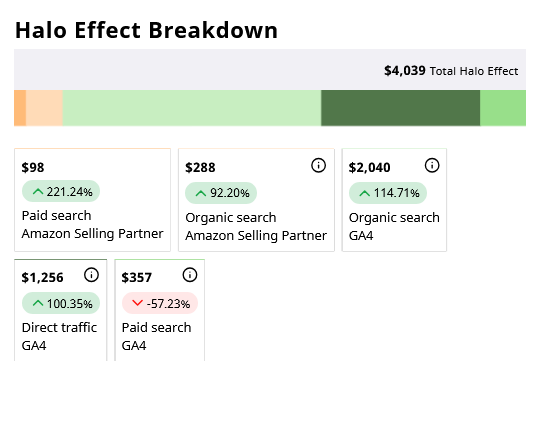
A campaign that's showing both organic and direct spillover is one worth understanding well before you make any decisions about scaling or cutting it. The direct traffic signal tells you the brand message is landing. The organic signal tells you it's also generating category awareness that your SEO strategy is converting. That combination is hard to see in platform reporting, but it's exactly the kind of information that changes how a campaign should be evaluated.
Where Prescient comes in
Prescient's MMM measures the spillover from your awareness campaigns onto both direct and organic traffic at the campaign level, so neither signal has to be read as an unexplained aggregate. You can see which campaigns are driving which downstream effects and make budget decisions based on a fuller picture of what's actually working. If you'd like to see how the platform shows you how your campaigns are performing across both channels, book a demo.
FAQs
Is direct traffic always a sign that someone already knew our brand?
Mostly, yes, but not exclusively. Direct traffic in analytics catches all sessions where no referral source was recorded, which includes typed URLs, bookmarks, and some unattributed clicks from mobile apps and messaging platforms. What it reliably reflects is that the visitor didn't arrive through a search or a tracked referral, which generally implies some level of prior brand awareness. A notable portion of direct traffic from DTC brands comes from people who saw a URL in an ad creative and returned to it later, which is a paid-influenced visit that gets counted as direct.
If organic traffic is mostly category searches, does that mean branded search is a different metric entirely?
Yes, branded search shows up in organic traffic in most analytics platforms, but it's worth separating out if you can. A visitor who searched your brand name and clicked an organic result is meaningfully different from one who searched a category term and found you. Some platforms allow you to filter organic traffic by branded vs. non-branded queries. If yours does, it's worth doing; the two signals have different implications for what's working in your marketing mix.
Can direct traffic be inflated by things that aren't really brand recall?
It can. Internal team traffic, QA visits, and certain link types that strip referral data can all end up in your direct bucket. For most DTC brands with reasonable traffic volume, these don't move the number significantly, but it's worth filtering out known internal IP addresses if you want a cleaner signal. The broader point still holds: directional changes in direct traffic—especially spikes that correlate with awareness campaigns—are worth paying attention to.
Should we be worried if organic traffic grows but direct traffic doesn't?
Not necessarily. Organic and direct traffic reflect different things, and they don't have to move together. Strong organic growth without corresponding direct growth might mean your content is performing well in category searches, but brand awareness isn't building at the same rate. That's useful information. It might suggest an opportunity to invest more in awareness campaigns that build the brand recognition that eventually shows up as direct traffic. The two metrics are most powerful when read in relation to each other and to your paid activity.
How do we know which awareness campaigns are driving organic vs. direct spillover?
Standard analytics tools don't connect these dots because they're built around last-touch session data. Seeing which specific campaigns are contributing to organic and direct traffic downstream requires a modeling approach that looks at statistical relationships across your full data set over time, which is what an advanced MMM is designed to show. Prescient's platform reports on this at the campaign level, so you can see not just that organic or direct traffic is up, but which campaigns drove that movement.
The Halo
Exclusive insights, every week.
Subscribe to The Halo for sharper marketing thinking.
You're subscribed to The Halo!
Quick question (optional): How familiar are you with MMM?
Thanks for sharing! Enjoy The Halo.
Keep reading
View all
How AI is changing top of funnel demand generation
Read article
How your upper funnel drives revenue (even when platform reporting says it doesn't)
Read article
What happens to your sales after a promotion ends
Read article
Why traditional MMMs fall apart during peak sales
Read article
Why halo effects matter even more for subscription businesses
Read article
5 Predictive analytics wins our clients got with the Prescient platform
Read article