




What do marketing mix models show advertisers?
Certain advanced marketing mix models can give advertisers an accurate view of performance that accounts for cross-channel interactions and spillover effects.
Linnea Zielinski · 8 min read

A ship's navigator in the pre-GPS era didn't just need to know where the ship had been, they also needed a way to synthesize wind data, ocean currents, and star positions into a single picture of where the ship actually was and where it was heading. Without that synthesis, every reading existed in isolation, and the map was always incomplete. Marketing without a marketing mix model works the same way. You can see what each channel reports about itself, but you can't see the full picture of what's actually driving your brand's sales.
For advertisers managing spend across multiple marketing channels and campaigns, that incomplete picture has tangible financial consequences. What marketing mix models show advertisers is a unified, accurate view of how their marketing efforts connect to revenue so decisions about where to cut, where to scale, and how to plan future campaigns stop being educated guesses. For any brand that wants to make data-driven decisions and build more effective marketing strategies grounded in actual sales outcomes, understanding what mix models show advertisers is the right place to start.
Key takeaways
- Marketing mix models use historical data and statistical analysis to show advertisers how their marketing efforts across all channels contribute to sales, independent of platform-reported numbers. (*)
- MMMs analyze and report on incremental sales driven by specific marketing activities, helping advertisers understand the true impact of each campaign.
- Unlike platform-reported data, which reflects only what each channel can see, marketing mix models give advertisers an accurate view of performance that accounts for cross-channel interactions and spillover effects.
- Advanced marketing mix models track halo effects—the revenue that awareness campaigns generate through channels like branded search, organic traffic, and retail—which most attribution methods miss entirely.
- Budget optimization tools built on MMM insights help advertisers simulate scenarios, reallocate advertising spend efficiently, and plan future campaigns with greater confidence.
- The best marketing mix models update daily and report at the campaign level, giving advertisers the granularity they need to act on insights quickly rather than waiting for monthly readouts.
- Model accuracy can be validated against actual sales outcomes over time, giving advertisers a concrete basis for trusting the recommendations they're acting on.
(*) This is true of most, but not all, MMM platforms.
What marketing mix models measure at a foundational level
At their core, marketing mix models analyze the statistical relationships between marketing inputs—things like advertising spend, impressions, and timing—and sales outcomes. They use historical data to attribute a portion of your brand's sales to each marketing activity running during a given period, while also accounting for factors like seasonality, promotions, and competitor activities across your marketing channels that affect revenue independently of what you're spending.
This decomposition separates your brand's sales into two buckets: base sales, which represent the revenue your business would generate without any paid marketing, and incremental sales directly tied to your advertising efforts. Understanding where base sales end and marketing's contribution begins is foundational to everything else an MMM shows advertisers, and to making data-driven decisions about your marketing budget with any real confidence. Without that separation, it's difficult to know whether a strong revenue period reflects genuine marketing effectiveness or just a seasonal lift that would have happened anyway.
What makes marketing mix models different from other measurement approaches is that they don't rely on tracking individual users through tracking pixels or cookies. They look at aggregate data—totals and trends across your marketing channels—which makes them both privacy-safe and capable of capturing channels that click-based attribution can't touch, like TV commercials, out-of-home advertising, and streaming.
What your ad platforms won't tell you
Your ad platforms almost always report higher ROAS than your business actually sees. That's a known structural problem. Each platform measures the conversions it can observe and takes credit for them. When a customer moves along a conversion path that touches Meta, then Pinterest, then completes a purchase through Google search, all three platforms may count that sale. The numbers don't add up because they can't.
Marketing mix models give advertisers a completely independent read on media performance, one that isn't calculated by the platforms that have a stake in looking effective. That contrast can be significant.
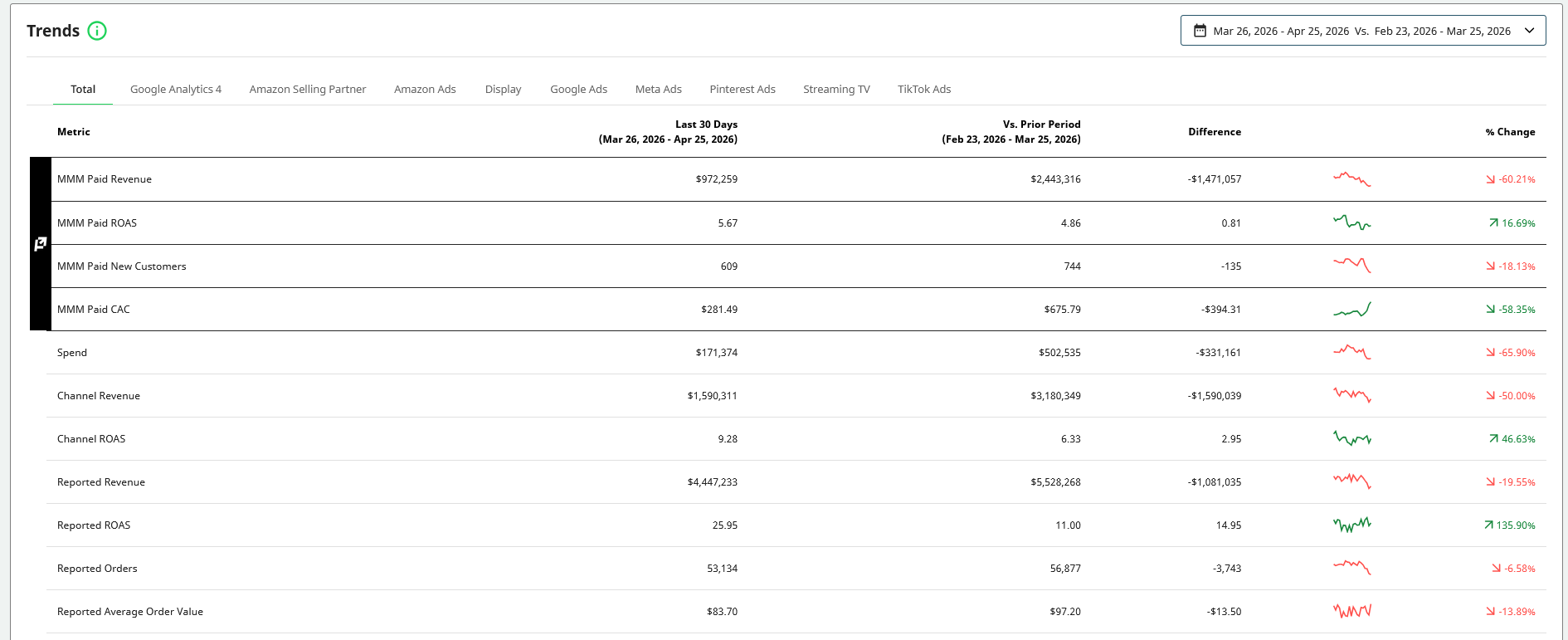
This kind of gap between channel-reported data and what marketing mix models show is common across advertisers. It doesn't mean platform data is useless, just that advertisers need an external model to contextualize it. MMM analysis puts a number on that gap and helps you build more informed decisions on a more complete picture of your brand's sales rather than fragmented, self-reported conversion data that each channel's marketing activities generate on their own terms.
Why campaign-level insights matter more than channel-level data
Most MMM providers report at the channel level. Prescient reports at the campaign level, and that distinction matters more than it might seem for driving sales and assessing campaign success efficiently.
Advertisers don't make budget decisions at the channel level. You don't turn off Meta. You turn off a specific prospecting campaign on Meta that isn't pulling its weight so you can redirect that advertising spend to a retargeting campaign that is. Channel-level data forces you to average across campaigns that may be performing very differently, which means you're always making strategic decisions with less information than you need.
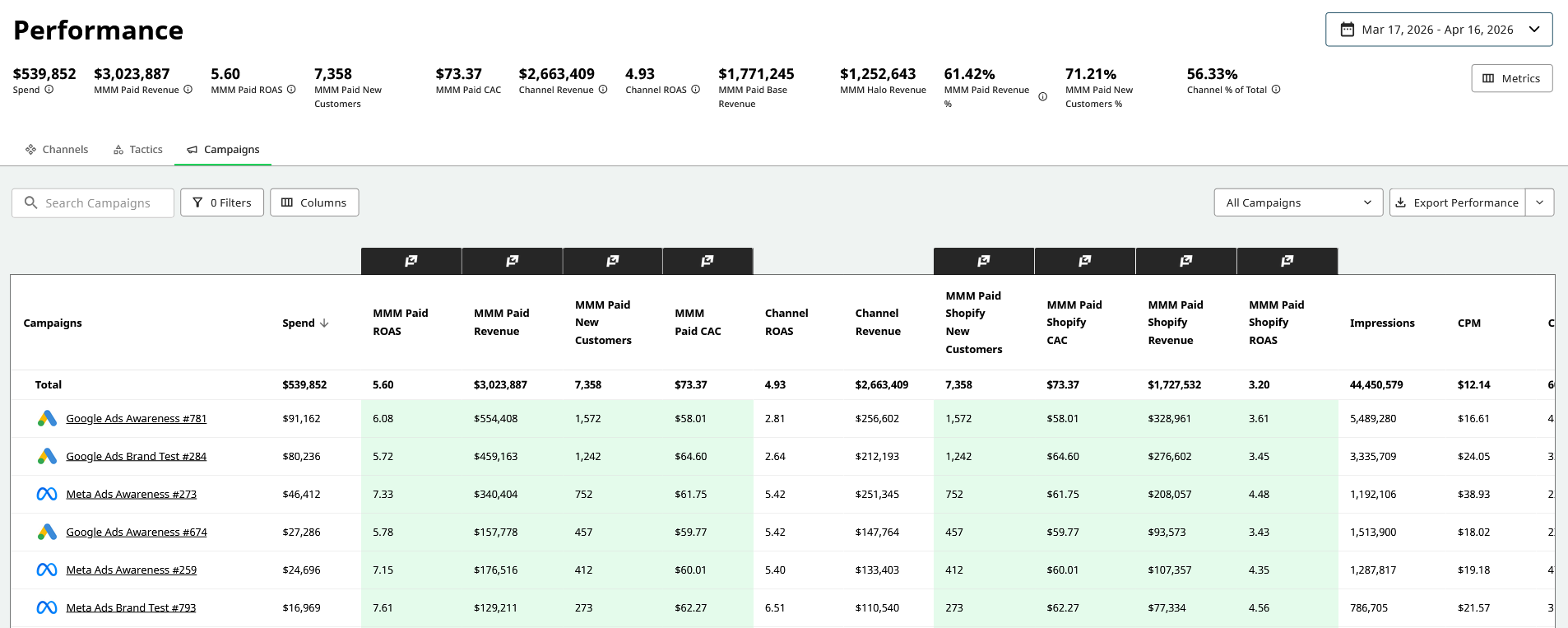
Campaign-level granularity also surfaces something channel-level reporting hides: the fact that campaigns within the same channel can have very different saturation curves. One Meta campaign might have room to scale while another is already past its point of diminishing returns. You'd never know that from a channel average, and averaging across campaigns is one of the most common blind spots in standard marketing reporting.
What marketing mix models reveal about spillover effects
One of the most important things mix models show advertisers is the revenue generated by campaigns that never gets credited to those campaigns in platform reporting. Advertisers often undervalue awareness and upper-funnel spend because the brand's sales it generates tend to show up somewhere else, like branded search, direct traffic, organic search, or retail. These are the downstream effects of your marketing efforts that standard attribution simply can't see, and Prescient calls them halo effects.
You've absolutely seen these effects in action: a customer sees a display ad, doesn't click, searches your brand name two days later, and buys. That sale shows up as a branded search conversion. The display campaign gets no credit. Marketing mix models that measure halo effects trace that revenue back to the awareness campaign that actually influenced it, giving advertisers a much more accurate view of what their marketing investments are actually worth.
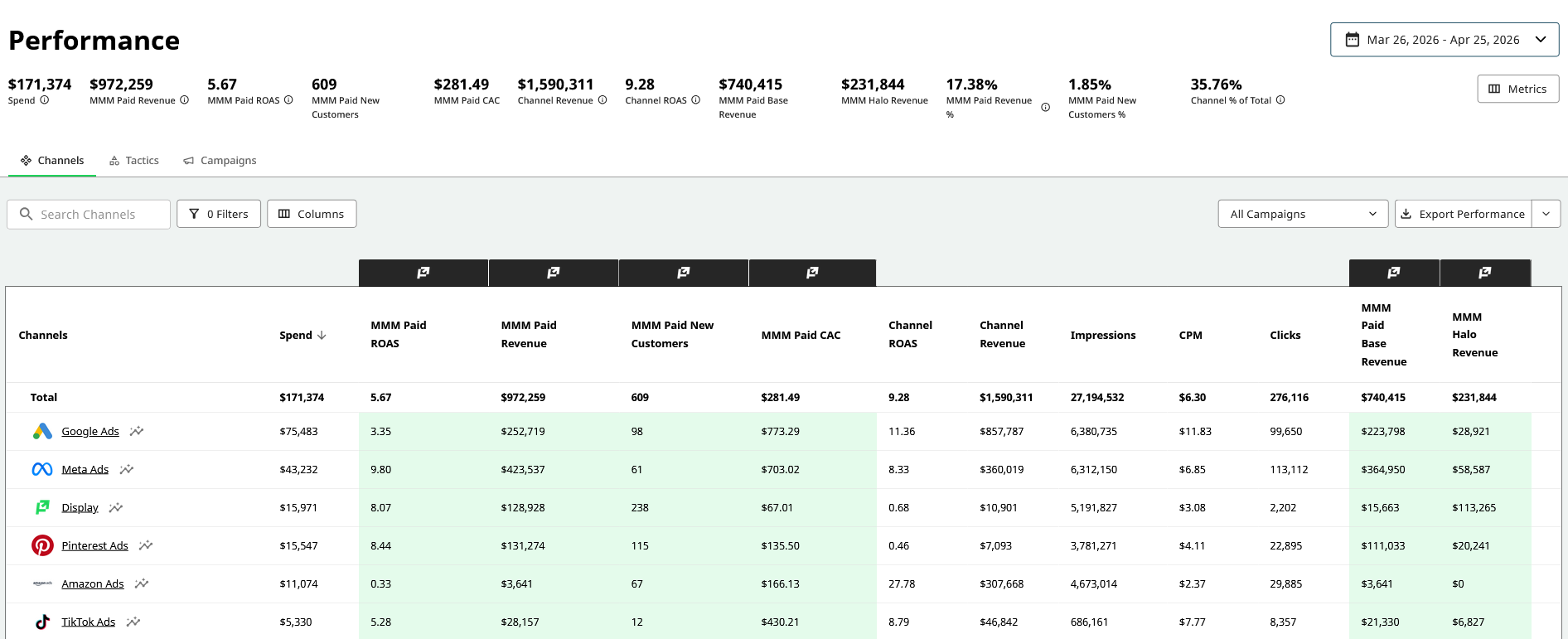
NOTE: You can see how significant halo effects can be on certain campaigns. The display campaign earned $113K in halo revenue for $15K of spend. This illustrates how upper-funnel campaigns generate downstream brand's sales that aren't visible in platform data.
This also applies to retail. Brands that sell on Amazon often find that Meta or CTV campaigns drive Amazon sales that never show up in their DTC analytics. Halo effects measurement gives those campaigns their due credit across every storefront where revenue lands, and it gives advertisers a holistic view of their total marketing ROI rather than just what each channel claims.
How marketing mix models show whether your campaigns are approaching saturation
Every campaign eventually reaches a point where spending more produces proportionally less. Advanced marketing mix models show advertisers where that point is and, more importantly, they show that it isn't the same for every campaign. (Many open-source MMMs force uniform saturation curves that don't necessarily reflect reality, so you'll want to ask a potential provider about how they handle MMM saturation curves.) A specific variable like creative format, audience size, or channel mix can dramatically change how quickly any given campaign saturates, and understanding those differences is central to smart budget allocation.
The practical value here is that saturation isn't always a cliff. Saturation curves built from MMM data show you where you actually are on that arc for each campaign. When advertisers can see campaign-level saturation data alongside confidence scores, they can reallocate advertising spend toward campaigns with room to grow—driving sales more efficiently—rather than continuing to pour budget into advertising costs that are no longer generating incremental brand's sales.
Forecasting and budget optimization
Knowing what happened is only half the value of marketing mix models. The other half is using that information to make better decisions about what happens next. This is where forecasting and budget optimization tools turn MMM insights into action, and where marketing mix models show advertisers something most reporting tools can't: a forward-looking picture tied directly to their marketing strategies and business objectives.
Prescient's Optimizer uses MMM data to help advertisers simulate scenarios and find the most efficient allocation of their media spend toward their business objectives. You can set a goal—maximize revenue, improve ROAS, or optimize within a fixed budget—and see projections for how shifting advertising spend across campaigns would affect sales over the next 28 days, with marketing channels broken out so you know exactly where to move the money. Confidence scores accompany every recommendation so you can weigh projected sales outcomes against your team's risk tolerance.
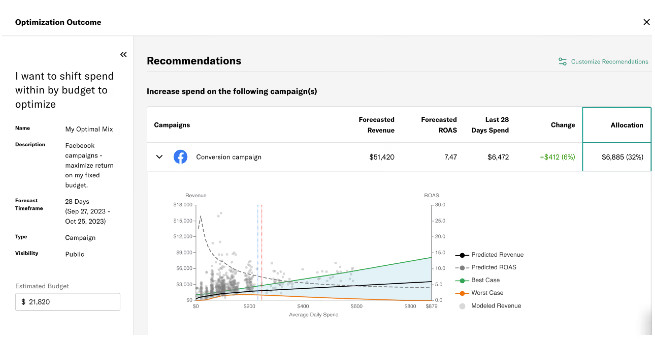
This kind of scenario planning is especially useful when advertisers are under pressure to justify marketing investments to leadership. Instead of presenting a historical attribution report, you can walk into that conversation with a forward-looking model that connects your marketing tactics to projected sales and that models the impact of different strategies before you commit advertising budget to any of them.
How you know the model is working
One reasonable concern any advertiser should have when adopting a marketing mix model is whether to trust it. The answer shouldn't be "because the vendor says so," it should be visible in the tool itself. Prescient's MMM Fit view shows the model's predicted revenue tracked alongside actual reported sales over time, including upper and lower confidence bounds. It's a data-driven decisions tool in the truest sense: you can see, period over period, whether the conversion data the model produces tracks with what actually happened in your business.
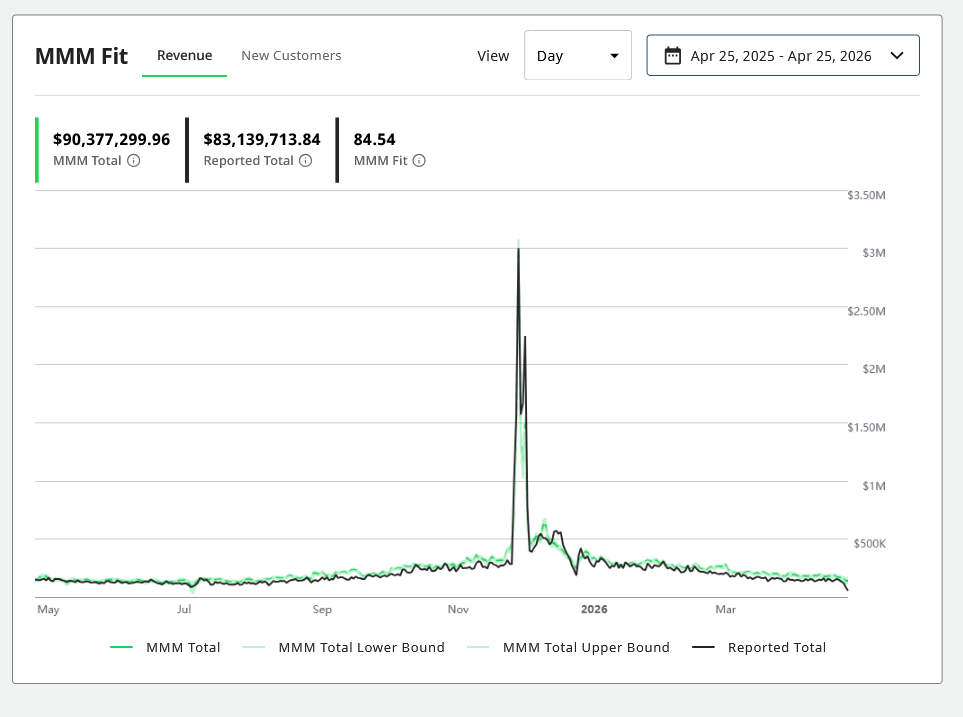
When predicted and actual sales move together consistently, that's evidence the model is accurately capturing the real dynamics of your business, not just fitting to noise. It's the kind of transparency that makes it reasonable to act on what mix models show, whether that means scaling a campaign, reallocating marketing spend, or pulling back on advertising that looks efficient in platform reporting but isn't holding up when the MMM shows advertisers the full picture.
Where Prescient comes in
Most marketing mix models give you a read on what happened last quarter. Prescient gives you that read every day, at the campaign level, with halo effects measured across every revenue source, including Amazon. That means the insights driving your marketing strategies are never more than 24 hours old, and they reflect the full complexity of how your marketing activities interact with each other and with your brand's sales, not just what each individual channel can see about itself.
The Optimizer translates those insights into concrete budget recommendations, and the MMM Fit view gives you an ongoing basis for trusting the numbers you're acting on. For advertisers who are done making decisions based on fragmented customer journeys and conversion data that doesn't reconcile across platforms, Prescient offers a more complete and accurate view of what's driving your brand's sales. It's the kind of data-driven decisions foundation that pays off not just in better attribution, but in more confident spend. See all the platform has to offer when you book a demo.
The Halo
Exclusive insights, every week.
Subscribe to The Halo for sharper marketing thinking.
You're subscribed to The Halo!
Quick question (optional): How familiar are you with MMM?
Thanks for sharing! Enjoy The Halo.
Keep reading
View all
The 31 best marketing intelligence tools, organized by use case
Read article
How to measure CTV advertising effectively
Read article
What is LTV (lifetime value)? A marketer's guide
Read article
Marginal ROAS: Calculation, Purpose & Potential Pitfalls
Read article
How to calculate return on marketing investment
Read article
Return on marketing investment: How to calculate and improve your marketing ROI
Read article