


Welcome back to The Halo. In this issue we cover:
- Industry Watch: Prime Day moved $26.4B in four days. The post-event audit is where Amazon-first brands find out what actually drove it.
- The Take: Zenwise pulled 22 points of spend out of Amazon Sponsored Ads. Amazon revenue grew anyway.
- From the Blog: A framework for allocating budget across channels when Amazon carries most of the revenue.
- Prescient Voices: Sal Aziz, CEO of Zenwise, on what changed when marketing stopped being measured channel by channel.
- Three Things: Reads on TikTok Shop halo, retail MMM selection, and cross-channel budget tools.
Prime Day 2026 pushed $26.4 billion through the US online economy in four days. Adobe put opening day alone at $8.3 billion, the biggest single day of online shopping so far this year. For Amazon-first brands, that means one thing: revenue spiked, hard and fast.
Four weeks out, the spike has settled into a number on a dashboard. The harder question is what produced it: Sponsored Ads on Amazon, a Meta campaign that never touched Amazon's checkout, a TikTok video that sent someone searching? Zenwise, a supplement brand with Amazon as main sales channel, ran into this exact question in January, when it relaunched its brand and needed Shopify DTC to grow without cutting the campaigns that had established the Amazon base funding the business.
Cross-channel measurement gave Zenwise an answer: upper-funnel channels were driving more Amazon revenue than their team expected, most of it never touching Amazon's own ad surface. Brands that learn from Zenwise and trace the path leading to their Amazon storefront can own the number. Brands that don't can only watch it happen and hope they don't cut the campaign driving it.
Welcome to The Halo. Each week: one piece of measurement analysis, the best of the blog, one real customer result, and three reads worth your time.
Let's dive in.
INDUSTRY WATCH
Prime Day 2026 moved $26.4 billion without a receipt for where it came from.
Adobe Analytics logged $26.4 billion in US online spend across Prime Day 2026's four days, June 23–26, up 9.3% year over year. Opening day alone hit $8.3 billion, the biggest single online shopping day of 2026 so far. Despite brands selling across their own sites and Amazon, that volume concentrated on the online giant's marketplace.
Numerator ranked health and wellness as the third fastest-growing category at Prime Day 2026, with 27% of shoppers buying into it, trailing only apparel and shoes at 30% and household essentials at 28%.
Amazon captured 79.7% of all US retail media spend, per eMarketer's 2026 forecast, with ad revenue at $56.71 billion, up 17.9% year over year. That concentration means Sponsored Ads gets credited for a lot of revenue that started somewhere else, like a Meta ad, a Google search, or a TikTok video.
Last-click attribution assigns that revenue to whichever ad interaction was closest to purchase. It's unable to factor in what put the shopper in a buying mood in the first place. Cross-channel measurement does: it decomposes every dollar of spend into incremental revenue by destination, doling out credit from the top of the funnel to the bottom. That's a much more holistic performance report for brands auditing Prime Day.
Sources: Adobe Analytics, Numerator, eMarketer.
01 · THE TAKE
Zenwise grew DTC revenue and held Amazon steady in the midst of a rebrand
Zenwise, a digestive enzyme and gut-health supplement brand, entered 2026 with 94% of its revenue running through Amazon, one of the most Amazon-concentrated brands in its category. January brought a full relaunch: new brand, new Shopify DTC site, and even new products. The mandate was to grow the new DTC business without touching the Amazon base that had built the company.
Their immediate problem was measurement. Last-click can't track a shopper who sees a Meta ad and buys on Amazon three days later. It shows Amazon Sponsored Ads triggering another conversion and Meta driving nothing. Without a way to see the full impact of upper-funnel spend, moving budget to Amazon Sponsored Ads looked like the only option.
Prescient's MMM broke out Zenwise's spend by destination, tracing incremental revenue across Shopify, Amazon, and TikTok Shop for every channel. Across Meta, Google, Pinterest, and TikTok, most of the revenue those channels drove landed on Amazon. For a brand this Amazon-first, this breakdown was the context they needed to make confident reallocation decisions.
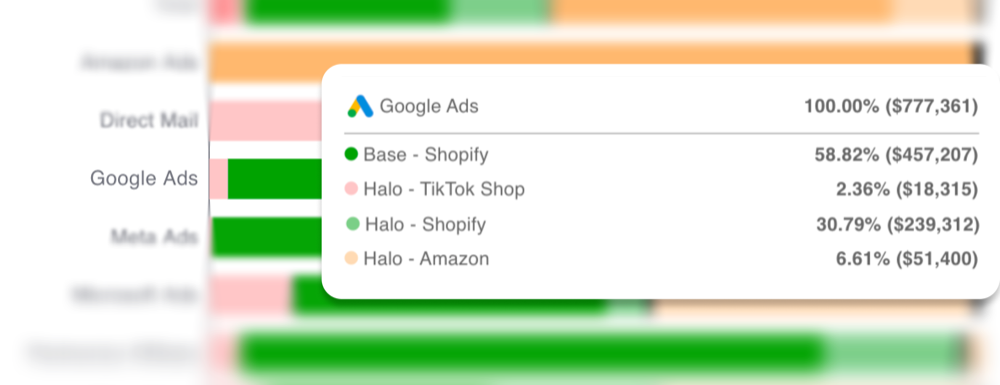
Example from an anonymized account. This is how Prescient traces a channel's revenue by destination, crediting upper-funnel spend even when the purchase happens on Amazon.
With that signal, Zenwise moved 22 points of spend share out of Amazon Sponsored Ads into upper-funnel channels. Amazon revenue from omnichannel paid media grew 31%, more than the Sponsored Ads cut gave up. Shopify DTC grew roughly 5x year over year. Amazon's base held.
Prime Day proves the same math at scale: the spike is real, and cross-destination measurement is what tells a brand which channel earned it.
02 · FROM THE BLOG
How to allocate marketing budget across channels
The Zenwise reallocation was a budget question before it was a creative one. Moving 22 points of spend share out of Amazon Sponsored Ads is only defensible if a brand knows what happens to Amazon revenue when the money leaves. The platform reports won't answer that question.
Allocating budget across channels requires understanding how channels interact, where saturation curves flatten, and what a marginal dollar produces on each surface. This post walks through that framework: what to look for in channel interactions, how to read saturation curves, and where the reallocation math typically breaks down.
For an Amazon-first brand or any omnichannel portfolio, the framework only holds up if the measurement is cross-channel.
03 · PRESCIENT VOICES
Prescient has fundamentally changed how we think about marketing investment. Instead of optimizing channels in silos, we're able to understand how every dollar contributes across our entire business. That confidence has allowed us to scale our DTC business while continuing to grow Amazon, something we couldn't accurately measure before.

04 · THREE THINGS WORTH READING
1. What TikTok Shop halo effects mean for your content strategy
If you run TikTok Shop, the platform's own performance data leaves out halo effects. This article walks through what TikTok Shop actually contributes to demand on other surfaces, and how to build a content strategy around the full picture. Read →
2. Best MMM solutions for retail and omnichannel brands
Retail complexity breaks a lot of MMM setups: multiple storefronts, retail media, wholesale, DTC and marketplace demand competing for credit. This blog post compares the top MMM platforms for retail and omnichannel brands and walks through what to look for when you need cross-channel visibility. Read →
3. The best cross-channel budget optimization tools for marketers
Reallocation is only as good as the tool that surfaces the trade-offs. This article covers the current landscape of cross-channel budget optimization tools, what each one is built for, and where they hold up when the portfolio spans DTC, marketplace, and retail media. Read →
The Halo
Exclusive insights, every week.
Subscribe to The Halo for sharper marketing thinking.