



Welcome back to The Halo. In this issue we cover:
- Industry Watch: CTV keeps earning more attention than ad budget, and 2026 is the year the money starts to catch up.
- The Take: How Laundry Sauce used Prescient AI to prove Vibe was its best growth channel, then scaled it 4x.
- From the Blog: Why a CTV sale almost never happens on the screen that showed the ad.
- Prescient Voices: Ian Blair, Laundry Sauce's co-founder, on what gave him the confidence to scale CTV spend.
- Three Things: Three short reads on measuring the channels that build brand awareness before they drive conversions.
Streaming now claims about 20% of the average American adult's media day, something like two and a half hours. Advertisers still put only 8.1% of ad budgets there. That gap has held for years across CTV's entire growth curve, and it's one of the widest imbalances between attention and ad dollars anywhere in media.
Laundry Sauce, a premium home fragrance brand selling on Shopify, Amazon, and TikTok Shop, ran into a version of this problem up close. Its CTV campaigns with Vibe were building the kind of awareness a founder can feel in the business. But a streaming ad isn't clickable. There's no last-click trail, and households get served ads by several platforms at once, so credit for any single sale is close to a guess. Without a clearer signal, Laundry Sauce didn't have enough evidence to justify scaling the channel.
Prescient's MMM measures the impact CTV produces across every storefront Laundry Sauce sells on, not just their DTC website. For a channel built to create awareness first and conversions later, that's the only way to see the full picture.
Welcome to The Halo. Each week: one piece of measurement analysis, the best of the blog, one real customer result, and three reads worth your time.
Let's dive in.
INDUSTRY WATCH
CTV keeps outgrowing its ad budget
American adults spend about 20% of their daily media time on connected TV, roughly two hours and thirty-four minutes a day, according to eMarketer's 2026 forecast. Advertisers allocate 8.1% of ad budgets to the channel. That's a wide gap between where attention goes and where dollars follow, and it's held steady even as CTV spend keeps growing.
The money is starting to move, just on its own timeline. eMarketer expects US CTV upfront commitments to reach $17.73 billion in 2026, compared to $16.98 billion for primetime linear TV. That's the first year CTV upfronts have outpaced linear. Total US digital video ad spend is projected to top $80 billion in 2026, up 11% year over year, according to the IAB's 2026 Digital Video Ad Spend and Strategy Report.
Confidence hasn't caught up to the investment, though. In that same IAB report, 43% of CTV buyers said they weren't sure their ads had actually run where they thought they had. eMarketer analyst Ross Benes summed up why: mapping out which viewers you intend to reach is the easy part, but executing against that plan is difficult, since CTV inventory is sold by an array of different companies that don't communicate with each other.
That's the real ceiling on CTV growth: whether the spend can be measured with confidence. Laundry Sauce ran into exactly that question, and answered it with Vibe.
Sources: eMarketer, IAB 2026 Digital Video Ad Spend Report.
01 · THE TAKE
Laundry Sauce made CTV measurable, then scaled it 4x with Vibe
Laundry Sauce is a premium home fragrance brand, founded in 2020, selling on Shopify, Amazon, and TikTok Shop. Its CTV campaigns with Vibe were building real top-of-funnel awareness, the kind Ian Blair, the brand's co-founder and CEO, could sense were helping the business. He just couldn't prove it. A streaming ad has no click to follow, and households are served ads across several platforms at once, so a last-click tool has no way to credit a sale back to it.
Prescient's MMM quantifies the revenue each channel produces across all three of Laundry Sauce's storefronts at once. That's how CTV, through which a sale never closes on the screen that showed the ad, finally gets the credit it's due. Buyers see the ad on television and buy later, wherever they already shop, but Prescient can attribute those sales.
The model found that 73% of the revenue Vibe generated converted off Laundry Sauce's own DTC site, on Amazon or TikTok Shop. Vibe produced more balanced growth across all three storefronts than any other channel in the brand's mix. And it turned out to be Laundry Sauce's top source of new customers, responsible for roughly 25% of all new customers from a small share of total paid spend.
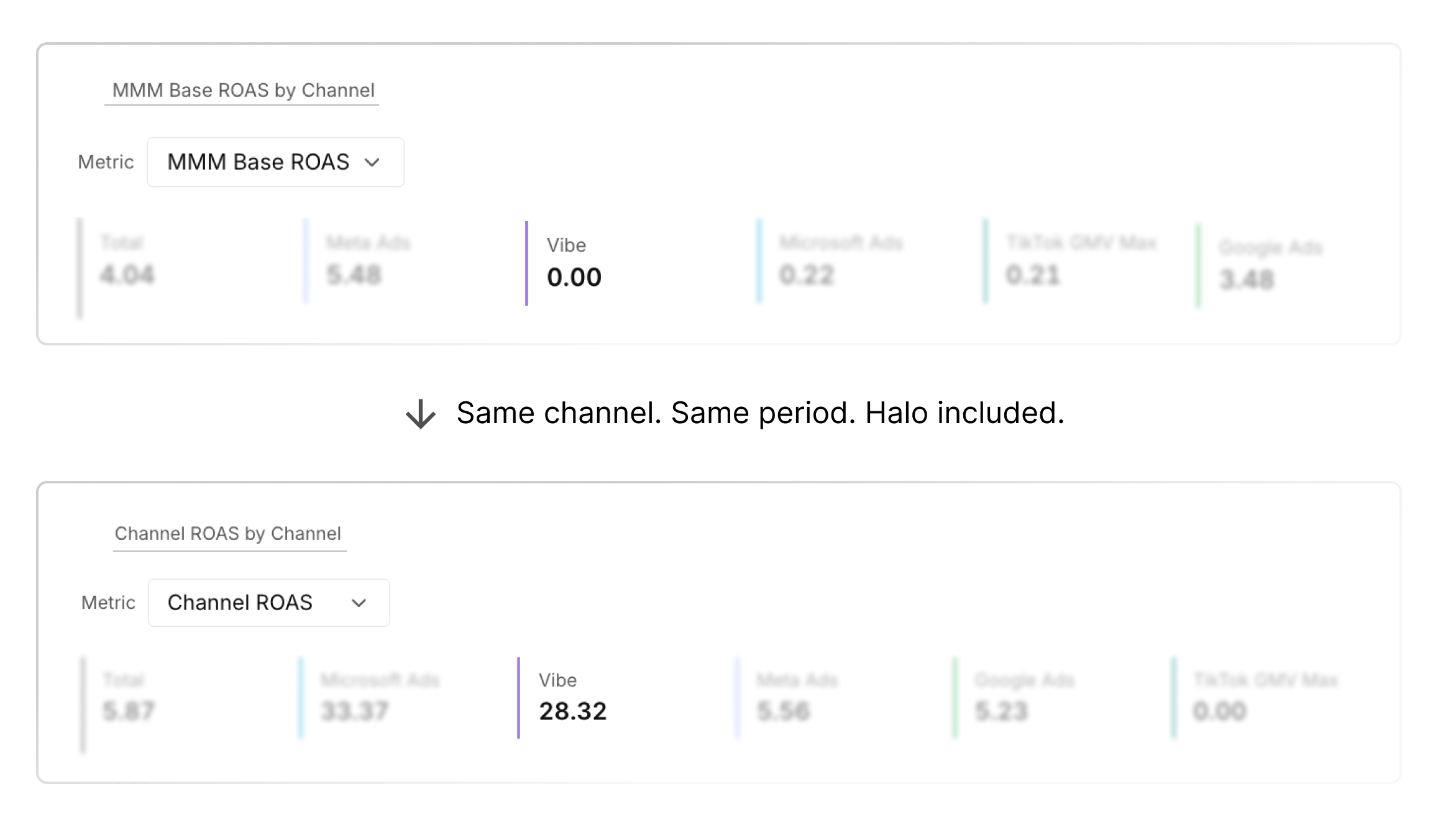
Illustrative data. Base ROAS counts only sales that close on the advertiser's own site, so a CTV channel reads as zero. Channel ROAS includes halo. That's where CTV's revenue actually lands.
The new visibility helped Ian Blair scale spend on Vibe 4x with confidence. Return per dollar doubled alongside it. There was finally a way to quantify the ROI of CTV they knew was there.
For a channel built to create awareness first and conversions later, cross-storefront measurement is the only way to see the full picture.
02 · FROM THE BLOG
OTT measurement: making streaming performance measurable

CTV is built to create awareness. The purchase closes somewhere else. A streaming ad plays on a living room television, and the buyer, if they show up, usually shows up later on a phone, in a marketplace app, on a completely different storefront. That gap between impression and purchase is normal. It's also exactly what breaks last-click measurement.
This is a halo effects problem more than an attribution bug. Halo effects describe how spend on one channel lifts revenue on a different platform, sometimes weeks after the ad ran. Tools built to track a single click through a single checkout were never designed to catch that kind of shifted impact.
A marketing mix model is built for exactly this. It estimates what each channel adds across every storefront a brand sells on, so a CTV campaign's contribution is counted, no matter which storefront the sale lands on.
03 · PRESCIENT VOICES
Great brands need top-of-funnel marketing, but most companies underinvest in CTV because they can't measure it with confidence. Prescient helped us understand the true business impact across all of our storefronts, not just our website. That visibility gave us the conviction to significantly increase our investment in Vibe, and as we scaled, the economics continued to improve.

04 · THREE THINGS WORTH READING
1. How last-click attribution hides the value of awareness campaigns
The direct companion to this week's Take. Awareness channels like CTV do most of their work without a click. The post walks through why last-click tools undercredit these channels, and what measurement approach surfaces their impact. Read →
2. Benefits of omnichannel marketing
Laundry Sauce sells on Shopify, Amazon, and TikTok Shop. That's the shape of modern DTC. The post covers what omnichannel actually earns a brand, how buyers move across storefronts, and where measurement has to reach to keep up. Read →
3. What is direct response TV (DRTV) marketing?
The counterweight to a brand-building CTV story. DRTV built its reputation on selling straight from the screen with measurable response, and the post walks through what it does well, where it falls short, and how it compares to the awareness-first play brands like Laundry Sauce run today. Read →
The Halo
Exclusive insights, every week.
Subscribe to The Halo for sharper marketing thinking.