



Welcome back to The Halo. In this issue we cover:
- Industry Watch: Cyber Week 2025 hit $44.2B in consumer spending, and TV budgets are following.
- The Take: Jones Road Beauty nearly doubled Linear TV heading into Black Friday and their total paid media ROAS still rose 7%.
- From the Blog: Beauty brands have a massive measurement blind spot, and it's costing them money.
- Prescient Voices: Cody Plofker, CMO at Jones Road Beauty, on how measurement changed what he could do with Linear TV.
- Three Things: Three reads on TV attribution, MTA limits for TV, and why halo effects deserve a permanent seat in budget reviews.
Q4 planning doesn't start in October anymore. It starts in the last two weeks of August, when media plans get locked and budgets get signed off. There's a huge reason that having more time to plan matters: the revenue you could bring in has never been bigger. Cyber Week consumer spending hit $44.2 billion in 2025, up 7.7% year over year, according to Adobe. They also noted that Black Friday grew faster than Cyber Monday for the second year running.
This expansion in spend explains why more marketers are pulling budget forward: 71% plan to raise performance-TV budgets for this holiday season, up from 57% last year.
But that puts more pressure on marketers to prove that TV works. 63% of marketers now rank revenue as the top outcome for TV spend, up from fourth place in 2025. Jones Road Beauty ran into exactly that problem a year ago: they knew TV was working, but they had no way to show it. We'll go over what changed for them.
Welcome to The Halo. Each week: one piece of measurement analysis, the best of the blog, one real customer result, and three reads worth your time.
Let's dive in.
INDUSTRY WATCH
The Q4 peak keeps moving earlier, and TV budgets are following
Consumers spent $44.2 billion during Cyber Week 2025, up 7.7% from the year before, per Adobe Digital Insights. Black Friday saw $11.8 billion, up 9.1% YoY. Cyber Monday drove $14.25 billion, up 7.1% YoY. Black Friday grew faster for the second straight year, making it the biggest shopping day on the US calendar.
Shopify's own BFCM weekend backs it up. Merchants on the platform moved $14.6 billion in gross merchandise volume, up 27% YoY, across more than 81 million customers worldwide. At the Black Friday peak, Shopify merchants sold $5.1 million worth of merchandise a minute.
Brands are responding to the increased spending by pulling forward budget and ramping up spend on a channel previously considered only for brand-building. 71% of marketers plan to raise performance-TV budgets for holiday 2026, up from 57% a year ago, per a tvScientific/Attentive survey cited by eMarketer. Black Friday and Cyber Monday alone now pull 35% of seasonal TV budgets, and 63% of marketers rank sales as the top outcome for TV spend.
But the shift into TV raises an important question for marketers: if you're putting more money into the channel, are you confident you can tell the board exactly how much it returns? Jones Road Beauty faced and answered that question last year.
Sources: Adobe Digital Insights, Shopify SEC filing, eMarketer / tvScientific-Attentive.
01 · THE TAKE
Jones Road knew Linear TV worked, but couldn't quantify its impact
Cody Plofker, Chief Marketing and Revenue Officer at Jones Road Beauty, had a problem familiar to a lot of marketers: proving TV's ROI. The brand devoted about 10% of their budget to Linear TV, and revenue moved when the campaigns ran, but nothing in the reporting separated what TV did from the impact of everything else. Without click-level data, the team simply watched platform ROAS, held the budget steady, and hoped the lift was real.
Prescient integrated all of Jones Road's channels, Linear TV included, into a marketing mix model. The model gave Linear TV's value a real number, one significantly higher than the team expected. More importantly, it quantified the halo effects TV placements were creating on direct and organic revenue, which platform reporting couldn't see.
Those numbers changed what Cody could do with the channel. He could see which specific Linear TV campaigns were most efficient, and exactly where each one started to saturate.
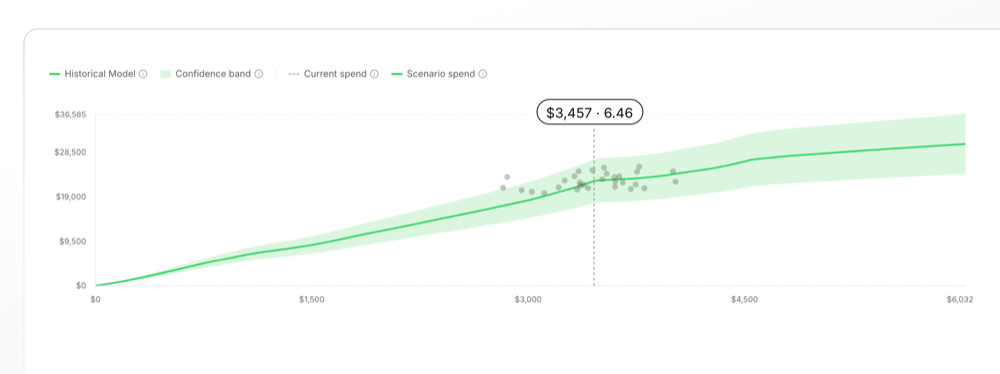
Illustrative data. The dashed line marks current daily spend. The curve shows where added spend starts returning less, and the shaded band shows how confident the model is at each level.
With that visibility, Jones Road nearly doubled Linear TV's share of their marketing budget without sacrificing return. Scaling a channel that aggressively while heading into Black Friday usually costs efficiency, but their total paid media ROAS rose 7% through the ramp up.
A TV budget you can defend before Black Friday is worth more than one you have to explain in January.
02 · FROM THE BLOG
This measurement blind spot is costing beauty brands credit for their media spend
Jones Road, like most beauty brands, sells at Sephora and Ulta because that's where beauty shoppers actually spend most of their time browsing. But every marketer in the category runs into the same issue with retail: reporting is done in silos and usually depends on a click, so there's no way to connect a TikTok campaign or CTV spot to a purchase in one of these stores.
Jones Road needed to quantify Linear TV, but beauty's blind spot extends beyond it into retail aisles. If a beauty brand is using a form of attribution that treats each channel like it doesn't impact any other, its true contribution stays invisible.
The post walks through this blind spot, and what a marketing mix model like Prescient's catches when it can measure the impact of campaigns in every destination a brand sells. Jones Road's Linear TV story is one example of what closing that gap looks like.
03 · PRESCIENT VOICES
It's one thing to know a channel works, another to know why, how it compares within measurement framework, and how far investment can extend without losing return. Prescient AI made my team more efficient.

04 · THREE THINGS WORTH READING
1. How to get TV attribution right and measure the impact of your ads
The direct companion to Jones Road's story. TV attribution methods like ACR and geo tests only tell part of the story. This post walks through where each method stops, and what a marketing mix model adds when a brand wants to see how TV moves revenue across every storefront it sells on. Read →
2. Is a multi-touch attribution model for TV enough?
The technical read on why MTA falls short for TV. Multi-touch attribution has real limits, especially when you factor in device graph issues and halo effects. The post covers what MTA misses on TV, and how measurement beyond click-based tracking fills the gap. Read →
3. Halo effects aren't a nice-to-have metric
Our fresh POV on why halo effects deserve to be in every budget review. The post walks through what a brand risks when a model ignores the revenue campaigns drive beyond what a click can measure, and what smart Q4 budget decisions require in return. Read →
The Halo
Exclusive insights, every week.
Subscribe to The Halo for sharper marketing thinking.