





Welcome back to The Halo. In this issue we cover:
- Industry Watch: DTC brands put just 0.34% of their ad budget into Pinterest, despite the channel's continued growth.
- The Take: MaryRuth Organics scaled Pinterest 8x. 67% of the revenue landed off the destination the ad pointed to.
- From the Blog: How to measure Pinterest when the sale closes on Amazon a week later.
- Prescient Voices: MaryRuth's VP of Growth on seeing the same halo pattern on another channel.
- Three Things: Three reads on always-on strategy, multi-channel planning, and halo effects for subscription businesses.
The average DTC brand puts barely any of its ad budget into Pinterest. Meta takes 61.4%. Google takes 33.3%. Whatever's left after that gets split between Pinterest, TikTok, and AppLovin, and Pinterest's slice of that remainder is small enough to round to zero in most media plans.
That allocation is out of sync with the actual platform. Pinterest just posted its twelfth consecutive quarter of record users, and its ad business is still compounding. Most brands haven't noticed, because most brands aren't measuring what Pinterest actually does.
MaryRuth Organics found this gap through measurement and then worked to close it: a channel with almost no line-item budget was producing plenty of value for the company, but it was showing up somewhere else in the business. That's the nature of awareness channels like Pinterest that generate demand that's later claimed by bottom of funnel channels through last-click attribution.
Welcome to The Halo. Each week: one piece of measurement analysis, the best of the blog, one real customer result, and three reads worth your time.
Let's dive in.
INDUSTRY WATCH
The 0.34% channel
Common Thread Collective tracked $231M in ad spend across 299 DTC brands in Q1 2026. Pinterest's share of it: 0.34%. As CTC put it, two out of every three ad dollars flow to Meta, and Pinterest splits what's left with TikTok and AppLovin.
Pinterest's own numbers tell a different story than its budget share implies. Q2 2026 earnings put global monthly active users (MAU) at 640 million, up 11% year over year, the platform's twelfth straight record quarter. Revenue reached $1.18B, up 18% year over year. The US and Canada region grew a slower 4% to 106 million MAU; nearly all the growth is international. So why do domestic DTC brands still allocate so little to a platform posting double-digit revenue growth?
Budget allocation in DTC has been sticky for years: Meta and Google get the lion's share by default, and everything else gets spend levels that are too small to create a strong signal. A channel funded at 0.34% will never generate enough data, in most standard attribution setups, to prove it deserves more. The issue is structural.
MaryRuth Organics ran into that exact problem. Their underspending on Pinterest had a specific cause: none of its measurement tools could see what Pinterest was actually doing for the business.
Sources: Common Thread Collective Q1 2026 Channel Mix Benchmark, Pinterest Q2 2026 earnings release.
01 · THE TAKE
The channel worth 3x what click-based attribution reports
MaryRuth Organics sells supplements and wellness products across Shopify, Amazon, and TikTok Shop. Amazon accounts for nearly two-thirds of total revenue, which put the team in a familiar bind: most of the business lived on a platform where the impact of upper-funnel marketing can't be tracked. None of MaryRuth's tools could show whether Pinterest, or any other channel, was actually feeding that Amazon revenue. Amazon's own reporting, Google Analytics, and multi-touch attribution each missed the answer for different reasons.
Prescient's marketing mix model gave MaryRuth a different view. Pinterest was generating revenue in Shopify, but that only captured 33% of Pinterest's total contribution. The remaining 67% showed up as halo effects across other channels: 80% of the halo effects landed on Amazon Selling Partner, another 18% on Amazon paid search, and the rest split across TikTok Shop organic and Shopify. Put plainly, traditional measurement was capturing very little of what Pinterest was worth to MaryRuth.
That gap was also an opportunity. Prescient forecasted the scale MaryRuth could reach if Pinterest got real budget behind it, and connected the team directly with Pinterest's own partnerships group. Pinterest provided ad credits and hands-on scaling support for a structured test that ran in November 2025.
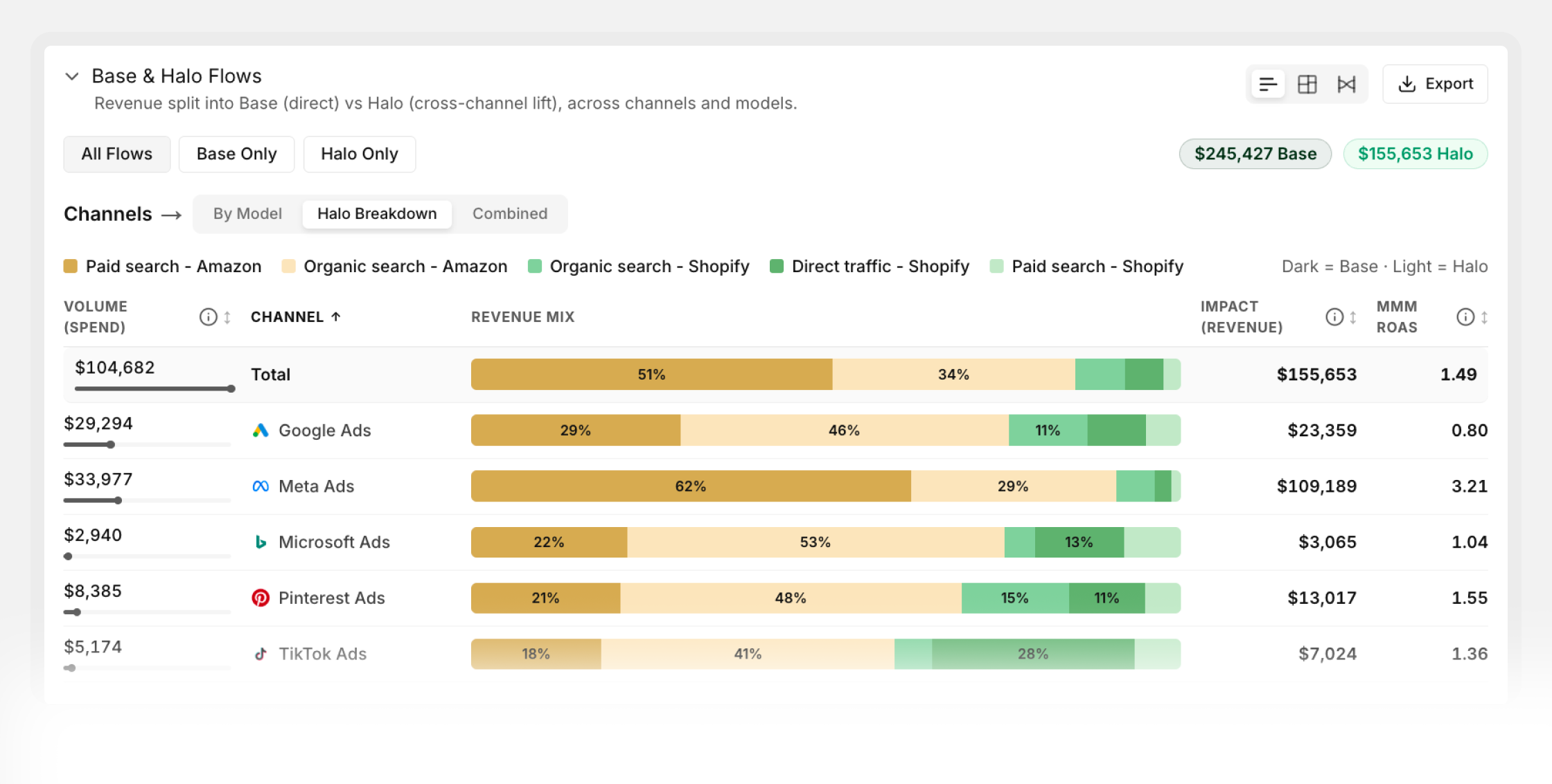
Base & Halo Flows in Prescient. Pinterest's halo lands mostly on Amazon, the pattern MaryRuth's model surfaced too. Sample account.
The channel's efficiency held up under scale. MaryRuth increased Pinterest spend 8x month over month and came out the other side with CAC roughly 50% more efficient than its portfolio average, despite the higher spend level. Pinterest CAC was 92% lower than Microsoft Ads, 81% lower than Amazon Ads, 73% lower than Meta, 63% lower than Google, and 58% lower than TikTok. The halo effects pattern held too: 67% of Pinterest's impact was still landing off-platform, with 80% of that still flowing to Amazon Selling Partner. MaryRuth has since extended the same measurement approach to AppLovin, Tatari, programmatic, and retail media.
A channel funded at token spend can only prove itself once the measurement can read what it actually does.
02 · FROM THE BLOG
How to measure Pinterest effectively

Pinterest is where discovery starts. The purchase closes somewhere else. A Pin gets saved on a phone, the shopper comes back weeks later, and often buys on Amazon or a marketplace app the Pin didn't point to. That gap between save and purchase is normal on Pinterest. It also explains why platform reporting stops short of showing what Pinterest actually does.
Attribution built for click-based journeys is largely biased against the top of the funnel. Pinterest's own reporting can only see conversions that close by interacting with Pins. Cross-channel attribution helps but hits the same wall on Amazon and offline. The channels doing awareness work get cut first when the model credits the sales they drive to something further down the funnel.
The post walks through how to actually measure Pinterest in a modern DTC mix, what the platform's own tools show versus what a marketing mix model catches, and how to size a Pinterest budget on incremental impact across every storefront a brand sells on.
03 · PRESCIENT VOICES
When we got AppLovin data into our MMM with Prescient, we saw significant results lift. AppLovin's halo effect on Amazon sales was very large, taking our average 30D ROAS up about 300%.

04 · THREE THINGS WORTH READING
1. How to build an always-on marketing strategy that actually compounds
The strategic companion to MaryRuth's story. Channels that compound like Pinterest usually reward always-on funding over stop-start campaigns. This post walks through how to structure a media plan for compounding returns, and what measurement it takes to be able to defend that plan during a budget review. Read →
2. How to plan a multi-channel marketing campaign that actually works together
A DTC brand running Shopify, Amazon, and TikTok Shop needs a plan in which the channels can work with one another, so that a Pinterest impression can close on a marketplace weeks later. The post covers how to plan across storefronts, and what to measure when the channels overlap. Read →
3. Why halo effects matter even more for subscription businesses
Our fresh POV on why halo effects carry more weight for a subscription brand than a one-off DTC seller. When a first-order acquisition compounds into months of revenue, undercounting the channel that drove the acquisition compounds, too. The post walks through what that means for measurement priority. Read →
The Halo
Exclusive insights, every week.
Subscribe to The Halo for sharper marketing thinking.