





Welcome back to The Halo. In this issue we cover:
- Industry Watch: Political ad spending and reservations have hit a record $11.21 billion ahead of Tuesday's midterms.
- The Take: How Saatva went from getting TV reports every six months to daily reads, and how that changed where its TV budget went.
- From the Blog: How does MMM handle correlation?
- Prescient Voices: Alex Diesbach, VP of Marketing at Saatva, on getting TV data daily.
- Three Things: Three reads on cross-channel optimization, budget optimization, and bottom of funnel content.
TV is one of the hardest channels to measure with a click-based dashboard. People rarely buy anything from the screen itself, so TV's impact shows up later in search, on a brand's website, and in stores.
Saatva, the omnichannel mattress brand, was scaling into linear and streaming TV with performance reports that only arrived every six months, which was too late to make decisions on. Once the team moved to daily, campaign-level reads from Prescient's marketing mix model, they could shift TV spend while campaigns were still running, and revenue from TV ads grew 22%.
Welcome to The Halo. Each week: one piece of measurement analysis, the best of the blog, one real customer result, and three reads worth your time.
Let's dive in.
INDUSTRY WATCH
Political ads hit a record the week before the midterms
Political ad spending and reservations for the 2025-26 cycle have reached a record $11.21 billion, according to AdImpact. That narrowly edges past the $11.20 billion recorded in the 2023-24 presidential cycle and is well above the $8.9 billion of the 2022 midterms.
Broadcast TV carried 51% of the $3 billion in political ads that aired in the third quarter, and connected TV carried 23%. In closely contested markets, campaigns are competing for a limited number of commercial slots, and that demand can push up what local stations charge for ad time.
Know what's coming after Tuesday: Once political campaigns stop buying, that TV ad inventory opens back up just in time for Black Friday and Cyber Monday.
Source: AdImpact data via TheWrap (Oct 27, 2026).
01 · THE TAKE
From six-month TV reports to daily reads
Saatva sells handcrafted luxury mattresses online and through its own Viewing Rooms nationwide. As the team scaled into linear and streaming TV, its existing measurement only delivered channel-level reports every six months. Those reports were too broad and came too late to help with the budget decisions the team was making. Linear TV also seemed to be driving more search traffic, but the team couldn't prove it, and a TV holdout test would have been expensive and hard to run across all of Saatva's markets.
With daily, campaign-level reads from Prescient's marketing mix model, the team could see more than which TV channel was working. They could see which buys inside each channel were actually driving revenue. On linear, large broadcast news buys and programming with a captive audience performed best. On streaming, larger buys across a whole content category beat placements on specific shows.
The team then shifted budget between linear and streaming, and within each of them, toward the spots our marketing mix model forecasted would perform best. After they put those recommendations in place, revenue from TV ads rose 22%, and branded search traffic grew 75% year over year.
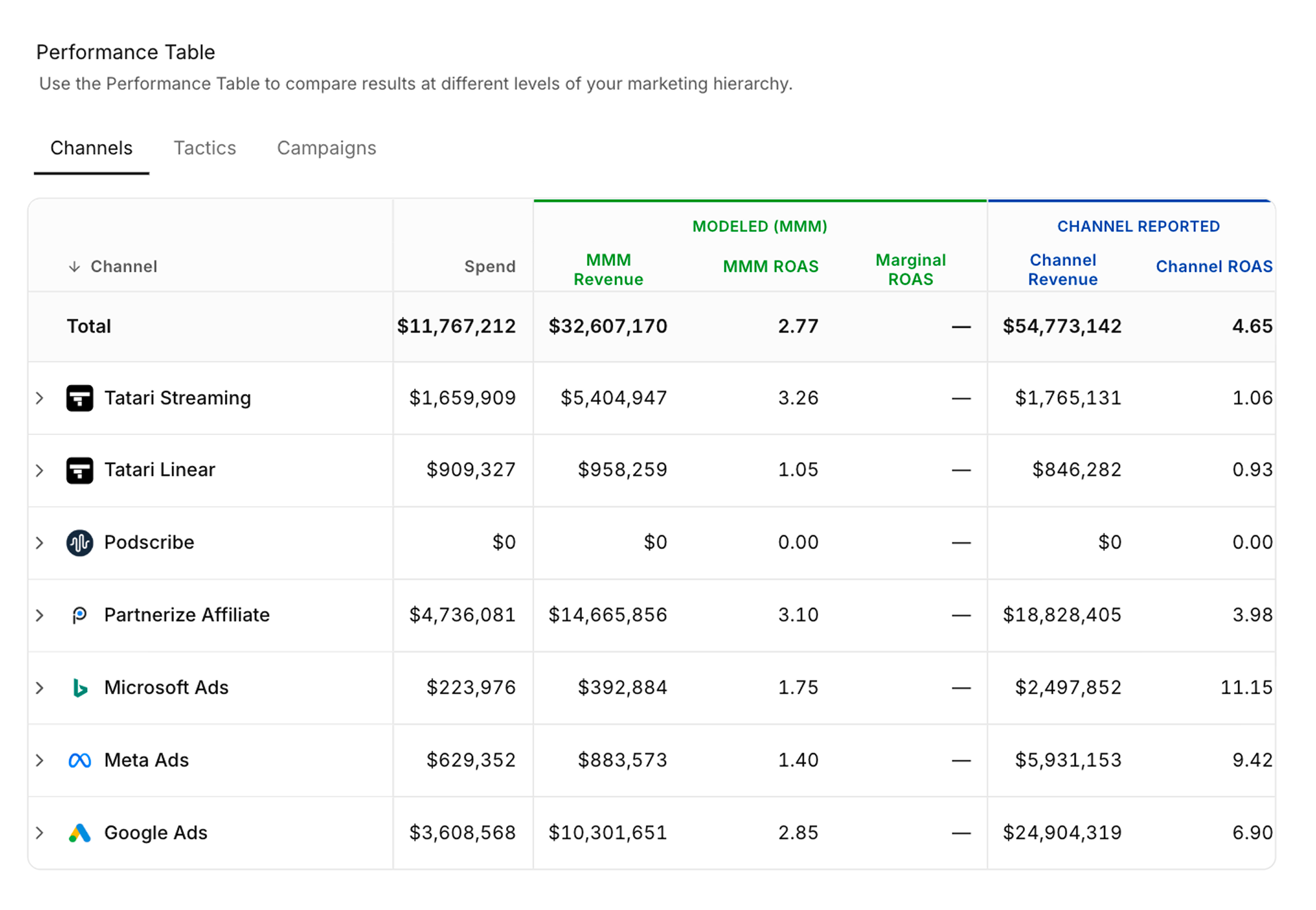
The Performance Table in Prescient shows Modeled ROAS by channel, with Tatari Streaming at 3.26 against Tatari Linear's 1.05. Saatva used this same view to move TV budget between the two. (Sample account.)
- 22% Increase in revenue from TV ads
- 75% YoY growth in branded search traffic
- Daily TV performance reads, instead of every six months
When you can see TV results every day, you can move budget toward what's working while it's still working.
02 · FROM THE BLOG
How does MMM handle correlation?

Saatva could see search traffic rise alongside linear TV, but two things moving together isn't proof that one drove the other. Channels that feed each other, like YouTube driving branded searches, are one of the places a traditional marketing mix model gives credit to the wrong channel.
This post explains why correlation misleads marketers so easily (brands tend to raise spend when demand is already rising, so their ads get credit for sales that were coming anyway). It also covers why the statistical adjustments traditional MMMs use to keep their results stable don't make those results any more accurate.
Finally, it gets into a limit every MMM shares: no model can prove cause and effect from historical data on its own. That's why the most trustworthy results come from a model whose accuracy is checked against the revenue that actually came in, including whether adding test results makes it more or less accurate.
03 · PRESCIENT VOICES
Prescient gives you data daily, whenever you want it, and at a level of granularity that no other vendors are going to give to you.

04 · THREE THINGS WORTH READING
1. Cross-channel optimization: How to make your marketing channels work as one system
The channel with the highest platform-reported ROAS is often just collecting demand that other channels created, so looking at each channel's reporting on its own can steer your budget the wrong way. This post covers how channels influence each other, why saturation differs by campaign, and how to keep checking your mix after you change it. Read →
2. Are there MMMs that do budget optimization?
A recommended budget split is only as good as the marketing mix model's understanding of how each channel responds to more or less spend. This post covers three ways traditional budget optimization goes wrong, including mistaking holiday demand for ad efficiency, which is worth knowing with Black Friday just four weeks away. Read →
3. You're overestimating the impact of your bottom of funnel content
Bottom of funnel content mostly captures demand that other campaigns created, much like branded search after a TV push. This post covers what that content does well and how to measure it alongside the upper funnel spend that feeds it. Read →
The Halo
Exclusive insights, every week.
Subscribe to The Halo for sharper marketing thinking.