


Welcome back to The Halo. In this issue we cover:
- Industry Watch: Adobe expects a record $275.1 billion in US online holiday sales, and shoppers already started spending more in October.
- The Take: How HexClad measured the impact of its ads on Shopify and Amazon when customers take 30 to 90 days to decide to buy.
- From the Blog: Consideration marketing: How to win the shortlist and prove it's paying off
- Prescient Voices: Cameron Bush, Head of Advertising at HexClad, on why there's no other tool like Prescient.
- Three Things: Three reads on cross-channel analysis, attribution bias, and influencer ROI.
Black Friday is just three weeks away. For products that people take time to research before buying, a purchase made during Cyber Week may have started with an ad someone saw weeks earlier.
HexClad, the hybrid cookware brand, sells premium pans on its own Shopify store and on Amazon, and its customers can take anywhere from 30 to 90 days to decide to buy. Once the team could measure how its ads drove sales across both storefronts over that long a window, ROAS rose 20% and budgeting took more than 20 fewer hours a month.
Welcome to The Halo. Each week: one piece of measurement analysis, the best of the blog, one real customer result, and three reads worth your time.
Let's dive in.
INDUSTRY WATCH
The holiday shopping season officially started Sunday, but shoppers started in October
Adobe forecasts a record $275.1 billion in US online sales from November 1 through December 31, up 6.7% year over year. Cyber Week (Thanksgiving through Cyber Monday) is expected to bring in $47.5 billion, and Cyber Monday on November 30 is predicted to be the biggest single shopping day of the season at $15.1 billion.
The season is also starting earlier. Adobe predicted $95.8 billion in US online spending in October, up 8% year over year, with the October Prime Day event driving more spending before the holiday season even starts. Adobe also expects affiliates and partners, along with social media, to see the biggest gains in their share of holiday revenue.
Know where your Cyber Week sales are really coming from: Much of the demand that turns into purchases over Cyber Week is being built right now, in channels that won't get credit for it in last-click reports.
Source: Adobe Analytics holiday forecast (Sep 28, 2026).
01 · THE TAKE
Measuring a 90-day decision across Shopify and Amazon
HexClad combines stainless steel, cast iron, and nonstick in one line of premium cookware, sold through its Shopify store and on Amazon. Its customers can take 30 to 90 days to decide to buy, and last-click attribution gives all the credit for the sale to whatever came right before the purchase, not to the campaigns that got the customer thinking about it in the first place. Cameron Bush, HexClad's Head of Advertising, also needed to see Amazon halo effects (the sales HexClad's ads drove on Amazon) at the campaign and channel level, with consistent metrics across the UK, EU, Australia, and Canada.
Prescient had HexClad's data up and running in our platform within days. Cameron's team can now run our marketing mix model several times a day to get up-to-date ROAS and plan top of funnel spend, and they can forecast ROAS months ahead. Within two months, Prescient delivered Amazon halo effects metrics, which showed HexClad that its Amazon budgeting process needed an overhaul.
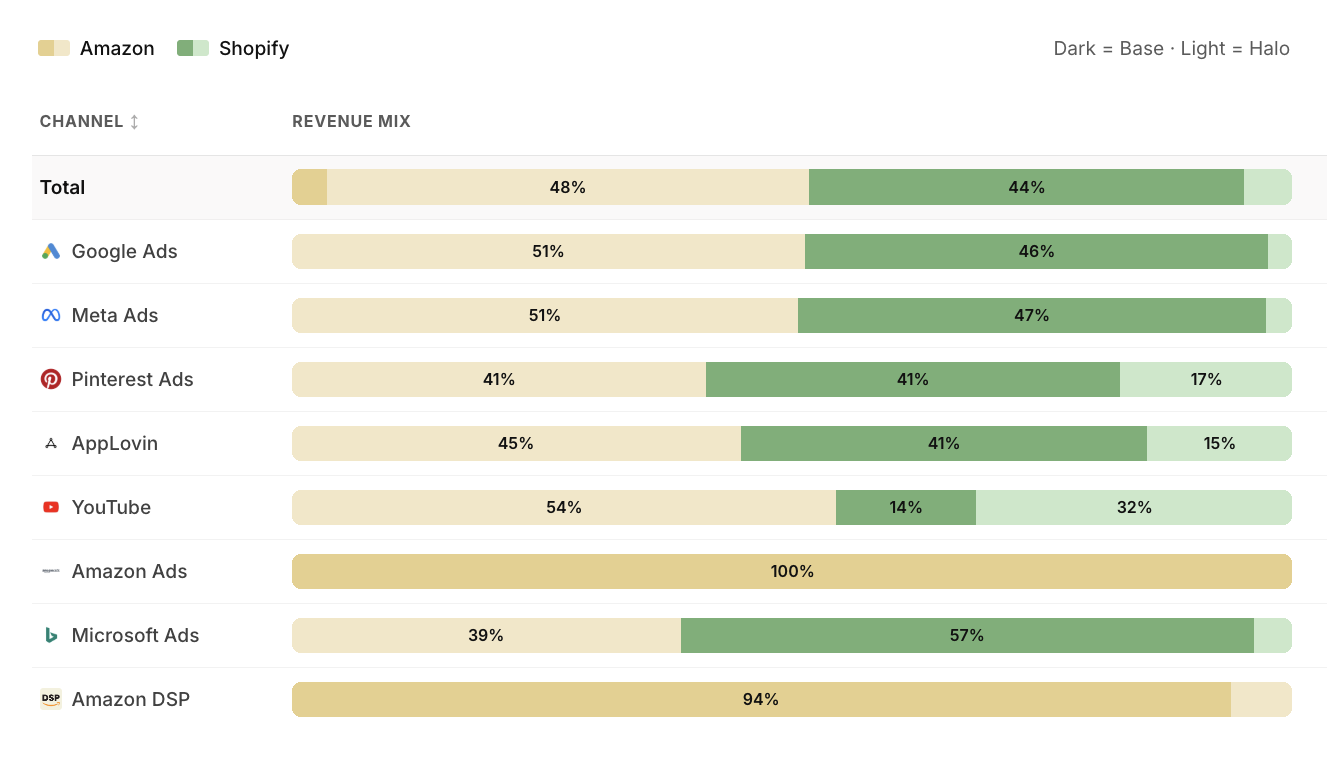
How the Prescient platform shows where each channel's revenue lands, split between Amazon and Shopify. Example view, illustrative data.
Once they could see how paid media affected both total revenue and incremental revenue, the team was able to lower its risk of overspending and identify which campaigns were driving halo effects in other channels. ROAS rose 20%, and budgeting and revenue tracking now take more than 20 fewer hours a month.
When your customers take up to 90 days to decide, the last thing they clicked can't tell you what convinced them to buy.
02 · FROM THE BLOG
Consideration marketing: How to win the shortlist and prove it's paying off

HexClad's 30-to-90-day buying window is a classic consideration problem. Someone might watch a product demo, not click, and then search for the brand days later or buy it on Amazon. The campaign did its job, but the sale shows up somewhere else, where in-platform reporting can't connect it back to the ad.
This post breaks down four things marketers often blur together (engagement, consideration, purchase intent, and purchases) and explains why last-click tends to give the credit to branded search, direct traffic, or retargeting instead of the campaigns that created the demand.
It also covers how to measure middle of funnel spend across every place you sell, including retail stores, and why your measurement window has to match how long your customers actually take to decide.
03 · PRESCIENT VOICES
Prescient has done exceptionally valid work with our data, and they've done so quickly and affordably. There's really not another tool like it.

04 · THREE THINGS WORTH READING
1. What cross-channel analysis really shows you (and what most dashboards miss)
Every ad platform's dashboard only reports on its own channel, so the sales one channel drives in another never show up in any of them. This post covers what a cross-channel view adds and what most dashboards leave out.
2. What causes attribution bias in marketing and how to reduce it
Attribution bias is how a purchase decision that took 90 days ends up looking like it came from a single click. This post covers where that bias comes from and how to reduce it before it steers your Cyber Week budget in the wrong direction.
3. How can a business assess the ROI from influencer marketing?
Creator content often works a lot like a long consideration cycle, since people see it, wait, and then buy later through search or on Amazon. This post covers how to judge influencer ROI beyond promo codes and affiliate links.
The Halo
Exclusive insights, every week.
Subscribe to The Halo for sharper marketing thinking.