





- Industry Watch: Spending by consumer brands on AppLovin grew by triple digits year over year, heading into the holiday quarter, when these brands spend the most.
- The Take: How MaryRuth's measured everything its AppLovin ads drove on its site and on Amazon, including sales that came through halo effects.
- From the Blog: How to measure conversions without user-level identifiers.
- Prescient Voices: Wyatt Lowe, VP of Growth at MaryRuth's, on how much AppLovin's halo effects on Amazon raised its ROAS.
- Three Things: Three reads on Amazon incrementality, incrementality testing tools, and comparing privacy-safe measurement.
Black Friday is just eight days away, and plenty of brands are testing newer channels to reach shoppers before then. Ads in mobile games can drive a purchase on the spot, but they also build awareness that turns into sales days later, often in a completely different place, like Amazon.
MaryRuth's Organics sells more of its vitamins and supplements on Amazon than anywhere else. When the team measured everything its AppLovin ads were driving, they found that most of the Amazon sales those ads led to never showed up in click-based reports.
Welcome to The Halo. Each week: one piece of measurement analysis, the best of the blog, one real customer result, and three reads worth your time.
Let's dive in.
INDUSTRY WATCH
AppLovin's e-commerce business is heading into its biggest quarter
AppLovin reported record third quarter revenue of $2.18 billion on November 4, up 55% year over year. Spending by consumer advertisers (the category that includes the brands now advertising on AppLovin outside of gaming) grew by double digits from the previous quarter and by triple digits year over year.
CEO Adam Foroughi said e-commerce advertisers typically spend heavily in the fourth quarter and less in the first, so AppLovin expects bigger fourth quarters, followed by tougher first quarters, as that part of the business grows.
Know what a new channel is really driving: Many of the sales an in-app ad leads to happen later and somewhere else, like on Amazon, where click-based reports can't connect them back to the ad.
Source: AppLovin's Q3 2026 earnings call, via MarketBeat on TradingView (Nov 4, 2026).
01 · THE TAKE
Two measurements of what AppLovin really drove
MaryRuth's Organics sells vitamins and supplements mainly through Amazon (its largest sales channel) and its Shopify store, and its products are also sold at retailers like Ulta and Whole Foods. To diversify its marketing, the team partnered with AppLovin to run ads in mobile games. They started with campaigns built to drive same-day purchases, then added campaigns built around purchases within seven days to reach shoppers who take longer to decide. AppLovin's in-platform reporting showed strong ROAS and customer acquisition costs on par with MaryRuth's top channels, like Meta.
But in-app ads also build awareness that turns into sales later, and click-based measurement can't see those sales. Using Prescient's marketing mix model, MaryRuth's measured the full value of its AppLovin campaigns, including the Amazon sales they drove that never got credited to a click. Our marketing mix model found a Modeled ROAS of 2.7x for AppLovin and showed that 87% of the Amazon sales AppLovin drove came through halo effects.
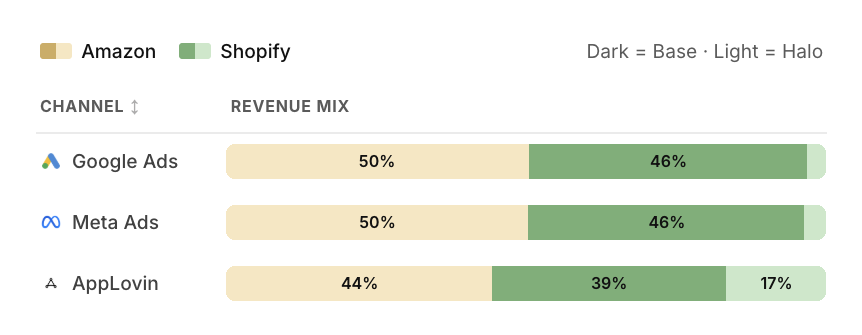
This example view from the Prescient platform shows how much of each channel's revenue lands on Amazon versus Shopify, and how much of it comes through halo effects. (Illustrative data.)
MaryRuth's also ran a four-week geo incrementality test on AppLovin across both its own site and Amazon, holding out 30% of regions and tracking delayed purchases for two more weeks. The test found AppLovin drove a 4.89% lift in DTC sales, with incremental ROAS (iROAS) 49% above the team's target, plus a 1.84% lift in Amazon sales, for a combined iROAS of 4.03x. With both measurements showing AppLovin was driving real revenue, including on Amazon, the team increased its AppLovin investment by 40%.
Once you can see everything a new channel drives, including on Amazon, it can earn a permanent place in your budget.
02 · FROM THE BLOG
How to measure conversions without user-level identifiers
The Amazon sales AppLovin drove through halo effects are exactly the kind of sales that user-level tracking struggles to see. Browser restrictions, Apple's App Tracking Transparency, and privacy laws have all made it harder to follow a shopper from ad to purchase, so multi-touch attribution now tends to give too much credit to the last touch.
This post explains how marketing mix modeling measures conversions using total spend and revenue instead of individual shoppers, and why many marketing mix models still give credit to the wrong channels when spend rises and falls with demand, like it does during the holidays.
It also covers how to check whether a privacy-safe model is accurate, including why a model that predicts total revenue well can still split credit between channels incorrectly.
03 · PRESCIENT VOICES
When we got AppLovin data into our MMM with Prescient, we saw significant results lift. AppLovin's halo effect on Amazon sales was very large, taking our average 30D ROAS up about 300%.

04 · THREE THINGS WORTH READING
1. How do you measure Amazon advertising's incremental impact on Amazon sales?
With Black Friday so close, a lot of brands are raising their Amazon ad budgets. This post covers why the sales Amazon credits to its own ads aren't always sales those ads created, and how to measure what those ads actually add. Read →
2. A vendor-by-vendor guide to the best incrementality testing tools
MaryRuth's ran a geo test alongside its marketing mix model. This guide compares incrementality testing tools and the questions to ask each vendor, and explains how Prescient runs your model with and without a test's results to see which version forecasts more accurately. Read →
3. How to compare privacy-preserving measurement platforms
Since most measurement vendors now work without cookies, privacy compliance is just the starting point. This post covers how to compare platforms on how they build and check the accuracy of their models, including how clearly they explain what their data can't support. Read →
The Halo
Exclusive insights, every week.
Subscribe to The Halo for sharper marketing thinking.