



How many channels can an MMM measure?
How many channels can an MMM measure? There's no fixed limit, but traditional MMMs often stall at 5 to 10 broad groups. Here's why, and what changes that.
Linnea Zielinski · 8 min read
A recording engineer working a 40-piece orchestra on a four-channel mixing board has to make compromises. All the violins go on one fader, all the brass on another, and the percussion shares a channel with whatever's left. The final mix might sound fine, but if one violin is out of tune, there's no way to find it, let alone fix it. The engineer can only turn the entire string section up or down.
That's the position a lot of marketing teams are in with their measurement. There's no fixed number of channels an MMM can measure, because it depends on how the model is built and how much data each channel has. Many traditional MMMs hold up best with a small set of broad channel groups, often somewhere around 5 to 10, because their math becomes unstable as inputs pile up. Prescient's MMM is designed to measure dozens of channels, and it goes down to the campaign level within each one.
That matters because modern media plans don't fit in 10 buckets. When TikTok, Meta, Pinterest, and Snap all share a "paid social" line, the only decision left is to move the whole group at once, even if one platform is carrying it and another is dead weight.
Key takeaways
- There's no universal limit on how many channels an MMM can measure. It depends on the model's design and how much data each channel provides.
- Many traditional MMMs work best with a handful of broad groups, often around 5 to 10, so distinct platforms get lumped together.
- Adding channels to a traditional MMM adds unknowns faster than history can pin them down, and channels that scale together become hard to tell apart.
- Penalties that keep a crowded traditional model stable can pull small or new channels toward zero, making them look ineffective.
- Prescient's MMM separates channels by the job each one does, such as creating demand or capturing it, and by how long each one's effect lasts.
- Prescient connects to more than 110 platforms and reports results at the channel, tactic, and campaign level.
Media plans have outgrown channel buckets
A typical brand's media plan today spans far more than search, social, and TV. It might include several social platforms, CTV and streaming, creators, affiliates, podcasts, and retail media networks like Amazon Ads, Walmart Connect, and Target's Roundel, plus separate search tiers for branded and non-branded terms.
Traditional MMM setups usually can't take all of that in as separate inputs. Instead, distinct platforms get combined into groups like "paid social," "video," or "retail media," and the model reports on the group.
The cost of that grouping is the detail you'd actually act on. If "paid social" shows a decent return, you can't see that TikTok is pulling most of the weight while another platform barely moves revenue. The resulting recommendation is something like "cut paid social by 10%," which trims the strong performer right along with the weak one.
Why traditional MMMs struggle as you add channels
Traditional MMMs run into trouble with more channels for three reasons: each one adds unknowns the data can't fully pin down, channels that rise and fall together become hard to separate, and the usual fixes tend to undervalue smaller channels.
Each new channel adds more unknowns than the data can settle
In a traditional MMM, every channel brings its own set of numbers to estimate:
- how strongly it drives sales
- how long its effect lingers
- where its returns start to taper
Two channels might mean six or so unknowns. Thirty channels can mean nearly a hundred. Your history doesn't grow just because your channel list did, so the model ends up with too many dials and too little evidence to set each one. Results start to jump around between runs.
Channels that scale together get their credit scrambled
Brands tend to raise spend across many channels at once—around a launch, a sale, or the holidays—because that's when it pays to be everywhere. When 15 channels all climb in the same weeks, a traditional model has no dependable way to tell which one moved sales. It may hand most of the credit to one channel in this week's run and to a different one next week, even though nothing about your marketing changed.
Stabilizing a crowded model can shortchange small channels
To keep a crowded model from swinging wildly, traditional approaches often add statistical penalties that pull channel estimates toward zero unless the data strongly argues otherwise. That steadies the output, but it doesn't help the model see more clearly. It just picks one answer among many that fit the data equally well. Big channels have enough data to push back against that pull, and small or new channels usually don't. A promising podcast test or a newer retail media network can end up looking like it doesn't work, when the model simply didn't have enough evidence to say.
How Prescient measures dozens of channels
Prescient measures a broad media mix by treating your marketing as a single system where each channel is defined by the role it plays, instead of letting channels fight the others for a share of sales. Our model estimates channel impact from your spend and sales data, without tracking individual shoppers.
Channels are told apart by the job they do
A channel's role gives the model real structure to work with. Some channels mainly create demand, such as CTV, YouTube, creators, and TikTok. Others mainly capture demand that already exists, such as branded search, retargeting, and many retail media placements. Our model represents that difference, so a branded search campaign and a CTV campaign that spike in the same week aren't treated as interchangeable. It also lets Prescient measure halo effects, meaning sales a channel produces by way of another channel, like a CTV ad that leads to a branded search and then a purchase. Demand-creating channels usually generate more halo effects, but capture channels can produce them too.
Timing helps separate channels that run together
Channels also differ in how long their effect lasts. A 24-hour promotional push fades almost immediately, while a brand video can keep influencing purchases for several weeks. Our MMM learns those patterns for each channel instead of assigning one decay rate to all of them, and those different time signatures are another way to separate channels that happen to launch together.
Smaller channels draw on context instead of being zeroed out
Low-spend channels are hard for any model, and Prescient doesn't pretend otherwise. Instead of pulling them toward zero by default, it gives them sensible starting assumptions based on benchmarks from other brands and on what the model has learned about channels that play a similar role. That gives a newer channel a realistic estimate with an honest range, instead of an "insufficient data" message or a false zero.
New channels aren't capped before they've had a chance to scale
Our model doesn't assume every channel is already bending toward a ceiling. When a newer channel is still returning at a steady rate as spend grows, the model lets that hold, and it shows a slowdown only when your results actually start to taper.
What determines how many channels you can measure well
How many channels an MMM can measure well comes down to how much evidence each one gives the model to work with. Four factors matter most:
| Factor | How it affects the read | Practical next step |
| Spend per channel | Bigger channels leave a clearer mark in your sales data and show results sooner. | Expect firmer reads on major channels and wider ranges on small tests. |
| Distinct timing patterns | A channel whose effect fades in a day is easy to tell apart from one that builds over weeks. | Keep accurate launch and end dates for every channel and campaign. |
| History length | More history gives the model more moments where channels moved independently. | A newly launched channel will take time to firm up, so judge it over a longer stretch. |
| Test results | A geo test reflects one region at one point in time, which may not carry over to other seasons or budgets. | Use a test as supporting evidence, not as the last word. |
That last row is where many teams expect a test to resolve everything. In Prescient, a test result can be added to the MMM as a prior, and you'll see the model's accuracy both with it and without it, so the decision on whether to rely on it stays with you.
There's a floor, too. A channel with only a few days of spend in the past year doesn't give any model much to go on, so it's better treated as part of a broader group until it has more history.
Why measuring every platform pays off
Measuring each platform separately changes the decisions you can make, from moving whole groups of channels to moving money between specific platforms and campaigns. Teams tend to notice the difference in three places.
- More precise budget moves. "Cut paid social by 10%" becomes "move $50,000 from a saturated Meta prospecting campaign into a TikTok campaign that's still scaling."
- A fair shot for new channels. Emerging channels like podcasts, CTV platforms, or a new retail media network get measured on their merits instead of being written off by default.
- One view of the full mix. Leadership and finance see every channel in the same place, without platforms disappearing inside a broad group.
Where Prescient comes in
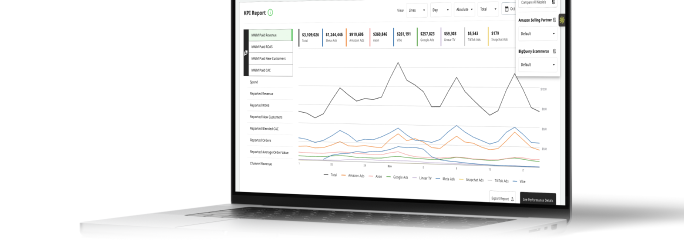
Prescient's MMM is built for omnichannel brands with many channels in play. It connects to more than 110 platforms across paid social, search, CTV, creators, affiliates, podcasts, and retail media, and it covers sales on your site, Amazon, and at retailers. You get Modeled ROAS by channel, tactic, and campaign, plus halo effects into other channels and into retailers, refreshed every day.
When a newer channel starts to look promising, Media Forecaster projects the likely return from giving it more budget or moving spend into it from elsewhere, so it grows on evidence instead of a hunch. To see how all of this looks in the platform and how brands can use it to fuel their growth, book a demo.
FAQs
Is there a maximum number of channels an MMM can measure?
No, there isn't a fixed maximum. The practical limit depends on how the model is built and how much data each channel has. Traditional MMMs tend to become unstable as channels are added, so many stick to a small number of broad groups. Models designed for more granular inputs can measure dozens of channels and their campaigns.
Why do traditional MMMs group channels together?
Grouping keeps a traditional MMM stable. Every channel adds values the model has to estimate, and channels that scale at the same time are hard to separate. Combining them into broad groups reduces both problems, but it hides which platform inside each group is performing.
Can an MMM measure small or new channels?
Yes, but expect a wider margin of error than you'd get for a major channel. A small channel leaves a faint signal, so its estimate will carry a wider range. Some models pull small channels toward zero to stay stable, which can make them look ineffective. Prescient instead uses benchmarks and what it knows about similar channels to give them a realistic starting point.
Should I measure channels separately or as one paid social group?
Separately, if your measurement can handle it. Platforms within the same group often perform very differently, and grouping them hides that. If a platform has very little spend history, it may be better to group it temporarily until there's enough data for its own read.
Does adding more channels make an MMM less accurate?
It can in a traditional MMM, because each channel adds unknowns and correlated spend makes credit harder to assign. In a model that separates channels by their role and timing, more channels mostly mean more detail, as long as each channel has enough spend and history to measure.
The Halo
Exclusive insights, every week.
Subscribe to The Halo for sharper marketing thinking.
You're subscribed to The Halo!
Quick question (optional): How familiar are you with MMM?
Thanks for sharing! Enjoy The Halo.
Keep reading
View all
A marketer’s guide to in-house MMM builds vs vendor tools
Read article
Can MMMs measure campaigns, or only channels?
Read article
How do MMMs work? What happens between your data and your budget recommendation
Read article
Modern marketing mix modeling (MMM): What it is and why it matters
Read article
The best cross-channel marketing software for DTC brands
Read article
What is multicollinearity? A marketer's guide to a hidden measurement problem
Read article