




How to read a confidence score (and what low confidence is telling you)
Learn what Prescient's confidence score actually measures, how its three inputs work, and what low confidence is telling you: so you can act with more clarity.
Linnea Zielinski · 6 min read
A good weather app doesn't just tell you it's going to rain. It tells you there's a 40% chance of rain, which carries a lot more meaning, because the difference between grabbing an umbrella and canceling your outdoor plans entirely depends on how you interpret that number. A percentage alone, without context, isn't useful. Context is what turns a number into a decision.
The same logic applies to the confidence score in the Prescient platform. You'll see it sitting right next to your Optimizer recommendations, and it's easy to assume that low confidence means "don't act" and high confidence means "go for it." But that reading leaves a lot on the table. Knowing what the score is actually measuring, and which part of it is dragging down a particular campaign, is what separates a marketer who gets full value from the tool from one who's moving on instinct alone.
Key takeaways
- Prescient's confidence score is a proprietary metric called Predictive Confidence, calculated from three inputs: data volume, the width of upper and lower outcome bounds, and how often you've spent at the recommended level historically.
- Because it uses a harmonic mean of those three inputs, one weak input can pull the overall score down significantly, which means a low score is worth interrogating.
- Low confidence tied to data volume means the model has fewer historical data points at that spend level for that specific campaign.
- Low confidence tied to outcome bounds means revenue results have varied more widely at similar spend levels in the past, a signal worth understanding.
- Low confidence tied to spend history means you haven't spent at that level before, so the model is working in less familiar territory.
- A low confidence score is not a red light; it's a yellow one that tells you something specific about what the model knows and doesn't know.
- The right response to low confidence depends entirely on which input is driving it, and your next move should follow from that.
What Predictive Confidence actually measures
Prescient's confidence score isn't a gut-check metric or a general indicator of campaign health. It's a calculated score built from three specific data points, and the way those three points combine matters more than most users realize at first glance.
The score takes the harmonic mean of its three inputs, which has an important implication: unlike a regular average, the harmonic mean is sensitive to low values. One weak input pulls the composite score down more aggressively than you’d expect if you’re more familiar with regular averages. That's by design. It means you can trust that a high confidence score reflects genuine strength across all three areas, not just a strong performance in one or two.
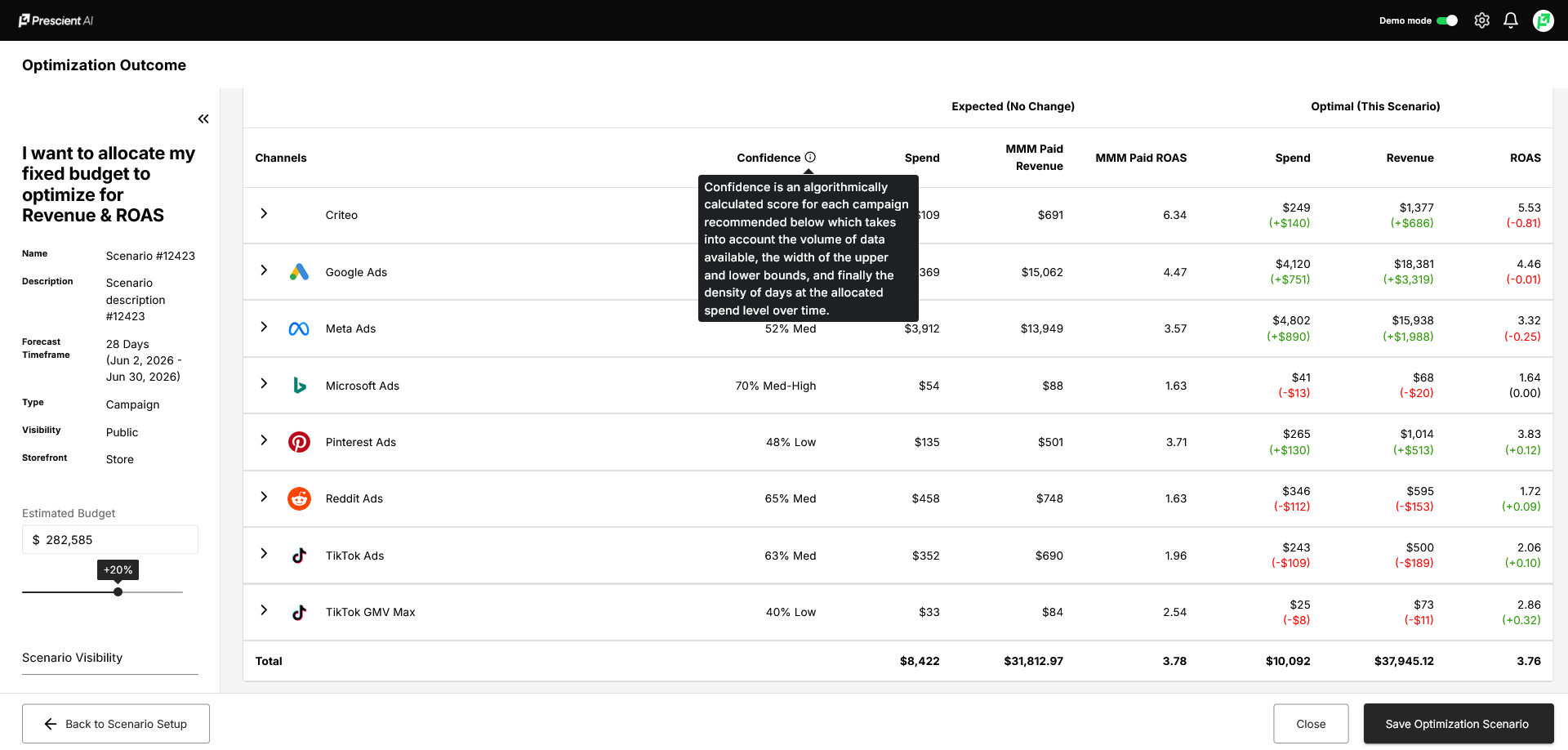
The tooltip in the platform puts it plainly: confidence accounts for the volume of data available, the width of the upper and lower bounds, and the density of days at the allocated spend level over time. Those three things map to the three inputs we'll walk through below.
What each input is telling you
Each input to the confidence score captures something different about how well the model knows a given campaign at a given spend level. When confidence comes back low, one of these three is usually the culprit, and identifying which one changes what you should do next.
Data volume
This input looks at how many data points exist within the confidence band for a given campaign. That band is built from a distribution of your brand's historical spend versus attributed revenue at the campaign level. When data volume is low, it means fewer observations exist at that spend range, not that the campaign is performing poorly.
A newer campaign will almost always have lower data volume scores simply because it hasn't accumulated enough history yet. That's expected, and it's honest. The model is telling you that its picture of this campaign's behavior is still developing. Whether you want to trust a still-developing picture has a lot to do with your brand’s risk tolerance, and we’re working on a piece about that to help you contextualize this number better.
Outcome bounds
This input captures how much revenue results have varied when you've spent at similar levels in the past. Think of it as the standard deviation of your campaign's performance at a given spend window. Wide bounds mean higher variability; narrow bounds mean more consistent outcomes.
Low confidence tied to outcome bounds doesn't necessarily mean the campaign is a bad bet. It means the campaign has behaved inconsistently at that spend level historically. Before acting, it's worth asking whether there's an external explanation: a seasonal spike, a promotion, or a competitive shift. If one of those factors accounts for the variability, the data may actually be more predictable than the score suggests.
Spend history
This is the most intuitive of the three, and often the most common reason for low confidence on a scale recommendation. Spend history captures how frequently you've actually spent at the level the model is recommending. If you've never spent there or rarely have, the model has less to work with.
We see this as transparency. We don’t want our platform to manufacture confidence it doesn't have. When spend history is low, the recommendation is still grounded in the model's best estimate, but it's being honest that this is newer territory for your brand.
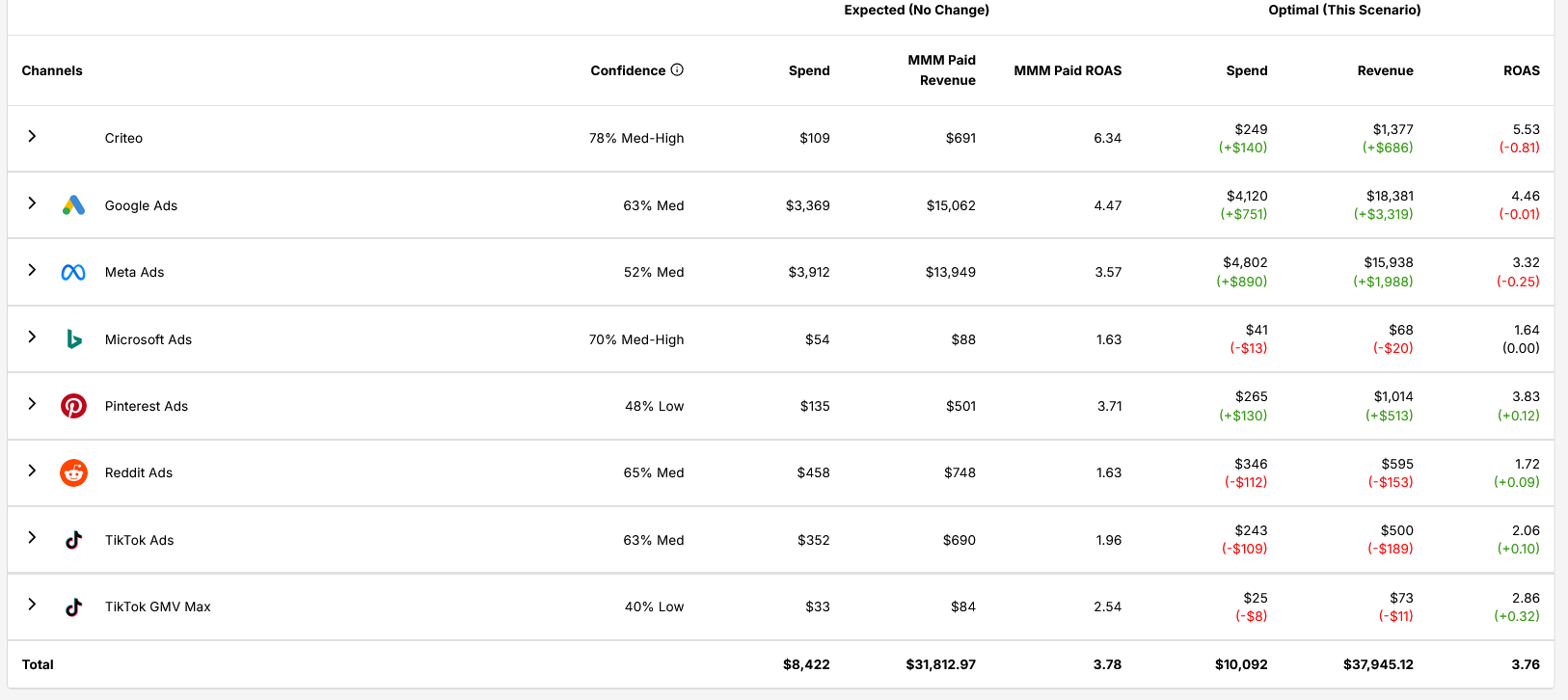
The channel-level view in the Optimizer makes this easy to scan across your campaigns at once. You'll often find that confidence varies significantly from channel to channel, and that variation is meaningful. A 78% Med-High on Criteo and a 40% Low on TikTok GMV Max aren't just different numbers; they're telling you different things about what the model knows about each of those campaigns.
What to do when confidence is low
Low confidence scores aren't a reason to close the tab. They're a prompt to ask a more specific question, and the answer to that question should shape your next move.
Here's a practical starting point for each input:
- If data volume is low: Give the campaign more time or more spend history at that range before making a large allocation change. If you want to move now, consider a smaller test spend that starts to build the data the model needs.
- If outcome bounds are wide: Pull up the campaign's historical performance and look for patterns in when results varied most. Seasonality, promotions, and external events often explain wide variability. If you can account for those factors, you may feel more comfortable acting than the score alone would suggest.
- If spend history is low: The model is recommending a spend level you haven't tried before. That's not inherently a reason to hold back, but it does mean you're taking on more uncertainty. Sizing down your first move at that level is a reasonable way to start building confidence without overcommitting.
If you're unsure which input is driving a low score, your customer success rep is the right person to loop in. They can help you read the signal and determine whether the score reflects something about the campaign or something that's likely to resolve with more data
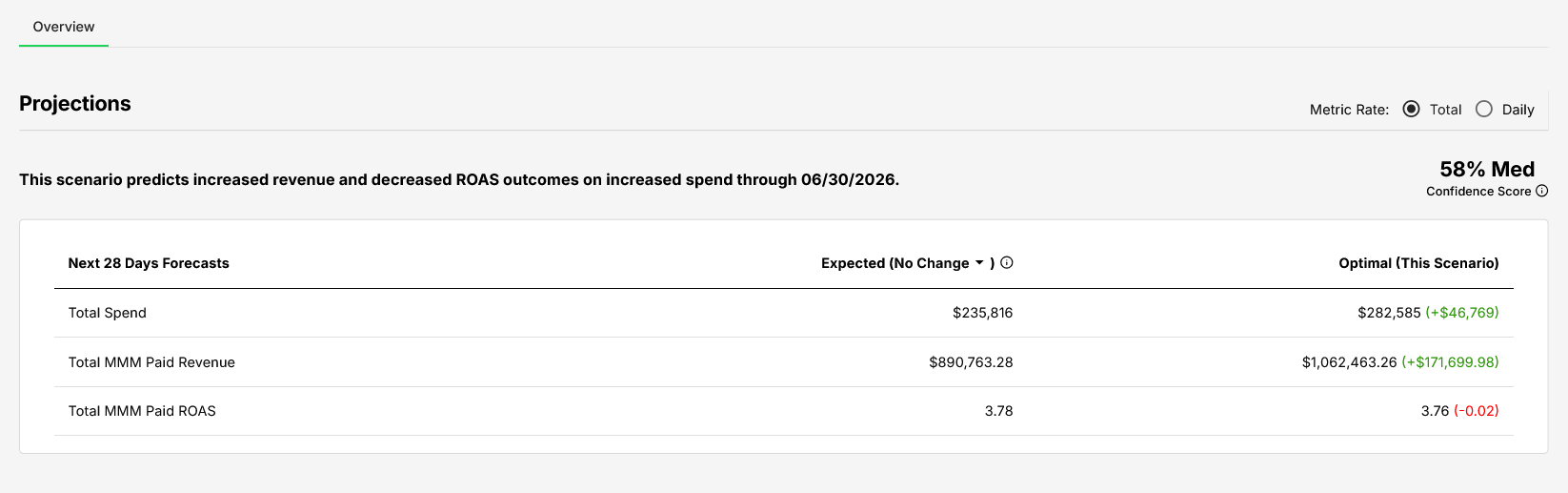
It's also worth noting that confidence scores appear at both the campaign level and the scenario level. The scenario-level score, visible in the Projections overview, reflects confidence across the combination of budget changes you've modeled together. If individual campaign scores are mid-range and the scenario score comes back lower than expected, it's a signal that the combination introduces more uncertainty than any single campaign would on its own.
Wrapping it up…
Confidence scores exist because Prescient was built with the understanding that a recommendation without uncertainty information puts marketers in a harder position. Knowing the projected outcome of a budget change matters, but so does knowing how much weight to put on that projection. The confidence score is how Prescient gives you both at the same time, so you can align what the model is telling you with your own risk tolerance and business context.
If you're not yet using Prescient and want to see how confidence scores work alongside Optimizer recommendations in practice, book a demo. We’d love to show you around the platform.
The Halo
Exclusive insights, every week.
Subscribe to The Halo for sharper marketing thinking.
You're subscribed to The Halo!
Quick question (optional): How familiar are you with MMM?
Thanks for sharing! Enjoy The Halo.
Keep reading
View all
How your upper funnel drives revenue (even when platform reporting says it doesn't)
Read article
Efficiency is about spending right, not just less
Read article
What happens to your sales after a promotion ends
Read article
Why traditional MMMs fall apart during peak sales
Read article
Budget freezes are a measurement problem as much as a money problem
Read article
When everyone pulls back, the brands that hold position win
Read article