




How to get TV attribution right and measure what your ads are actually doing
TV attribution methods like ACR and geo tests only tell part of the story. See how MMM can measure the impact your TV and CTV ad spend is really driving.
Linnea Zielinski · 9 min read

TV attribution is the method used to connect TV ad exposure to consumer actions like site visits, email sign ups, or purchases. That sounds simple until you remember that almost no one clicks a TV ad. A billboard on the highway works the same way. Thousands of drivers pass it every day, and a handful remember the name later while standing in a store aisle or typing into a search bar. No one credits the billboard for that sale if the company is running other campaigns because there's no click to trace it back to. TV and connected TV (CTV) ads leave the same kind of invisible trail, and how your team tries to follow that trail directly impacts your marketing strategy and efficiency.
If you can't tell the difference between an ad that was seen and an ad that actually drove a purchase, you're making high-stakes budget calls with hollow numbers. That gets expensive the longer it goes unchecked, whether it means cutting a channel that's actually working or defending spend you can't actually prove is paying off.
Key takeaways
- TV ad exposure can be tracked several ways, but tracking exposure isn't the same as proving it caused a purchase.
- Platform-reported numbers for TV and CTV spend often look weak or even read as zero, even when the channel is driving real revenue.
- View-through windows and modeled conversions are directional signals, not proof of incremental impact.
- Geo holdout tests can help validate TV's impact, but they come with real limitations, like contamination between test and control markets.
- TV's impact often shows up in purchases that come through branded search, organic search, direct traffic, and even Amazon, but that won't show up in a last-click report.
- Marketing mix modeling gives you a way to check TV performance daily instead of waiting weeks for a single test to finish.
What TV attribution actually means
TV attribution covers two different worlds of advertising, and each one requires its own attribution model. Linear TV refers to traditional scheduled programming and commercial breaks, the kind of TV advertising that's been around for decades. Connected TV, or CTV, refers to ads that stream through apps and devices like a smart TV's built-in interface or a streaming stick. The technical differences between the two mean advertisers can't apply the same tracking approach to both, and there isn't one right attribution model that works for every media type. Many advertising teams end up relying on multiple attribution models across their stack, one for TV and CTV and another for digital channels.
How exposure gets tracked
Before you can attribute anything, you first need proof that an ad exposure happened. A few tracking approaches handle that job, and each one works differently depending on whether a campaign is running on linear TV or CTV.
- Linear TV spike analysis: A fairly simple TV attribution method that compares baseline website or app traffic to the minutes right after a commercial airs on traditional TV, looking for a jump that lines up with the ad spend.
- Automatic content recognition (ACR): Uses audio or pixel fingerprints built into smart TVs to log what a household watched, then matches that first-party data against other devices in the same household.
- Connected TV tracking: Relies on device graph technology and identity resolution to link a streaming impression to a specific household using household-level data, since CTV ads run through digital channels that carry their own identifiers.
These methods do a solid job of confirming an ad exposure took place. What they can't tell you is whether that exposure is the reason someone visited your site or made a purchase.
Why exposure data isn't proof of impact
Once you know someone saw your ad, the next question is whether that ad actually changed their behavior, and this is where most TV attribution runs into trouble. View-through attribution windows count anyone who visits your site within a set number of hours or days of being exposed to an ad, whether or not the ad had anything to do with it. Someone who was already planning to buy gets counted toward the same purchase outcome as someone who wouldn't have converted otherwise, and online conversions that had nothing to do with the ad get folded into the total. Advertisers and marketers who dig into CTV platform data tend to agree that view-through windows are largely directional and face real hurdles proving true incremental conversion. Because of that, results from these methods stay probabilistic estimates. They tell you something is likely happening, but they don't guarantee your ad caused it.
TV attribution methods marketers use to validate impact
Since exposure data alone can't prove the impact of TV advertising, most performance teams lean on one of a few validation methods to get a clearer picture.
Geo holdout tests split similar markets into a test group that sees your TV advertising and a control group that doesn't, then compare results over several weeks. Done well, this can offer some of the more concrete evidence available that TV is driving incremental lift. But real-world geo tests face several challenges: markets are never perfectly matched, users can move between test and control zones, and a test only tells you what happened during that specific window, not what's true a month later or during a different season.
Multi-touch attribution (MTA) tries to spread credit across the full customer journey instead of giving full credit to a single touchpoint the way first touch attribution or last touch attribution models do. It's a reasonable idea in theory, but most attribution tools built for MTA depend heavily on the digital advertising touchpoints they can actually see, and they tend to undercount channels like TV that don't leave a clean digital fingerprint.
Marketing mix modeling (MMM) looks at TV spend alongside every other channel and business outcome over time, without depending on a single test window or a device graph that only captures part of the picture.
None of these methods works best in isolation. The strongest approach uses one to check the other. If a geo test says TV drove a 15% lift, an MMM can tell you whether that number holds up once you account for seasonality, other campaigns running at the same time, and organic demand that would've shown up anyway.
Why platform-reported numbers can mislead
Even when a TV or CTV campaign is working, the self-reported platform metrics sitting in front of you might say otherwise. Take a real example from Prescient's platform: a set of Tatari streaming campaigns where the channel-reported ROAS reads 0.00, even though the modeled numbers point to greater ROI and give you a set of actionable metrics the platform never shows.
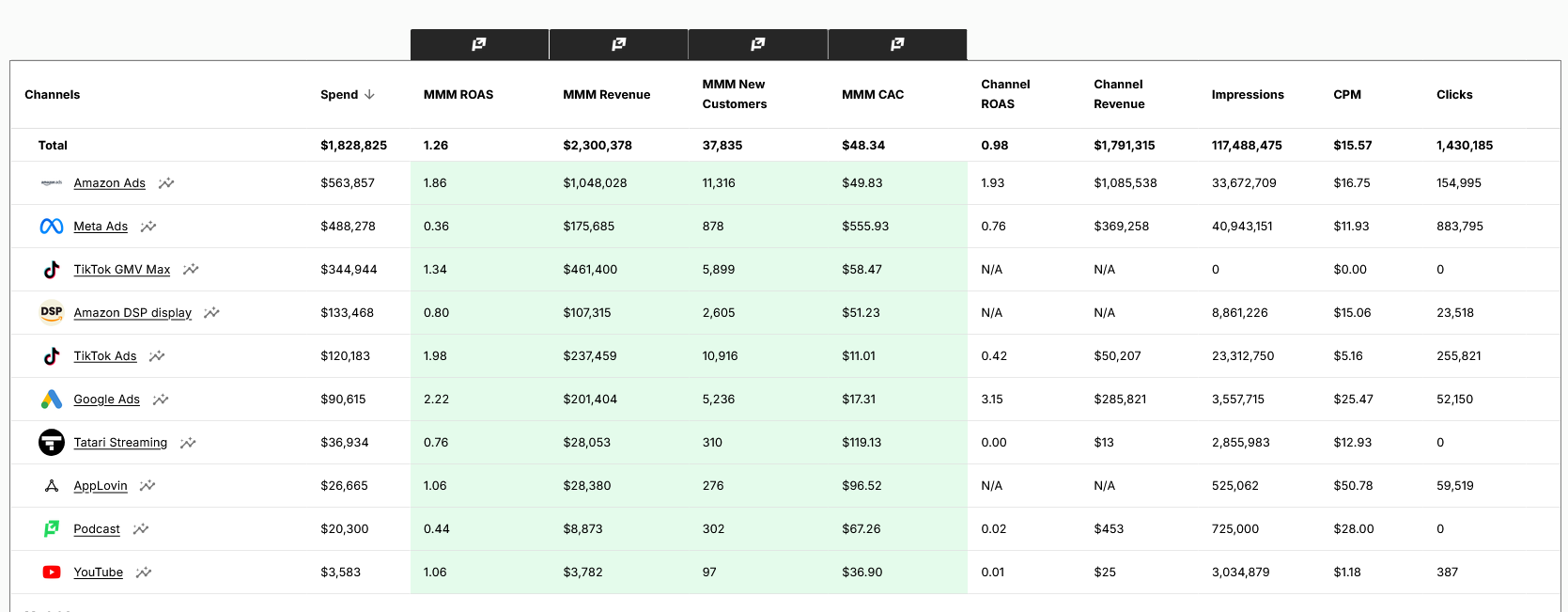
Across those campaigns, Prescient's model shows a 0.76 ROAS, $28,053 in modeled revenue, and 310 new customers. The platform's own channel-reported revenue reads $13. That's not a rounding error. This is the direct result of a channel that can't be tracked the way a paid search or Meta campaign can, so the platform has almost nothing to report unless it can trace a click. If you're only looking at channel-reported data, that spend looks like dead weight. The modeled numbers tell a different story.
Where TV's impact actually shows up
If TV isn't showing up in last-click numbers, where does the revenue actually go? Usually into channels no one thinks to check.
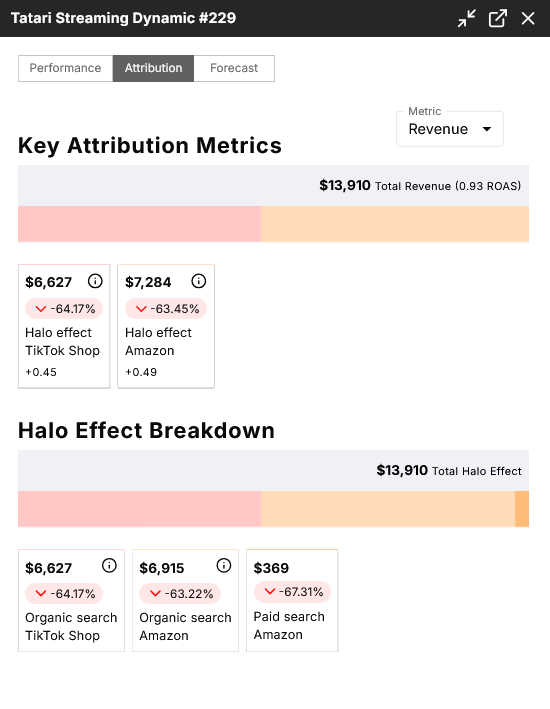
For one Tatari streaming campaign, every dollar of the $13,910 in revenue Prescient's model attributes to it shows up as halo effect: $6,627 in organic search tied to TikTok Shop, $6,915 in organic search tied to Amazon, and $369 in paid search on Amazon. None of that revenue would show up if you were only watching direct, trackable conversions from the streaming platform itself. It shows up because someone saw the ad, didn't click anything, and later typed branded search queries or bought through a retail partner. That's the same behavior as the billboard from earlier, just measured this time.
Common misconceptions about TV attribution
A few misconceptions come up again and again once teams start digging into TV attribution:
TV should perform like a direct response channel. Most marketers know better than to judge TV or CTV against the same benchmarks as a retargeting campaign, but it still happens under budget pressure. TV builds brand awareness and consideration first, and that value tends to show up weeks later, in a different channel, not immediately in the campaign that ran it.
Most CTV impressions are fraudulent. There's real concern about fraud in parts of the programmatic CTV market, particularly around impressions served in barely visible ad slots or on sites overrun with bots. That's a legitimate data quality issue worth raising with your vendor, but it's a separate question from whether your attribution model can measure real impact. Bad inventory and bad measurement are two different problems, and fixing one doesn't fix the other.
A managed marketplace running your test will bias the results. If a CTV marketplace is both selling you inventory and reporting your test results, it's fair to ask whether that creates a conflict of interest. The fix isn't to skip validation. It's to run that validation through a source that isn't also the one selling you the media.
A better way to validate TV performance
Geo tests and platform reports both have a role to play, but neither one gives you an ongoing, campaign-level view of what's happening. That's the gap marketing mix modeling is built to close. Because an MMM looks at spend, exposure, and outcomes across every channel at once, it can help validate whether a geo test's results hold up outside that specific test window, and it can do that on a rolling basis instead of waiting for the next test to run. Prescient's models refresh daily and report at the campaign level, not just the channel level, so you get reliable insights for ongoing optimization decisions well before a quarterly review forces the question, and a consistent way to compare TV against different channels instead of trusting whichever dashboard looks best that week.
Where Prescient comes in
Prescient's marketing mix model gives you a unified view of TV and CTV alongside every other channel in your media plan, instead of treating TV as an isolated line item competing against exposure data or a single test result. The Validation Layer checks whether incrementality test data, geo holdouts included, actually improves the model's accuracy before it gets folded in, so a test that's biased or underpowered doesn't distort your numbers. Because halo effects are measured at the campaign level across organic search, paid search, direct traffic, and retail channels like Amazon, you can see exactly where a specific TV campaign's revenue is landing instead of guessing.
If you're tired of choosing between a platform report that reads zero and a geo test that takes weeks to answer one question, it's worth seeing what a daily, campaign-level view of your TV ad spend actually looks like. Book a demo to see how Prescient measures the TV and CTV campaigns your current reporting can't.
FAQs
Is CTV advertising trackable?
Yes, to a degree. CTV attribution relies on digital identifiers that let platforms use device graph technology to match impressions to specific households, which is more precise than linear TV's spike-based tracking. That said, trackable exposure isn't the same as proven impact. Knowing a household saw your ad tells you exposure happened, not whether that exposure caused the purchase that followed.
How long should a TV incrementality test run?
Most geo holdout tests run somewhere between four and eight weeks, with a pre-period beforehand to establish a baseline for the test and control markets. Shorter tests risk missing delayed effects, since TV often influences purchases that happen well after the ad airs. Whatever the length, treat the result as a snapshot of that window rather than a permanent verdict on the channel.
What's the difference between TV attribution and multi-touch attribution?
TV attribution focuses specifically on connecting TV or CTV ad exposure to what happens afterward, using methods like spike analysis, ACR, or device matching. Multi-touch attribution is broader: it tries to assign credit across every touchpoint in a customer's journey, TV included. The catch is that MTA depends on clean digital data, which TV rarely produces, so it tends to undercount TV's actual role.
Can you measure TV performance without running a geo test?
Yes. Marketing mix modeling estimates TV's contribution to your business outcomes using historical spend, exposure, and revenue data across all of your channels, without needing a dedicated test to run first. That makes it possible to check in on an ongoing basis, and to use it to see whether a geo test's findings actually hold up.
The Halo
Exclusive insights, every week.
Subscribe to The Halo for sharper marketing thinking.
You're subscribed to The Halo!
Quick question (optional): How familiar are you with MMM?
Thanks for sharing! Enjoy The Halo.
Keep reading
View all
Retail media's CTV push is creating a measurement blind spot
Read article
Ad verification tells you where your CTV ad ran, not if it worked
Read article
Is a multi-touch attribution model for TV enough?
Read article
How to measure MNTN performance TV campaigns
Read article
How to measure CTV advertising effectively
Read article
Leading tools for measuring incremental lift from CTV ads
Read article