


Welcome back to The Halo. In this issue we cover:
The Take: How Beekman 1802 scaled TV 2.5x while watching media ROAS rise 11% across four months.
From the Blog: How to measure CTV honestly when impressions land on a screen and conversions close somewhere else.
Prescient Voices: David Baker, CDO at Beekman 1802, on tracking upper-funnel impact across platforms.
Three Things: Reads on top-of-funnel power, multi-retail halo measurement, and the best halo channels for 2026.
Third issue in a row featuring an upper-funnel channel that looked weak in platform attribution and turned out to be doing the heavy lifting.
Two weeks ago, Linear TV at Coterie. Last week, YouTube at Global Healing. This week: Beekman 1802.
Beekman 1802 is a dermatologist-founded skincare brand that sells through Shopify, Ulta Beauty, Target, Amazon, and specialty retailers. Connected TV and Linear TV looked underperforming in their platform reports. Most brands would have pulled back. Beekman scaled.
Welcome to The Halo. Each week: one piece of measurement analysis, the best of the blog, one real customer result, and three reads worth your time.
Let's dive in.
01 · THE TAKE
How Beekman 1802 scaled TV 2.5x with Prescient while watching media ROAS rise 11%
THE BET MOST BEAUTY BRANDS WON'T MAKE
By platform attribution, upper-funnel TV looked weak. Connected TV and Linear TV impressions weren't closing on the platforms themselves. They were purely halo.
Those platforms need an approach where measuring halo is native: a way to credit a CTV impression that became an Ulta retail purchase three weeks later, a Linear TV ad that drove a Target trip, or a streaming ad that ended in an Amazon checkout.
The platform-rational move was to pull back on TV and reallocate to channels with cleaner attribution paths. That is what most beauty brands do.
Beekman 1802 went looking for a more granular view of TV's actual impact first.
WHAT THE MODEL SAW
Beekman 1802 ran their commerce data through Prescient's MMM, integrating TV measurement via Tatari and NeonPixel. The model could see CTV and Linear TV impact across every destination, not just the surface they were trying to credit themselves with.
The picture changed. Upper-funnel TV was driving substantial halo across the commerce stack:
• Shopify DTC purchases
• Ulta Beauty retail purchases
• Target retail purchases
• Amazon purchases
None of those destinations had a native way to credit a TV impression. None of them reported back to CTV or Linear TV platforms. The model was reading the path that the dashboards couldn't see.
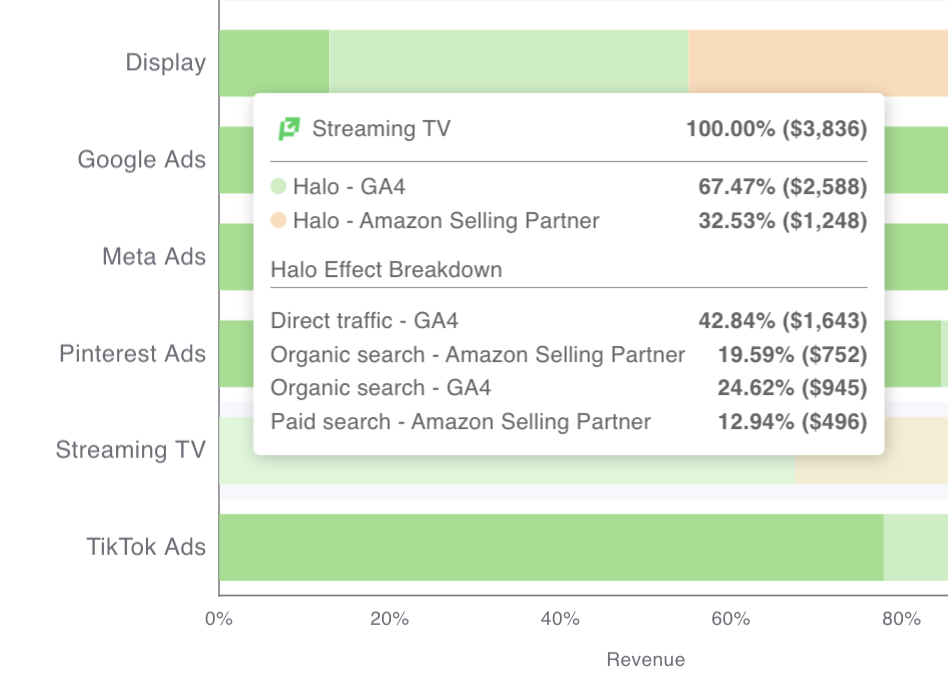
Example of Prescient's halo breakdown view for Streaming TV. Anonymized data, illustrative.
THE 2.5x SCALE-UP
With the model behind them, Beekman 1802 scaled TV's share of the media mix to 2.5x its baseline. Total paid impressions doubled across the same window. Media ROAS rose 11% within four months.
The scale improved efficiency. It did not break it.
WHY THIS KEEPS HAPPENING
You have now seen this pattern three weeks running. YouTube at Global Healing, Linear TV at Coterie, TV plus CTV at Beekman 1802. All had an upper-funnel channel that looks weak in platform attribution because its halo lands on conversion surfaces the platform cannot see.
This is a measurement constraint, not a vendor failure. For Beekman, the halo landed on Ulta, Target, and Amazon simultaneously. None of those retailers report back to the TV platforms. None of them credit a streaming ad impression with a Target trip three weeks later.
Click-based attribution needs its complement: a way to measure halo.
02 · FROM THE BLOG
How to measure CTV advertising effectively
Connected TV is one of the hardest channels to measure honestly: impressions land on a screen, but conversions close somewhere else entirely. The post walks through what to measure, why cross-device attribution alone falls short, and how incrementality testing, halo effects, and marketing mix modeling each fit into a complete CTV measurement stack.
• The metrics that matter for CTV, and the ones that don't.
• Why cross-device attribution alone undercredits CTV.
• Where halo effects and MMM enter the picture, and why both are needed.
The piece is the technical companion to this week's Take. Beekman 1802's TV scale-up is the worked example of every claim it makes.
03 · PRESCIENT VOICES
Prescient allows us to track the impact of scaling upper funnel channels AND campaigns across platforms.

04 · THREE THINGS WORTH READING
1. How your bottom of funnel is driven by your top of funnel
The POV piece behind Beekman's bet on TV. Bottom-of-funnel success depends entirely on a healthy, well-funded top of funnel. Cut top-of-funnel and the entire downstream conversion engine starves. A clear argument for why the brands that scale upper-funnel are the ones that keep their bottom-of-funnel efficient.
2. Your marketing drives retail sales. Now you can prove it.
The technical reference behind Beekman's multi-retail halo measurement. Brands knew their marketing was driving retail sales at Ulta, Target, and Amazon, but couldn't prove it, quantify it, or use it to make better budget decisions. The post explains the multi-retail connector feature that closes that loop.
3. The best halo contributing channels for 2026
A trend report on which channels are doing the most halo work this year. The channels driving the most revenue may not be the ones claiming credit in your reports. They are the ones helping everything else work better. Beekman's TV is exactly the kind of channel this report lists.
The Halo
Exclusive insights, every week.
Subscribe to The Halo for sharper marketing thinking.