





Welcome back to The Halo. In this issue we cover:
The Take: What Coterie changed about Linear TV without changing spend.
From the Blog: Why Linear TV and CTV are hard to measure.
Discovery of the Week: How Coterie cut reported Linear TV CAC by 22%.
Prescient Voices: What changes when the model can see the channel that resists every other measurement tool.
Three Things: Reads on cross-device attribution, MMM tooling, and BFCM measurement.
Last week's issue argued that the destination of CTV halo depends on the brand archetype (DTC-led, Amazon-led, retail-led, or balanced). The archetype predicts where the revenue shows up. This week we extend that lens to a channel that carries a deeper measurement challenge: Linear TV.
Coterie fits the balanced archetype, with revenue split between Shopify DTC and retail partners. Before working with Prescient, Coterie was using another model to evaluate Linear TV. After implementing Prescient's MMM, reported Linear TV CAC dropped 22%.
Welcome to The Halo. Each week: one piece of measurement analysis, the best of the blog, one real customer result, and three reads worth your time.
Let's dive in.
01 · THE TAKE
Coterie cut reported Linear TV CAC by 22% without changing TV spend
Before getting into the story, think about it. Linear TV does not have a pixel to track each purchase. There is no click to attribute. Most teams struggle to measure this channel, and standard models were not built for it.
What about incrementality testing? It helps, but only to a point. You would need to run multiple tests in sequence to measure, forecast, and optimize the budget.
Coterie's situation may sound familiar if you are running Linear TV or considering adopting it. Their previous attribution setup struggled to give a confident readout on Linear TV's contribution to the paid portfolio.
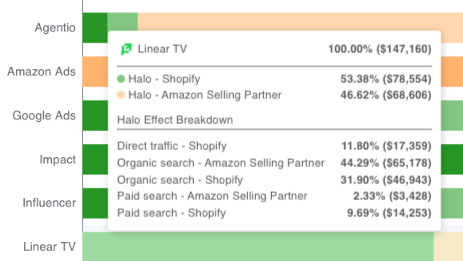
Demo screenshot - Linear TV halo breakdown: 53% to Shopify DTC, 47% to Amazon retail.
THE -22% NUMBER, IN CONTEXT
Once the model gave them visibility into the full halo, reported Linear TV CAC dropped 22%. Overall CAC dropped 7% and ROAS rose 6% in the same window.
Linear TV intensifies the channel where the customer already buys. The brand that measures it against the right reference sees what the channel actually does. The brand that does not, sees less.
With these numbers, Coterie had the confidence to make hard decisions. They reallocated budget, and the question moved from "is TV worth it" to "how much TV is the right amount."
THE ARCHETYPE LENS APPLIED TO LINEAR TV
The lesson connects directly to last week's piece on CTV. You can predict Linear TV and CTV halo destination based on your brand archetype. Find your archetype first; the channel will land where the brand sells.
For Coterie, with revenue split between Shopify DTC and retail partners, the Linear TV halo destination reflected that split. The channel's contribution became visible only once the model could see the full revenue surface.
02 · FROM THE BLOG
How to measure CTV advertising effectively
The post walks through the measurement challenges that show up for any TV channel, with CTV as the worked example.
• Impression-level data that cannot be reconciled with clicks.
• View-through windows that overstate proximity.
• Platform-reported ROAS that excludes the halo.
The same structural problem applies to Linear TV with fewer measurement tools available. This piece is the technical companion to this week's Take, framed around CTV but applicable to the broader question of how to value a channel whose contribution does not arrive as a click.
03 · PRESCIENT VOICES
Prescient AI's time-to-value is very, very fast. I just connected a couple of channels and, within a day, I had a model that streamlined my decision-making.

04 · THREE THINGS WORTH READING
1. What cross-device attribution is and why it matters
Once a brand sells across different platforms, the question of which device started the journey and which closed it stops being trivial. The post walks through how cross-device attribution works mechanically, where the signal breaks down, and what the practical implications are for measuring channels that span multiple touchpoints.
2. A practical guide to the best MMM tools for e-commerce brands
The Coterie story raises an operational question: if the measurement model is the variable that matters, which one to pick? The post compares the MMM options available to e-commerce brands by methodology, deployment time, and what each can actually decompose. Useful context for the team that just finished reading this issue and is asking what this would look like in their own stack.
3. BFCM: how to run the season and know why it worked
BFCM is the limit case for any measurement system. Paid spend and organic demand move together with more amplitude than at any other point in the year, which makes the question of what drove revenue harder to answer. The post covers the planning side. The measurement side opens a thread that the Prescient Perspective newsletter takes up directly next week.
The Halo
Exclusive insights, every week.
Subscribe to The Halo for sharper marketing thinking.