




Welcome back to The Halo. In this issue we cover:
- Industry Watch: MMM adoption surged 212% in two years. The brands that switched are 23% more efficient.
- The Take: How Catalina Crunch dropped CAC 24% in 30 days by asking the inverse question.
- From the Blog: The structural drivers of CAC and what separates lasting compression from short-term wins.
- Prescient Voices: Nick Osborn, Head of Growth at Catalina Crunch, on what changed once the model could see Amazon halo.
- Three Things: Reads on LTV:CAC framing, the hidden cost of cutting awareness, and the Spend Optimizer.
Four weeks running, the brand featured here had scaled an upper-funnel channel after the model revealed it was undercredited.
Coterie at Linear TV. Global Healing at YouTube. Beekman 1802 at TV across Ulta, Target, and Amazon. DECKED at video, where 95% of the channel's value was halo last-touch dashboards never credited.
This week, the inverse question. Catalina Crunch asked the same model where it could compress. The answer came back in 30 days as a 24% CAC drop across the blended DTC and Amazon business, with 15% of Amazon revenue confirmed as halo from DTC ad spend.
INDUSTRY WATCH · NEW RELEASES
MMM adoption surged 212% in two years. The brands that switched are 23% more efficient.
Google's 2025 Data-Driven Measurement Report shows MMM adoption rose 212% year-over-year since 2023. Nearly half of U.S. marketers (46.9%) plan to invest more in MMM in the coming year, per eMarketer. Gartner launched its first dedicated MMM Magic Quadrant in 2024 and expanded it in 2025. Forrester listed MMM in its top five technologies marketers plan to deploy in the next twelve months.
ConvertMate's analysis of 2,400 e-commerce brands across 14 verticals found that companies using MMM allocate budgets 23% more efficiently than those relying on platform-reported metrics alone.
This week's Take is what those numbers look like inside one growth team. Catalina Crunch ran in-house MMM for years before switching. The migration dropped CAC 24% in 30 days and saved 40 hours a month of manual workbook work. The trend tells you the industry is moving. Catalina tells you what happens when one brand makes the move.
Sources: Google Data-Driven Measurement Report (2025), eMarketer, Gartner, Forrester, ConvertMate
Read the eMarketer summary on MMM trends 2026 →
01 · THE TAKE
How Catalina Crunch dropped CAC 24% in 30 days with Prescient
THE INVERSE QUESTION
Catalina Crunch is a low-carb keto snack brand selling DTC plus 30,000 retail doors and Amazon. Nick Osborn, Head of Growth, had been running marketing mix models for five years. None of them used Catalina Crunch's own data. The vendors he had tried trained on aggregated category data from other brands and applied it generically.
Nick built his own internal model in Excel. The workbooks ran 600,000 rows long and took 15 minutes to open. He could see correlation between Meta impressions and Amazon revenue, but the model was scraping the surface of the question he actually wanted to answer.
The question was not "where should I scale?" It was "where can I compress without losing volume?"
WHAT THE MODEL SAW
Catalina Crunch ran their commerce data through Prescient's MMM, integrating DTC, Meta, Google, TikTok, and Amazon at the campaign level.
The model could see two things the Excel workbook never could:
• Which campaigns were driving inefficient cost-per-acquisition, by channel and by campaign
• How much of Amazon revenue was being driven by DTC ad spend (halo), versus closing directly on Amazon's own surface.
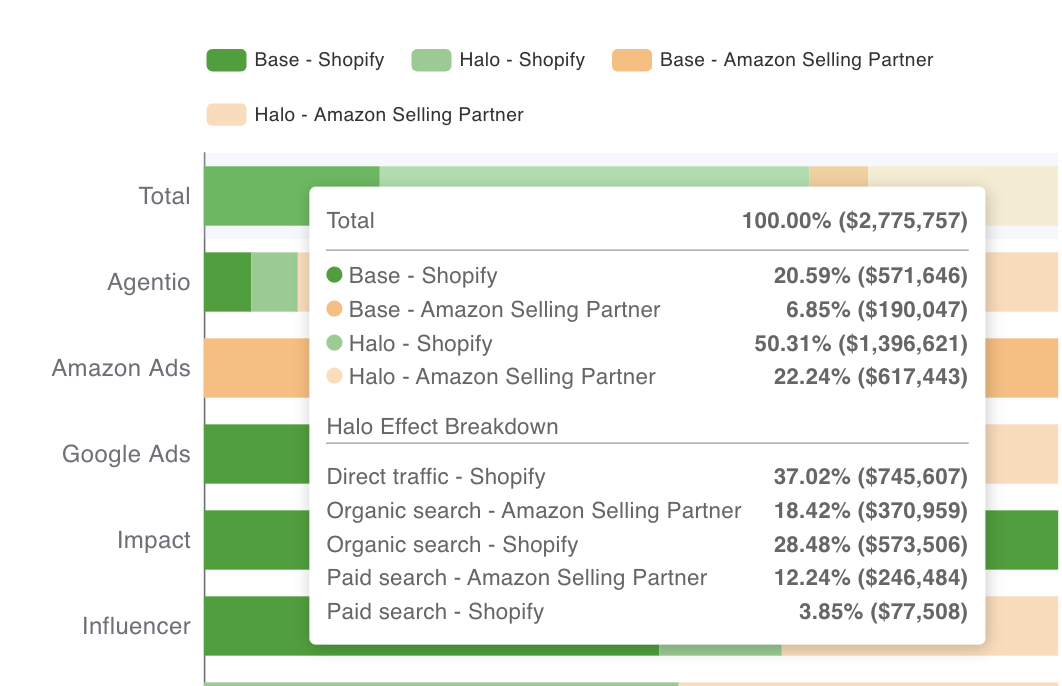
How Prescient splits base vs halo by channel. Anonymized account, not Catalina's numbers, just an example of the model at work.
THE 24% CAC DROP
With the model behind them, Nick made paid spend adjustments via the Spend Optimizer. March CAC came in 24% lower than historical averages across the blended business (DTC plus Amazon).
The 15% of Amazon gross sales that the model attributed to halo from DTC campaigns kept Nick from over-cutting awareness channels. The compression happened where waste lived, not where revenue was being created downstream.
The team also saved 40 hours a month they had been spending pulling Excel workbooks manually.
WHY THIS KEEPS HAPPENING
The same architecture that surfaced halo across Coterie, Global Healing, Beekman 1802, and DECKED also tells the inverse story. Once a model captures cross-channel interactions properly, it can answer either question: where to scale, or where to compress.
CAC compression and channel scale are the same question with different inputs. The model that can see one can see the other.
A model that cannot see halo will compress the wrong way (cutting upper-funnel that drives downstream conversion). A model that can see halo will compress where waste actually lives.
Compression done blind is just cost reduction. Compression done with the model is operating income.
02 · FROM THE BLOG
The hidden cost of cutting awareness spend

Cutting awareness spend looks safe on paper. The platform dashboards always rank it low. The reported ROAS rarely justifies the line item. The post walks through why those signals are systematically misleading for awareness, how the lost value shows up months later as eroded organic traffic and a dropping conversion rate, and what to do instead.
• Why last-touch dashboards understate awareness by construction.
• How an awareness cut compounds back as a revenue hole one or two quarters later.
• What measurement architecture actually reveals upper-funnel contribution.
The piece is the strategic companion to this week's Take. Catalina Crunch's 24% drop is the worked example of every claim it makes.
03 · PRESCIENT VOICES
Using Prescient, I can model out any spend. If I want more incremental ROAS for next month, the platform tells me where I should adjust my budget, spend, channels, campaigns, you name it. Prescient makes the whole process so easy.

04 · THREE THINGS WORTH READING
1. What LTV:CAC ratio means and why it matters
CAC compression in isolation can be misleading. A 24% CAC drop only matters if the lifetime value of the acquired customer holds. The post walks through how to read CAC in the context of LTV, how the ratio should be calculated, and what a healthy ratio looks like in different categories.
2. The hidden cost of cutting awareness spend
The counterpoint to this week's Take. Catalina Crunch compressed CAC without cutting the upper-funnel that was creating Amazon halo. Other brands cut awareness spend because it looks like a safe lever, and quietly lose organic traffic over months. The post explains why awareness spend reductions show up as efficiency wins on Monday and as revenue holes by Q3.
3. When to act on an optimizer recommendation vs. when to wait
The operational follow-up to Catalina's story. The Spend Optimizer surfaces a budget reallocation recommendation. Whether to act on it depends on confidence score, projected lift, and strategic context. The post walks through how to read what the optimizer says, what to do about it, and when to wait for more signal.
The Halo
Exclusive insights, every week.
Subscribe to The Halo for sharper marketing thinking.