



Welcome back to The Halo. In this issue we cover:
- Industry Watch: Retail media hits $71B in 2026 but most MMMs still treat spend as a spreadsheet. This inspired three new native connectors that are live now.
- The Take: How BrüMate scaled Amazon 85% by leaning into CTV even though platform reports ranked it last.
- From the Blog: Brands selling on Amazon need to be advertising on this channel.
- Prescient Voices: Hans Harris, Head of Growth at BrüMate, on what changed for the brand once the model could see their halo effects across DTC and Amazon.
- Three Things: Reads on retail media measurement, omnichannel halo effects, and reading what the model says about cross-surface spend.
INDUSTRY WATCH · NEW RELEASES
Most MMMs still require CSVs for spend data even as retail media hits $71B in 2026.
US advertisers spent $60.3B on retail media in 2025, and eMarketer projects $71.1B in 2026. Amazon and Walmart will capture 89% of the $10.5B in incremental spending. DoorDash and Instacart each generate close to $1B a year in ad revenue. Retail media and delivery commerce are where a growing share of brand spend now lives, and most measurement tools cannot see them without someone uploading a CSV every month.
We know brands need something faster than a spreadsheet, so on June 22 we added three native connectors to the ingestion pipeline: Walmart Connect, DoorDash Ads, and Vibe Ads. They cover ground that most MMMs still leave to manual exports.
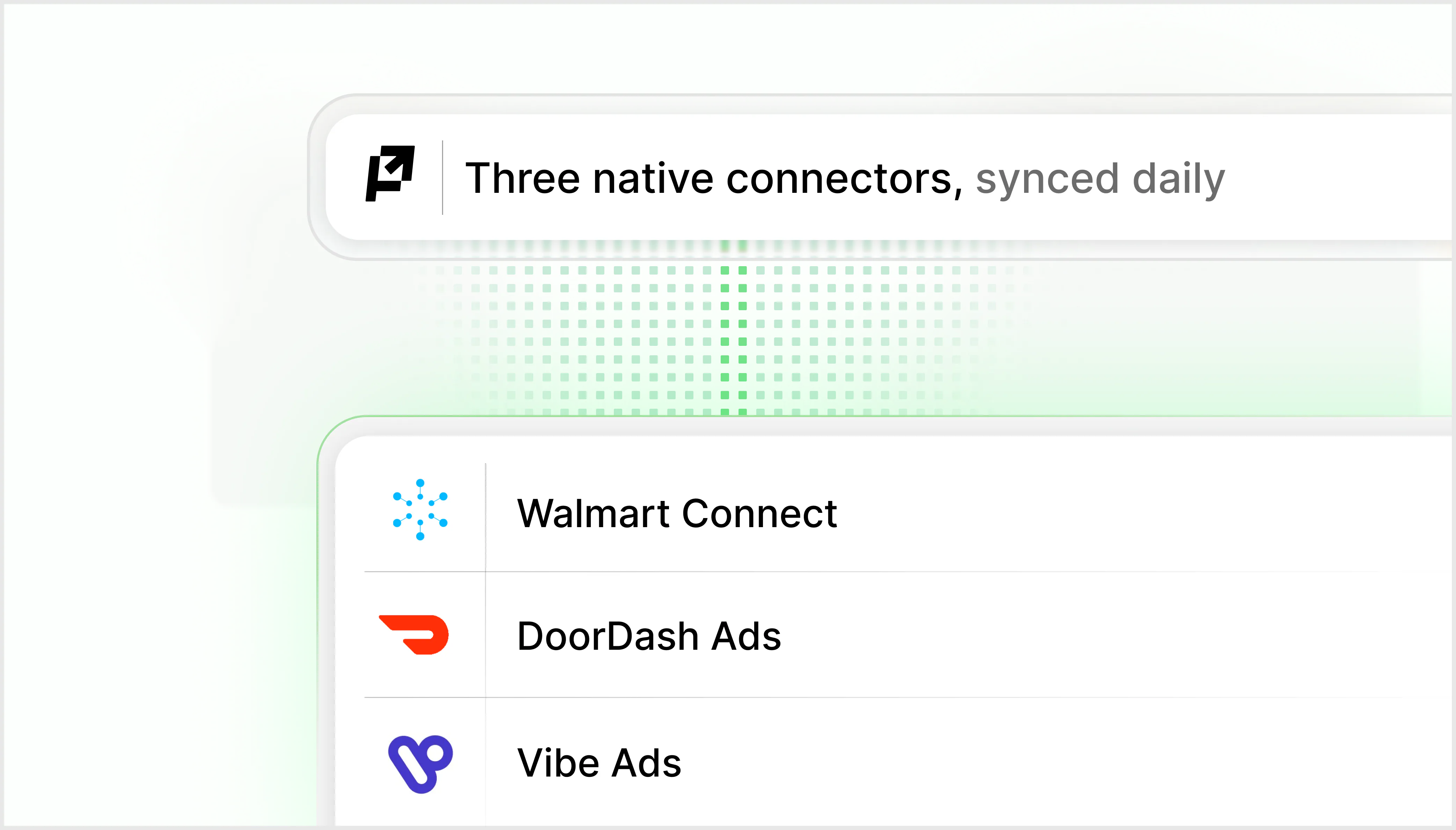
Native means the data flows in daily and automatically. No CSV cadence, no stale workbooks, no waiting until end of month to know what a channel did. If you have been waiting on a monthly export from Walmart Connect or DoorDash to measure those channels, the wait is over.
Sources: eMarketer Retail Media Ad Spending Forecast (Dec 2025 + H1 2026).
01 · THE TAKE
Platform reports said CTV was weak. BrüMate used it to scale Amazon 85%
THE CHANNEL THAT LOOKED WEAKEST
BrüMate is a premium drinkware brand known for their tumblers, wine canteens, and coolers. The business runs across Shopify DTC, TikTok shop, Amazon, and a growing network of retail and wholesale partners. Hans Harris, Head of Growth, was watching three things at once: how the DTC site was performing, how Amazon was scaling, and how upper-funnel investments like CTV were doing across both
The platform reports said CTV was the worst-performing channel in the mix. Last in ROAS. The kind of line item most growth leads would defund.
Hans was not convinced. The Amazon side of the business was growing. Something was driving it, and the dashboards had no answer.
WHAT THE MODEL SAW
BrüMate ran their commerce data through Prescient’s MMM, integrating DTC, paid social, search, CTV, and Amazon.
Two things showed up that the platform reports missed:
• CTV through Keynes Digital was not the worst channel. It was the #1 driver of Amazon halo effects, by a wide margin.
• Nearly 20% of revenue attributed to Keynes came from Amazon, which was completely invisible to Keynes’ own platform reporting.
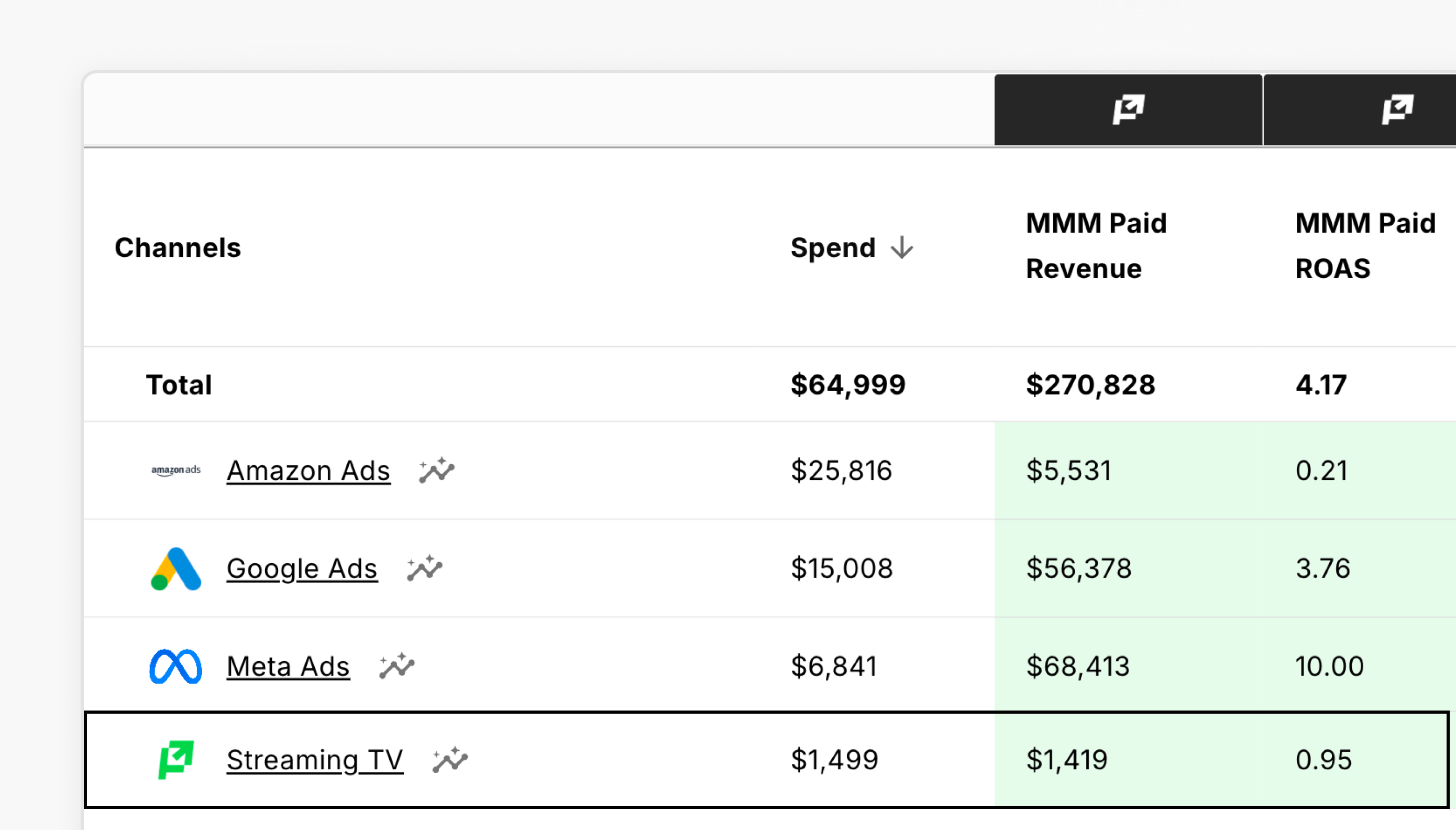
How Prescient scores every channel, including CTV, on modeled revenue and ROAS. Not client data.
THE 85% AMAZON LIFT
With CTV correctly credited, BrüMate scaled the channel instead of cutting it. Amazon sales grew 85%. New ecommerce customer growth came in at 15%. Total media spend grew only modestly.
The efficiency didn’t come from cutting awareness. It came from recognizing that awareness on CTV was the engine driving the Amazon line item.
WHY THIS KEEPS HAPPENING
CTV and retail media tell the same story from two sides: CTV looks weak because the conversions happen off-platform; retail media looks small in dashboards because the halo effects back to DTC are invisible.
A model that can’t see across surfaces will systematically undervalue the channels that bridge them. A model that can see across surfaces reveals the channels that look weakest on individual platforms but are carrying the business.
Last-touch can rank channels. It cannot value them.
02 · FROM THE BLOG
Brands selling on Amazon need to be advertising on this channel

A retailer opens a flagship store in a busy shopping district. Customers browse the displays, try on products, and fall in love with the brand. Then they walk across the street to a department store and buy the same product there because it’s more convenient, they have a gift card, or they’re already checking out with other items.
The flagship gets zero credit for the sale. The department store’s metrics look amazing. And the retailer, looking only at direct store revenue, concludes the flagship isn’t worth the investment.
The post walks through which channels drive spillover revenue on Amazon and how to measure it properly. BrüMate’s 85% Amazon lift from CTV is the worked example of every claim it makes.
03 · PRESCIENT VOICES
We could no longer rely on siloed, in-platform attribution or even basic MTA. We needed a way to measure not just direct response, but the halo effects across channels, especially as we leaned more into upper funnel tactics like CTV.

04 · THREE THINGS WORTH READING
1. Leading tools for measuring incremental lift from CTV ads
The technical companion to BrüMate’s story. What criteria matter when evaluating CTV measurement, how the methodologies compare, and why halo effects are the piece most tools still miss.
2. The best halo contributing channels for 2026
The channels driving the most revenue for your brand in 2026 aren’t necessarily the ones claiming credit in your reports. They’re the ones creating the conditions for everything else to work better. A ranked look at which channels drive halo across the board.
3. The hidden cost of cutting awareness spend
The counterpoint to BrüMate. They scaled CTV (typically an awareness channel) because the model showed the halo effects on Amazon. Other brands cut awareness because it looks safe in platform reporting. This article explains why top of funnel reductions show up as immediate efficiency wins while revenue craters by Q3.
The Halo
Exclusive insights, every week.
Subscribe to The Halo for sharper marketing thinking.