




Welcome back to The Halo. In this issue we cover:
- Industry Watch: TikTok Shop is headed for $23.41B in US sales in 2026, and Q4 will push it further.
- The Take: Portland Leather Goods scaled TikTok to 14% of their budget, but 70% of the revenue from this spend came through Amazon, retail, and DTC.
- From the Blog: Why channel ROAS and incrementality answer different questions.
- Prescient Voices: Matt Fey, Marketing Director at Portland Leather Goods, on measuring across a multi-channel portfolio.
- Three Things: Three reads on commerce media measurement, Q4 retail ROAS, and cross-channel retail measurement.
TikTok Shop is on track to move more money in the US this year than the ecommerce arms of Target, Costco, Best Buy, or Kroger. eMarketer forecasts $23.41 billion in US sales through TikTok Shop for 2026, up 48% year over year, after 2025 sales grew 108% to $15.8 billion and captured 18.2% of US social commerce. Q4 will push that further: last year's Thanksgiving-to-Cyber-Monday weekend alone generated more than $500 million in sales on TikTok Shop and drew over 760,000 livestream sessions.
Those are huge numbers, but the growth is audited by third parties, and still accelerating. Despite that growth, it's hard to see exactly what TikTok Shop's growth does for brands because so much of it happens outside the platform. GMV Max, TikTok's flagship ad product, has limited channel-level breakout, and purchases made inside the app don't trigger a brand's pixels.
Portland Leather Goods solved this problem with Prescient. Their team can see exactly how much of the revenue TikTok drives shows up in ecommerce, retail, and Amazon, and used that visibility to scale TikTok into one of their largest channels. That's what measurement built for 2026 looks like.
Welcome to The Halo. Each week: one piece of measurement analysis, the best of the blog, one real customer result, and three reads worth your time.
Let's dive in.
INDUSTRY WATCH
TikTok Shop is entering its biggest quarter yet
eMarketer projects TikTok Shop will generate $23.41 billion in US sales in 2026, up 48% from last year. It grew 108% in 2025 to $15.8 billion, capturing 18.2% of US social commerce. Growth rates like that rarely hold once a platform gets this large, and TikTok Shop has held it.
But we have yet to see what 2026 will bring for the platform because Q4 is its annual peak. Over the 2025 Thanksgiving-to-Cyber-Monday weekend, TikTok Shop generated more than $500 million in US sales, drew roughly 50% more buyers than the year before, and logged over 760,000 livestream sessions.
That growth is outpacing marketers' ability to measure it. Purchases made inside the TikTok app never register on a brand's own site pixel, and many buyers move to another platform to purchase after seeing a TikTok campaign. That's why most brands scaling TikTok this year will only see a fraction of what the channel is actually doing for them. Portland Leather Goods is the exception, and their story is what happens when a brand can actually measure the full impact of this channel.
Sources: eMarketer (Dec 2025 forecast), eMarketer social commerce FAQ 2026.
01 · THE TAKE
How Portland Leather Goods found 70% of its TikTok revenue somewhere else
Portland Leather Goods opened new stores throughout 2025 while running 11 marketing channels, each with a different profitability profile and a different role in the funnel. Matt Fey's team faced a common question: raise spend on the channel with the highest platform-reported ROAS, or hold steady? There was risk with either path that they would either hit saturation or leave money on the table.
Portland Leather had worked with Prescient before, so the team already suspected halo effects were at play. Prescient's marketing mix model quantified them. TikTok's role extended well past awareness and in-app purchases. Now that they could measure TikTok's full impact, reallocating budget to this channel was the obvious call.
TikTok was actually a highly effective driver of off-app purchases. 70% of TikTok-generated revenue showed up in ecommerce, retail, and Amazon. And 66% of revenue driven by GMV Max, the ad format built for in-app purchases, happened on other storefronts. The team also ran a parallel affiliate blitz in late March, roughly 500 creators producing 3,800 videos in seven days that generated $1 million in sales within 20 days. That creator content fed the same algorithm GMV Max relies on, so affiliate and paid efforts reinforced each other.
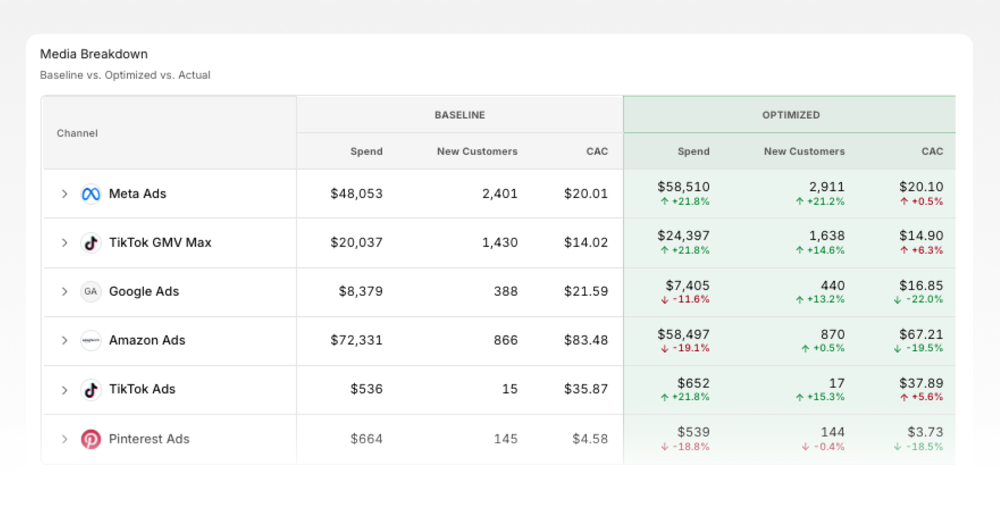
Media Forecaster in Prescient. The model recommends scaling TikTok GMV Max while pulling back elsewhere. Sample account.
With that visibility, the team scaled TikTok from 3.3% of their media budget in Q4 2025 to 9.0% in Q1 2026 and 13.9% by March; 14% of total spend within seven months. GMV Max led the final push, growing from 0.5% of the budget in December to 11.8% in March. Despite the aggressive growth, the brand's portfolio efficiency improved 8% over the same period.
Scaling the channel that looked riskiest on paper turned out to be the safest move for their bottom line.
02 · FROM THE BLOG
Attribution and incrementality answer different questions

Attribution reports post-click conversions. That's reflected in what platform ROAS numbers show. When a channel's ROAS looks low, that number is doing its job: it's telling you how much revenue closed through a trackable click on that channel. But that doesn't mean the channel isn't working.
Incrementality measures what a channel or campaign drives that wouldn't have happened otherwise. When a tool has the capacity to measure them, it reflects the impacts that never touch a channel's own pixel. For channels like TikTok Shop, where 70% of the revenue driven can show up on Amazon, retail, or DTC, incrementality is what can reveal that a "low ROAS" channel is actually one worth scaling.
The post walks through what each method actually measures, why they disagree, and how to make budget calls when the two numbers point in different directions.
03 · PRESCIENT VOICES
Running a multi-channel portfolio means every dashboard tells you something different. Prescient helped us to see TikTok as a different channel to increase our incoming revenue from DTC and retail.

04 · THREE THINGS WORTH READING
1. Commerce media is promising, but its measurement lags behind
Commerce media, including TikTok Shop, is scaling faster than the tools that measure it. This post walks through what commerce media platform reporting catches today, where the reporting stops, and what a brand can lean on to understand if their efforts are actually working. Read →
2. Your peak-season ROAS targets are probably wrong for retail too
The Q4 companion to Portland Leather's story. Seasonal spend spikes can amplify the cost of mistakes made because of faulty attribution. The post walks through why peak-season ROAS targets often mislead retail teams and how to set targets that hold up post-BFCM. Read →
3. Your digital campaigns are driving retail sales. Here's how you measure them.
Portland Leather opened new stores in 2025 and needed to know which digital dollars were driving store visits. The post walks through how brands running DTC, marketplaces, and physical retail together measure that connection with confidence. Read →
The Halo
Exclusive insights, every week.
Subscribe to The Halo for sharper marketing thinking.