


Welcome back to The Halo. In this issue we cover:
- Industry Watch: Streaming beat linear TV in the primetime upfront for the first time, and Q4 budgets are locking in now.
- The Take: BrüMate's reporting ranked CTV as its weakest channel until our model counted its impact on Amazon.
- From the Blog: Most attribution treats revenue like a pie chart, giving each dollar to one channel, but that's the wrong way to do it.
- Prescient Voices: Hans Harris, Head of Growth at BrüMate, on measuring the halo effects of their upper funnel efforts.
- Three Things: Three reads on full path attribution, marginal ROI, and walled gardens.
BFCM is nine weeks out, and Q4 CTV budgets are getting locked in this week. Upfront season just wrapped, the scatter market is active, and Prime Video Ads and Amazon DSP are both pulling for a bigger share of holiday inventory. For most marketing teams, the call on how much to commit will come down to the ROI captured in the platform dashboard.
That's the exact decision BrüMate faced when it launched CTV with Keynes Digital. Keynes' own reporting ranked the channel last among BrüMate's media platforms. On its own terms, that number was accurate: Keynes could only see revenue that closed through its own pixel, and a CTV ad rarely ends with the viewer making a click.
Prescient's marketing mix model read their CTV efforts differently. It ranked CTV as BrüMate's top driver of Amazon halo effects, the sales that show up on a different platform days after someone sees an ad. Nearly 20% of the revenue Keynes generated landed on Amazon, revenue Keynes' own reporting never saw.
Welcome to The Halo. Each week: one piece of measurement analysis, the best of the blog, one real customer result, and three reads worth your time.
Let's dive in.
INDUSTRY WATCH
CTV just won its first primetime upfront in history
For the first time, streaming outspent linear TV in the primetime upfront. 2026 commitments landed at $17.2 billion for streaming versus $16.6 billion for linear TV, with streaming spend up nearly 30% year over year. Linear still holds more total upfront dollars once every daypart outside primetime gets counted, but the flagship inventory (the slot advertisers pay the most to be seen in) just changed hands.
The full year tells a similar story. eMarketer projects US CTV ad spend will reach $38 billion in 2026, up roughly 14% from $33.35 billion in 2025: the fifth straight year of double-digit growth for the channel.
Amazon is one of the reasons why. Prime Video's ad-supported tier had over 315 million monthly viewers as of November 2025, and eMarketer projects Amazon's US ad revenue will grow 17.9% year over year to $56.71 billion in 2026, as Prime Video and Amazon DSP both push for a bigger share of Q4 inventory.
More budget is moving into CTV and onto Amazon simultaneously, which means the two channels are increasingly measuring the same behavior from different angles. That's the exact situation BrüMate ran into this year.
Sources: Media Dynamics data via Señal News (Aug 2026), eMarketer CTV forecast, eMarketer Amazon FAQ 2026.
01 · THE TAKE
The channel that looked broken was quietly building Amazon
BrüMate sells drinkware through its own Shopify site, TikTok Shop, Amazon, and a growing list of retail and wholesale partners, and its media mix is just as broad: performance, TV, influencer, and brand campaigns running all at once. As the team leaned further into upper-funnel tactics like CTV, in-platform attribution and even basic multi-touch attribution stopped giving them a usable read on what was working.
When BrüMate launched CTV with Keynes Digital, Keynes' own platform reporting ranked it last among BrüMate's media channels for one major reason: its reporting only had visibility into direct response on its own pixel.
Prescient's marketing mix model measured the same spend across Amazon, retail, and the DTC site together. CTV came out as BrüMate's #1 driver of Amazon halo effects, and nearly 20% of the revenue Keynes generated showed up on Amazon, invisible to Keynes' own reporting the entire time. With that visibility, BrüMate kept CTV in the plan with only a modest increase in media spend. Amazon sales grew 85% year over year, new ecommerce customers grew 15%, and portfolio ROAS held stable.
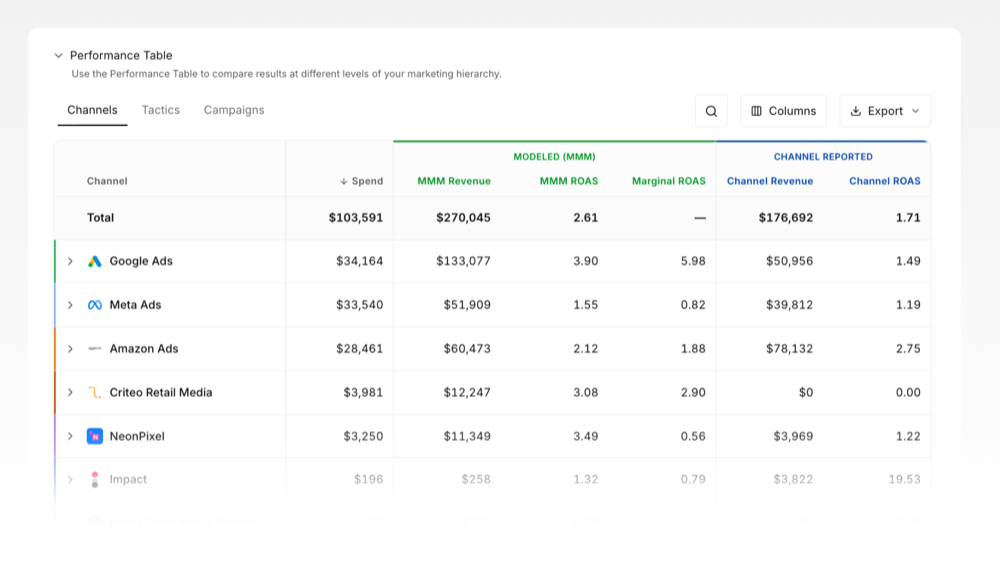
Attribution in Prescient. Criteo Retail Media reports $0 while the model credits it $12,247, the same gap BrüMate found with CTV. Sample account.
The channel that looked like it was failing in platform reporting was actually building the brand's Amazon business.
02 · FROM THE BLOG
The problem with slicing revenue like a pie chart
Most attribution, including traditional MMM, treats revenue like a pie chart, giving each dollar to one channel. That's clean to report, but it doesn't match how a marketing budget behaves once a brand runs CTV, Amazon, retail, and DTC together.
Prescient's marketing mix model doesn't force every dollar into a single slice. It estimates how every channel's spend and halo effects interact to produce total revenue together, which is why BrüMate's CTV campaign could rank last in one system and #1 in another. Both readings were accurate based on what they could see. Our MMM added the view Keynes' pixel could not.
The post walks through how Prescient establishes incrementality, what the model measures in place of a pie chart, and why the answer changes depending on whether a channel is graded on its own or as part of the full portfolio.
03 · PRESCIENT VOICES
We could no longer rely on siloed, in-platform attribution or even basic MTA. We needed a way to measure not just direct response, but the halo effects across channels, especially as we leaned more into upper funnel tactics like CTV.

04 · THREE THINGS WORTH READING
1. How full path attribution works and when it's worth using
BrüMate's CTV result only shows up if you can trace a path that runs through more than one channel. This post walks through what full path attribution measures, how it differs from single-touch models, and when it's worth the added complexity. Read →
2. What is marginal ROI (mROI) and why doesn't it always decline?
Scaling CTV or any channel into Q4 raises the same question every time: what does the next dollar actually return? The post explains marginal ROI, why it's a better scaling signal than average ROAS, and why it doesn't always fall as spend increases. Read →
3. What marketers need to understand about walled gardens
Keynes' own dashboard could only report what its own pixel could see, a limitation shared by most platform-native reporting. This post explains what a walled garden actually restricts, and what it takes to measure performance that crosses outside of it. Read →
The Halo
Exclusive insights, every week.
Subscribe to The Halo for sharper marketing thinking.