


Welcome back to The Halo. In this issue we cover:
- Industry Watch: TikTok has gotten both a new US owner and a new default ad format in the last 12 months.
- The Benchmark: TikTok drives revenue across other platforms, and Amazon and offline retail claim 77% of it.
- From the Blog: Why click-based reporting can rarely capture the full impact of an awareness campaign.
- Four Moves: Takeaways from our TikTok benchmark to help you strategize before you shift your budget.
- Three Things: Three reads on pixels, closed-loop marketing, and commerce media.
If your TikTok dashboard shows a modest ROAS, it's easy to conclude that the channel only builds awareness and that you should shift your budget somewhere else. Q4 starts today, so we want you to check that assumption before it shapes your holiday spend.
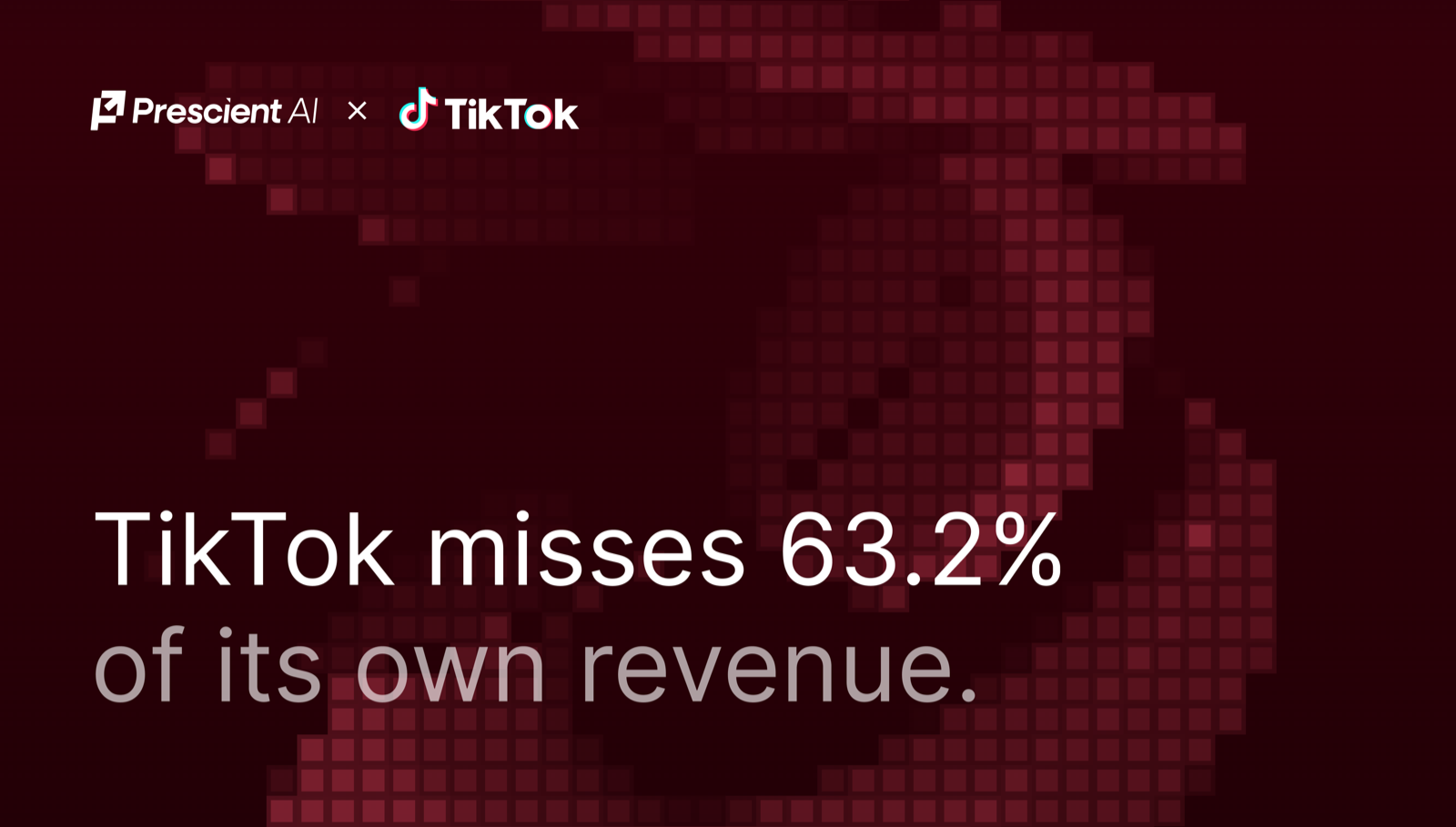
Prescient's marketing mix model reads the impact of TikTok spend differently. Across $126.0M in tracked TikTok spend over one year, the majority of the revenue the model attributes to TikTok landed off TikTok, largely on Amazon and in retail. For the typical brand in the study, that share is 63.2%.
Two weeks ago we covered how TikTok's halo effects showed up for one brand, Portland Leather Goods. This week we're publishing the full benchmark: a year of TikTok spend across omnichannel brands, broken down by where the revenue it creates lands.
Welcome to The Halo. Each week: one piece of measurement analysis, the best of the blog, one real customer result, and three reads worth your time. This week, the new benchmark takes the customer slot.
Let's dive in.
INDUSTRY WATCH
TikTok changed owners and ad formats inside this benchmark's window
In January 2026, ByteDance closed the deal that moved majority ownership of TikTok's US business to American investors, Oracle among them. By the time the NewFronts event happened in March, TikTok's pitch to advertisers centered on stability under the new US structure.
This followed another big change that had touched ad accounts. Starting July 2025, TikTok made GMV Max the default and only supported campaign type for TikTok Shop ads under the Sales objective. Brands could no longer create, edit, or duplicate LIVE Shopping Ads, Product Shopping Ads, or Video Shopping Ads.
We recently ran a benchmark study on TikTok. Both of these changes fell inside the 12 months our benchmark covers, and the benchmark's spend data moved in step with the second change: GMV Max went from 29% of tracked TikTok spend in July 2025 to more than half by February 2026, peaking at 60% in March.
When the ad format carrying a channel's spend shifts this fast, a single ROAS for that channel ends up averaging two ad types that behave differently.
Sources: Marketing Dive (Mar 2026), TikTok Ads Help Center, GMV Max migration, Prescient AI TikTok 2025–2026 Benchmark.
01 · THE BENCHMARK
Customers who move off of TikTok to purchase mostly go to Amazon and offline retail
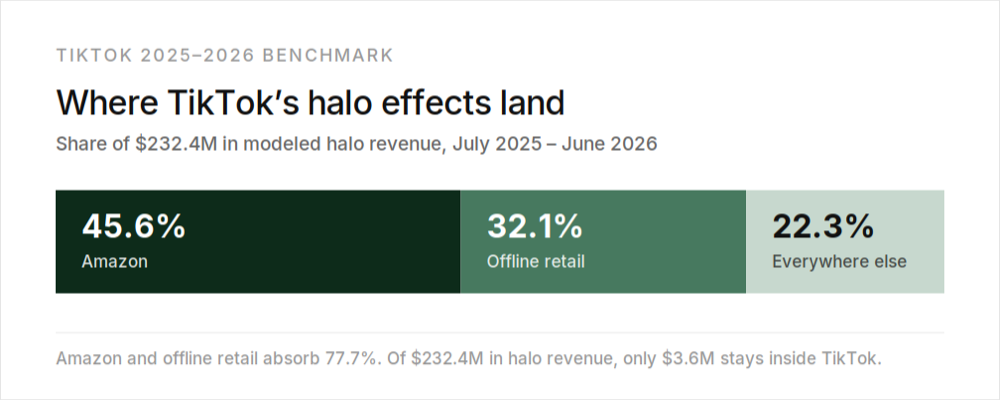
Most of what TikTok sells, TikTok never sees. For the typical brand in our study (the brand median), 63.2% of the revenue Prescient's model attributes to TikTok comes from halo effects: sales that show up on Amazon, in stores, or on a brand's own site with no TikTok click behind them. Add it all up and Amazon and offline retail take in 77.7% of those halo effects, at 45.6% and 32.1% respectively. Out of $232.4M in halo effects revenue, just $3.6M stays inside TikTok.
That blind spot shows up in ROAS too. For TikTok Web Ads, the model measures 1.92× the ROAS the platform reports at the brand median. TikTok's dashboard gets the conversions inside its own attribution window right. What it can't see is the shopper who buys on Amazon a few days later, or the one who grabs the product off a store shelf because a TikTok ad made the brand feel familiar. The report calls this gap measurement divergence, and it shrinks for the biggest programs, since they capture more of their conversions inside TikTok.
Before you chalk this up to holiday shopping, the pattern holds without Q4. Across rolling 30-, 90-, and 365-day windows, the typical advertiser's Web Ads Modeled ROAS stays between 2.90× and 3.18×, with divergence between 1.39× and 1.95×, including windows that skip the holiday quarter entirely. One more thing to keep an eye on: GMV Max carried more than half of TikTok spend by June, so the report recommends looking at the two ad types separately.
Methodology: Prescient's daily-updating marketing mix model, July 2025 to June 2026, $126.0M in tracked TikTok spend. Every median carries a 95% confidence range (for the 63.2% median, 50.8% to 70.2%). The cohort is omnichannel brands working with Prescient and skews DTC, so read these as directional signals.
Most of what TikTok drives lands past the edge of its own dashboard.
02 · FROM THE BLOG
An awareness campaign's full return rarely shows up as a click

Awareness ads don't always ask someone to click, which is exactly why they're so hard to grade. This week's post starts with the early signals worth watching, especially branded search, which usually moves well before survey results land. It also gets honest about where brand lift studies and vanity metrics come up short.
Then it follows the money into organic search, direct traffic, branded search, and the Amazon and retail sales that never trace back to a click. That spillover is where a lot of an awareness campaign's value lives, and once you measure it, the credit often shifts to different campaigns.
Think of it as the big-picture version of the question this week's TikTok benchmark answers.
03 · WHAT TO DO WITH IT
Four moves to make before you touch your TikTok budget
The benchmark points to a few practical steps, whether or not you're already using a marketing mix model.
1. Look at TikTok's contribution across every channel. If you have an MMM, check each quarter that the halo effects it credits to TikTok line up with what you're actually seeing on Amazon and in retail. If you don't, treat the ROAS in TikTok's dashboard as the minimum TikTok is delivering, and run a four-week geo-holdout before you pull any budget, keeping in mind that a short test will miss sales that land weeks later on Amazon or in stores.
2. Count Amazon and retail as places TikTok performs. Add Amazon trends and retail sell-through to the weekly view your TikTok team already checks, so the sales TikTok drives outside its own platform don't go unnoticed.
3. Test before moving budget between ad types. For the typical advertiser, GMV Max earns a higher Modeled ROAS than Web Ads (3.46× vs. 3.00×) and brings in more new customers. Before a meaningful reallocation, run an eight-week test within a single account, keeping creative and audience the same.
4. Calculate LTV across all your revenue. When a customer TikTok brought in buys again on Amazon or in a store, that repeat purchase never shows up as TikTok-attributed. LTV measured inside a single channel undercounts those customers and skews your CAC math.
04 · THREE THINGS WORTH READING
1. How retargeting pixels work and what they can't tell you
A pixel loses the trail the moment someone uses an ad blocker or clears their cookies, and it never sees purchases that happen somewhere it can't reach. The post also digs into why pixel-reported results can look better than they really are. That lines up with one of the benchmark's more surprising findings: Web Conversions, TikTok's highest-spend objective, ranks last on Modeled ROAS, while upper-funnel objectives come out on top. Read →
2. What is closed-loop marketing, and what does it miss?
Closed-loop marketing connects campaigns to sales through your CRM, which works well until a sale never creates a lead record. That means it shortchanges brand awareness campaigns, along with purchases made in stores or through retailers. In the benchmark, Amazon and offline retail are exactly where most of TikTok's halo effects end up. Read →
3. How do commerce media networks generate revenue for businesses?
Retailers are running high-margin ad businesses across their sites, apps, and stores, and the post breaks down what that earns the network versus what it costs the brands buying ads. It's helpful context for this benchmark finding: Amazon takes in 45.6% of TikTok's halo effects, sales that can easily pass for ordinary Amazon growth unless a model ties them back to the TikTok spend that drove them. Read →
The Halo
Exclusive insights, every week.
Subscribe to The Halo for sharper marketing thinking.