




This measurement blind spot is costing beauty brands credit for their media spend
Beauty shoppers mix brands freely at Sephora and Ulta. See why measuring both in-store and online sales matters for evaluating your media spend.
Linnea Zielinski · 4 min read
Walk into a record store and watch someone build their crate. A little bit of this label, a little of that one, a single they heard on the radio last month, an album a friend swears by. At the register, every one of those purchases gets swiped onto the same loyalty card, no matter which label actually got the shopper in the door. The label that landed them their new favorite single doesn't see any indication that they drove this visit to the store. All it knows is the record sold somewhere.
Beauty brands are living a version of this problem right now, and it's not just a reporting inconvenience. When a brand can't see which of its campaigns are driving purchases at Sephora or Ulta, it risks pulling the budget from the exact campaigns sending their customers to these stores.
Key takeaways
- Beauty consumers use multiple brands across categories, so single-brand loyalty is the exception, not the rule.
- Sephora and Ulta's rewards programs make cross-brand, cross-format purchasing more seamless than shopping each brand's own site.
- Online channels are expected to keep gaining share of beauty retail sales, but specialty beauty retail is growing too, not disappearing.
- Media exposure that never gets clicked can still show up as an in-store or online Sephora or Ulta purchase later.
- Brands that can't connect media spend to retail lift risk cutting the exact campaigns converting those shoppers.
- Prescient's Sephora and Ulta connectors cover both website and in-store data, so brands can see how their paid channels convert through each retailer specifically.
Most beauty shoppers aren't loyal to one brand
Every brand wants to be the only name in someone's medicine cabinet, but that's rarely how a beauty routine gets built. Most shoppers pull from several brands at once, and they're getting more selective about why.
McKinsey's State of Beauty research found that public-facing founders, once a major driver of brand consideration, have become one of the lowest-ranked purchase factors for beauty consumers. Product quality and efficacy now top the list instead. Shoppers are choosing based on what a product does for them, not which brand they've committed to, and that's exactly the mindset that leads someone to mix a serum from one brand, a cleanser from another, and a foundation from a third, all in the same routine.
Sephora and Ulta made cross-brand shopping easy
That kind of mixing and matching only works smoothly if the shopping experience supports it, and Sephora and Ulta built theirs to do exactly that.
Earning and redeeming rewards points across dozens of brands in one basket, with one login and one loyalty tier, is a lot simpler than managing separate accounts and checkouts on five different brand websites. A shopper doesn't have to think about which brand's site they're on or whether their points will carry over. They just shop. That convenience means beauty brands aren't only competing with each other for attention, they're competing with the retailer's own frictionless experience, and that's a much harder thing to out-market.
The channel mix is shifting, but in-store and specialty retail aren't going away
It's tempting to read all of this as a story about e-commerce eating retail, but the actual data tells a more specific version of that story.
McKinsey projects North America will see the largest e-commerce growth of any region through 2030, adding roughly $17 billion in sales. But specialty beauty retail, the category Sephora and Ulta sit in, is projected to grow by roughly $6 billion over the same period, while department stores and drugstores are expected to stay flat or decline. In other words, this isn't an online-replaces-retail story for beauty. It's an online-and-specialty-retail-both-grow story, while other formats lose ground. That makes measuring both online and in-store activity at Sephora and Ulta a requirement for growing beauty brands.
Media exposure that pays off at checkout, not at click
Here's where the loyalty card problem becomes a measurement problem: a shopper sees a brand's ad on social or streaming, doesn't click, and keeps scrolling. Weeks later, they're at Sephora or Ulta, in person or online, and they pick up that same product because the ad stuck with them.
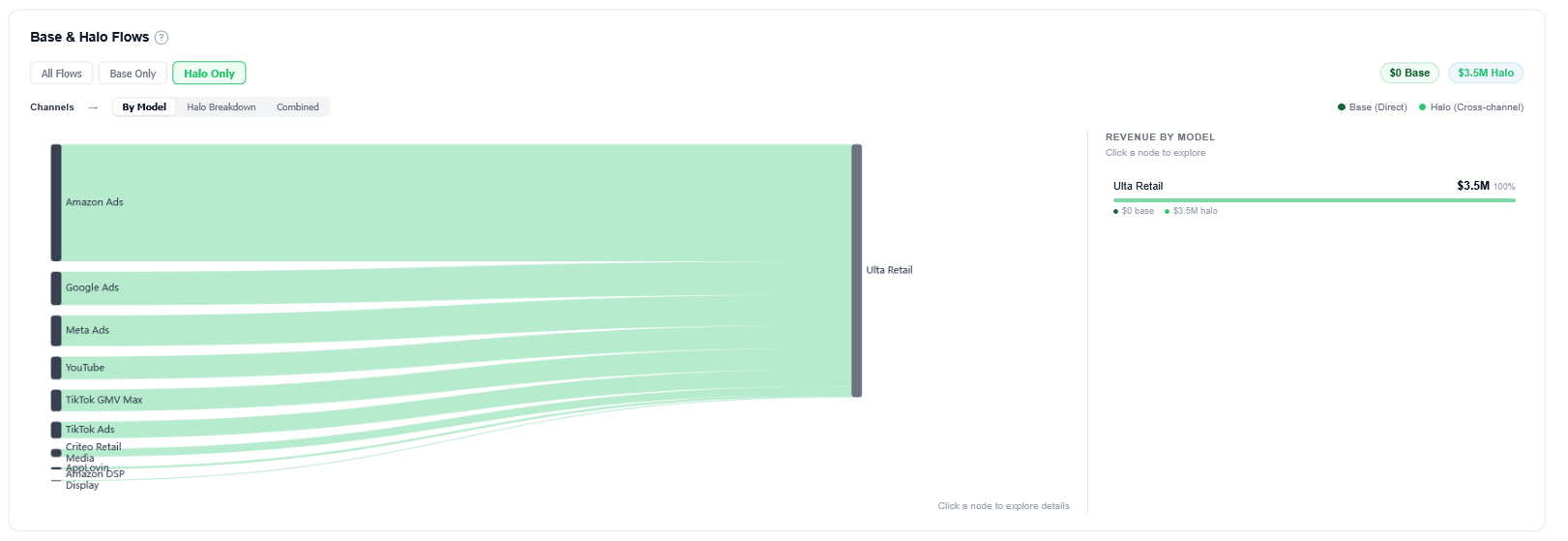
That's a halo effect, the same spillover concept Prescient already applies to conversions that happen without a click through branded and organic search, direct traffic, and Amazon, just showing up at a different retail partner. The mechanic isn't new. What's new is recognizing that it's happening at Sephora and Ulta specifically, and that most measurement setups have no way to catch it.
We talk about this risk a lot, but it holds here: a campaign that looks like it's underperforming through last-click DTC or platform-reported conversion reports might actually be the one feeding retail sales the brand can't see. Without visibility into that lift, the natural move is to cut the campaign, which means cutting the thing that was working.
Where Prescient comes in
Prescient's retail connectors cover Sephora and Ulta specifically, pulling in both website and in-store data so brands can see how each paid channel converts through each retailer rather than lumping "retail" into one box. Instead of guessing whether a campaign is working based on DTC conversions alone, brands get a campaign-level view of the lift that's showing up at the register and at checkout, wherever that shopper happens to be.
That kind of visibility changes which campaigns get cut and which get scaled, because the decision is based on where the revenue is actually landing, not just where it's easiest to track. If you want to see what that looks like on a live screen with a real brand’s anonymized data, book a demo and we'll walk you through it.
The Halo
Exclusive insights, every week.
Subscribe to The Halo for sharper marketing thinking.
You're subscribed to The Halo!
Quick question (optional): How familiar are you with MMM?
Thanks for sharing! Enjoy The Halo.
Keep reading
View all
What retail media attribution measures and what it misses
Read article
Commerce media is promising, but its measurement lags behind
Read article
A practical guide to omnichannel measurement for multi-channel brands
Read article
Your digital campaigns are driving retail sales. Here's how you measure them.
Read article
A marketer’s guide to in-house MMM builds vs vendor tools
Read article
What causes attribution bias in marketing and how to reduce it
Read article