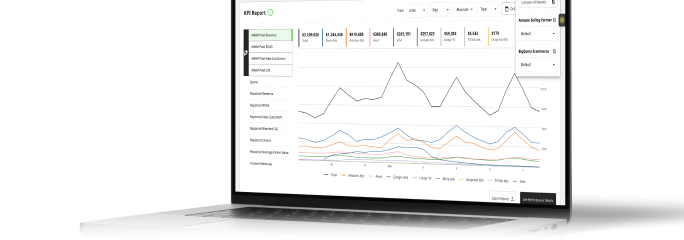



Data-driven attribution vs. MMM: How to measure what's actually working
See how each of these common measurement solutions measures marketing performance, where they differ, and when it makes sense for teams to use MMM alongside MTA
Linnea Zielinski · 12 min read

Your smartwatch tells you the second your heart rate spikes on a run. It counts steps, logs sleep stages, and buzzes when you've hit your activity ring for the day. It's precise, immediate, and great for adjusting your pace mid-workout. But it can't tell you if your cholesterol is creeping up, whether a new medication is doing its job, or how your overall health has trended over the past five years. For that, you need a full physical: bloodwork, a doctor looking at the whole picture, and enough historical data to spot a real pattern instead of a single data point.
Marketing measurement works the same way. Data-driven attribution is your smartwatch, built for reacting to what's happening right now. Marketing mix modeling is your annual physical, built for understanding what's actually moving the needle over time. Neither one replaces the other, and using the wrong one for the wrong question can send a team chasing the wrong numbers for months.
That comparison holds for how marketing mix modeling has worked for decades, and it's still a fair description of most models on the market today. But it's worth knowing upfront that not every marketing mix model actually runs on that slow cycle anymore. Traditional, regression-based models really do behave like an annual physical: useful, but only available on a fixed schedule. Newer, AI-driven models close a lot of that gap, refreshing daily and reporting at the campaign level instead of making you wait for the next check-up.
Choosing the right tool matters for your budget. Teams that lean entirely on attribution models to make budget calls tend to over-credit whatever channel is easiest to track, then pull spend from the offline and upper-funnel work that's actually driving business outcomes. Getting it right means every dollar in your marketing budget is working based on what's actually moving the business.
Key takeaways
- Data-driven attribution tracks individual, user-level digital paths using platform data and cookies, while marketing mix modeling uses aggregated historical data across both online and offline channels.
- Attribution models, including other multi touch attribution (MTA) methods, are built for fast, tactical decisions like campaign and creative optimization.
- Marketing mix modeling is built for slower, strategic decisions like budget allocation and marketing strategy, since it captures channels attribution simply can't see.
- Privacy regulations and ad blockers make user-level data collection increasingly unreliable, while marketing mix modeling stays privacy-first because it works from aggregated data rather than individual user data.
- The two methods aren't competitors. Most established marketing teams use both together.
- Traditional marketing mix modeling has its own limits, including an issue called baseline leakage, so it works best as part of a broader marketing measurement approach rather than the only tool in the toolkit.
- Not all marketing mix models work the same way: traditional, regression-based models refresh monthly or quarterly and report down to the channel level, while modern, AI-driven models like Prescient's refresh daily and report down to the individual campaign.
- Omnichannel brands with both retail and digital presence need marketing mix modeling in particular, since attribution models can't capture in-store sales or offline touchpoints influenced by digital marketing spend.
What is data-driven attribution?
Before comparing the two approaches side by side, it helps to know exactly what each one is measuring and how.
Data-driven attribution is a type of multi touch attribution model that uses algorithms, rather than a fixed rule, to divide conversion credit across every touchpoint in a customer's digital journey. Instead of handing all the credit to the last click or the first one, it looks at the entire customer journey and works out, based on patterns in your own collected data, how much weight each touchpoint actually deserves.
That puts data-driven attribution in a broader family of marketing attribution models that also includes simpler approaches like linear attribution, which splits equal credit across every touchpoint, and time decay attribution, which weights credit toward touchpoints closer to the sale. Data-driven attribution is generally considered the most sophisticated of the group, since it uses machine learning to find the patterns that actually exist in your data instead of applying a one-size-fits-all rule to every customer journey.
Where data-driven attribution earns its keep is in fast-moving, digital-only decisions:
- Reallocating budget between paid search, social, and display campaigns based on which is converting best right now.
- Testing and swapping out ad creative based on which version is driving more clicks along the user journey.
- Evaluating how specific audience segments are behaving across digital channels.
- Diagnosing a short-term dip or spike in campaign performance almost as soon as it happens.
The catch is that data-driven attribution can only track what it can see. It depends on cookies, device IDs, and tracking tags, which makes for a robust tracking infrastructure right up until a browser update, an ad blocker, or a privacy regulation breaks it. It also has zero visibility into offline touchpoints. A customer who sees a TV ad, hears a podcast mention, or walks past an in-store display never shows up in an attribution model's data.
What is marketing mix modeling?
Marketing mix modeling takes a fundamentally different approach to the same underlying question.
Instead of tracking individual users, marketing mix modeling (MMM) uses statistical analysis on aggregated historical data, comparing total marketing spend against total business outcomes over time, then layering in external factors like seasonality, pricing changes, and competitor activity that also influence sales. Because it works with aggregated data rather than user-level data, MMM can measure marketing channels that attribution models can't touch: TV, radio, print, out-of-home, and in-store retail media.
That's the classic version of marketing mix modeling, and it's still an accurate description of most models on the market. Traditional MMMs are built on regression analysis, a technique that's been around since the 1960s, and they tend to refresh monthly or quarterly while only reporting down to the channel level. If you want to know how your Facebook spend performed as a whole, a traditional model can tell you. If you want to know how one specific campaign inside that channel performed, you're often out of luck.
Where modern MMM comes in
Modern, AI-driven models change that math. Prescient's marketing mix model, for example, refreshes daily instead of monthly and reports down to the individual campaign level rather than stopping at the channel, layering multiple models together to capture how campaigns interact with each other. The historical trade-off with marketing mix modeling has always been giving up speed and granularity in exchange for a broader, privacy-first view. A modern MMM narrows that trade-off considerably without giving up any of the privacy or channel-scope advantages that make MMM valuable in the first place.
This is exactly why omnichannel brands lean so heavily on marketing mix modeling, whether traditional or modern. If your brand sells through retailers like Target, Ulta, or DICK'S Sporting Goods alongside your own site, a large share of your actual sales never generates a trackable digital user journey in the first place.
One of the most useful things a well-built, modern mix model can surface is retail halo effects: the offline and retail sales lift that happens because of digital marketing spend, even when no direct digital click gets the credit for it. A customer who sees a paid social ad and then buys the product at a retail store two weeks later would be invisible to attribution, but shows up clearly in a marketing mix model that's actually built to measure it.
Marketing mix modeling tends to be the better fit for:
- Setting overall marketing budget and deciding how to split it across all marketing channels, not just digital ones.
- Measuring true marketing effectiveness for channels without built-in tracking, like TV, radio, or retail media.
- Planning around seasonal periods and understanding how external factors like economic conditions affect marketing performance.
- Getting a privacy-first read on marketing impact that doesn't depend on cookies or user-level tracking at all.
- Getting campaign-level detail without losing the macro view, if you're working with a modern, AI-driven MMM instead of a traditional regression-based one.
Core differences: data-driven attribution vs. marketing mix modeling
Side by side, the practical differences come down to five things: how granular the data is, which channels each one can actually see, how resilient they are to privacy changes, how often the model refreshes, and what kind of decision each one is built to support. Since not all marketing mix models work the same way, it's worth splitting traditional MMM and a modern, AI-driven MMM like Prescient's out separately here.
| Data-driven attribution | Traditional MMM | Prescient's MMM | |
| Data granularity | User-level data: clicks, cookies, and individual paths | Aggregated historical data, typically reported down to the channel level | Aggregated historical data, modeled down to the individual campaign level |
| Channel scope | Digital channels only, wherever tracking tags function | Online and offline channels, including TV, print, and retail | Online and offline channels, plus retail halo effects other models don't isolate |
| Privacy and resilience | Vulnerable to ad blockers, browser restrictions, and privacy law | Privacy-first, since it doesn't depend on individual user data | Privacy-first, on the same aggregated-data foundation as traditional MMM |
| Refresh cadence | Near real-time | Monthly or quarterly, since regression models take time to run | Daily |
| Decision horizon | Day-to-day campaign and creative decisions | Macro budget planning, typically reviewed after the fact | Macro budget planning and campaign-level decisions, on a near-term cadence |
None of this makes data-driven attribution inherently better or worse than marketing mix modeling. It just means they're built to answer different questions, and that a modern MMM answers more of those questions on a faster timeline than a traditional one.
When to use data-driven attribution vs. marketing mix modeling
The short version: match the method to the size and speed of the decision you're actually trying to make.
- Use data-driven attribution when you need to adjust live digital campaigns, test creative, evaluate a specific audience segment, or react to a short-term shift in digital channels.
- Use marketing mix modeling when you're planning marketing budget at a macro level, evaluating long-term business outcomes, or trying to measure a channel that doesn't have built-in tracking.
- Lean toward a modern MMM specifically if you also want campaign-level detail and a near-daily read, not just a monthly or quarterly one. That's the use case a traditional, regression-based model simply wasn't built to handle.
In practice, the two methods work well together; there's no need to treat them as competing dashboards. A common claim is that incrementality testing exists to confirm which of the two is "right." That framing oversells what a single test can actually do. Incrementality tests are locally accurate but globally inaccurate: a well-run test can tell you a lot about one channel, one region, or one time window, but it can't tell you how your entire marketing mix is performing at once, and it definitely can't tell you what to do next. That's a job for marketing mix modeling.
A quick example: how this plays out for an omnichannel brand
It's easier to see how the two fit together with a concrete scenario in mind.
Say a beauty brand runs a six-week marketing campaign around a new product launch, spread across paid social, email, TV, and in-store retail displays. Data-driven attribution is watching the digital channels in real time. Within a day or two, it can tell the team that one Instagram creative is driving three times the click-through of everything else running, so the media buyer shifts more marketing budget toward it right away, adjusting marketing performance on the fly.
A traditional marketing mix model is working on a much longer clock. It won't have a clean read on this specific campaign until the following month's refresh, and even then, it can only tell the team how the TV channel performed as a whole, not how this particular launch campaign performed inside it. By the time that data arrives, the launch is already over and the budget decision is moot.
A modern, daily-refreshing MMM like Prescient's closes most of that gap. Partway through the six weeks, the team already has an early campaign-level read on the full marketing mix, not just the digital slice, showing that the TV spot and in-store displays are driving real sales lift alongside the digital push, including the retail halo effect from customers who saw the campaign online but bought in a physical store. By the time the campaign wraps, the team has two different but equally important pictures of the same launch: attribution's blow-by-blow view of the digital campaign, and the MMM's read on which combination of marketing channels actually built into a real lift in sales.
Neither read is wrong. They're just answering different questions about the same customer journey, at different points in the marketing measurement process, and each one is drawing on genuinely different customer behavior data to get there.
Where traditional MMM has to be honest about its limits
No marketing measurement method is perfect, and traditional marketing mix modeling has a limitation worth understanding before leaning on it entirely: baseline leakage.
Baseline leakage is a structural challenge for regression-based MMMs in particular, since they're built to enforce a clean separation between baseline and media effects that doesn't actually exist in the data. Prescient's model is built specifically to reduce this kind of baseline–media confounding rather than assuming it away.
Where Prescient comes in
The thread running through all of this is that "marketing mix modeling" isn't one fixed thing, and the model you pick determines how much of the traditional MMM trade-off you're stuck living with. Prescient's marketing mix model is built for omnichannel brands specifically: instead of tracing a customer journey through cookies, the way most attribution models do, it works from observable outcomes backward, starting with something like an actual storefront sale, so it can measure retail halo effects, in-store lift, and offline touchpoints that attribution was never built to see, all refreshed daily and broken out down to the campaign level.
Prescient's Media Forecaster then takes those modeled results and turns them into forward-looking budget guidance, showing how shifting spend between channels is likely to affect business outcomes before a team actually makes the move. We'll show you how the different features reveal hidden efficiency when you book a demo.
FAQs
What are the key differences between MTA and MMM?
Multi touch attribution (MTA) tracks individual, user-level data across digital touchpoints and assigns conversion credit algorithmically or by rule, while marketing mix modeling uses aggregated historical data across every marketing channel, including offline ones. MTA is fast and granular but limited to digital channels and vulnerable to privacy restrictions. Traditional MMM is slower and less granular, but it captures the full marketing ecosystem, including channels MTA can't track at all.
What are the four types of attribution?
The most common attribution models are first-click, which gives all credit to the first touchpoint; last-click, which gives all credit to the final touchpoint before conversion; linear attribution, which splits equal credit across every touchpoint; and data-driven attribution, which assigns credit algorithmically based on actual patterns in the underlying data. Some marketers also use time decay attribution, which weights credit toward touchpoints closer to the sale, as a fifth option.
What is the difference between data-driven attribution and last-click attribution?
Last-click attribution gives all the conversion credit to the final touchpoint before a sale, ignoring every other interaction that led up to it. Data-driven attribution spreads that credit across the entire customer journey based on statistical analysis of what each touchpoint actually contributed. It generally gives a more accurate read on marketing touchpoints that influence a sale early on, like an awareness-stage social ad, that last-click attribution would ignore completely.
What is data-driven attribution and how does it work?
Data-driven attribution is a machine learning-based attribution model that assigns conversion credit across every touchpoint in a customer's path, rather than relying on a fixed rule. It works by analyzing large volumes of platform data and collected data to identify statistical patterns, like which sequences of touchpoints most often lead to a conversion, then distributes credit accordingly for each individual customer journey.
Can you use data-driven attribution and marketing mix modeling at the same time?
Yes, and most established marketing teams do exactly that. Data-driven attribution handles fast, tactical decisions like campaign and creative optimization, while marketing mix modeling handles macro budget allocation and measures channels attribution can't see. Running both means marketing teams get quick, actionable insights for day-to-day digital marketing efforts alongside a more accurate picture of overall marketing effectiveness. Pairing attribution with a modern, daily-refreshing MMM like Prescient narrows the speed gap between the two even further.
What's the difference between a traditional MMM and a modern MMM?
A traditional marketing mix model uses regression analysis, refreshes monthly or quarterly, and only reports down to the channel level. A modern, AI-driven MMM like Prescient's refreshes daily, reports down to the individual campaign, and layers multiple models together to capture how campaigns interact with each other rather than treating each channel as a single black box. Both are built on the same aggregated, privacy-first foundation, but a modern MMM closes much of the speed and granularity gap that used to separate marketing mix modeling from attribution.
Which is better for measuring offline or retail sales, data-driven attribution or marketing mix modeling?
Marketing mix modeling is the better option by a wide margin, since data-driven attribution has no way to observe offline touchpoints or in-store transactions at all. MMM uses aggregated sales data to measure the impact of digital marketing spend on offline and retail channels, including retail halo effects, where a customer sees a digital ad but completes the purchase in a physical store. For any omnichannel brand, this offline visibility is the main reason marketing mix modeling belongs in the marketing measurement stack, and a modern MMM that isolates halo effects at the campaign level gives an even clearer read than a traditional, channel-level model.
The Halo
Exclusive insights, every week.
Subscribe to The Halo for sharper marketing thinking.
You're subscribed to The Halo!
Quick question (optional): How familiar are you with MMM?
Thanks for sharing! Enjoy The Halo.
Keep reading
View all
Marketing mix modeling vs. multi-touch attribution: Which one answers your question?
Read article
How full path attribution model works and when it's worth using
Read article
How a W-shaped attribution model works and when to use it
Read article
How the time decay attribution model works, when to use it, and where it falls short
Read article
MTA vs. holdout tests vs. Prescient: What each one can (and can't) tell you
Read article
What is position-based attribution, and when should you actually use it?
Read article