



Marketing efficiency vs. effectiveness: Why chasing one can cost you the other
Marketing efficiency and effectiveness aren't the same, and optimizing hard for one can cost you the other. Here's how to measure each of them and balance both.
Linnea Zielinski · 9 min read
The quickest route to work and the one that gets you there calm, caffeinated, and actually ready to perform aren't always the same route. Sometimes the fast way dumps you into traffic that has your blood pressure spiking before your first meeting. Sometimes the slower way, past the coffee shop and away from the highway, gets you through the door in a better headspace, even if it costs you ten extra minutes.
Marketing teams run into a version of this every time they build a marketing budget. You can optimize marketing spend for the cheapest path to a click or a lead, or optimize marketing activities for the path that actually builds a company worth running. Those two goals sound like they should point in the same direction, and sometimes they do. But they don't always, and that's the marketing efficiency vs effectiveness tension every marketing team eventually deals with. Mixing the two up means marketing decision making that looks smart in isolation while working against the business goals the company actually needs, and the damage often doesn't show up until months later.
Key takeaways
- Marketing efficiency measures how cheaply your marketing efforts get a result. Marketing effectiveness measures whether that result actually drives real business outcomes and real growth for the company.
- These two marketing metrics can pull against each other. Optimizing hard for efficiency can undercut effectiveness, and pouring resources into effectiveness can sometimes tank your efficiency metrics.
- A marketing dollar doesn't buy the same efficiency year-round. Seasonality changes what "efficient marketing" looks like from month to month.
- Marketing efficiency and marketing effectiveness often report to different budget owners inside the marketing department, which is part of why marketing teams treat them as competing priorities instead of complementary ones.
- A simple cost, quality, and speed framework can help your marketing team improve efficiency and find the right balance instead of guessing.
- Balancing marketing effectiveness and efficiency together requires measurement approaches that show both at once, not one metric standing in for both.
What marketing efficiency actually measures
Marketing efficiency is a measure of resource optimization: how little your company spends, in marketing budget, time, or effort, to produce a given result. It's the "doing things right" side of marketing performance, and it's usually the easiest side to put a number on, which is exactly why so many marketing teams default to it.
Marketing teams typically measure marketing efficiency through a handful of familiar efficiency metrics:
- Cost per acquisition, also called customer acquisition cost
- Cost per click, common in paid search and paid social
- Return on ad spend, or a higher ROAS on ad spend overall
- Cost per lead, useful for lead generation programs
These efficiency metrics earn their popularity because they're time efficient to measure and simple to compare week over week. If your cost per acquisition drops or your conversion rate climbs, you know almost immediately and can see the desired results fast, whether you're looking at online channels or offline channels like TV and out-of-home. That immediacy makes efficiency metrics the default language of weekly reporting meetings, even when the bigger question, whether the marketing investment is actually building the company, goes unanswered. A higher ROI on paper doesn't guarantee a healthier company, which is exactly why effectiveness exists as its own measure.
What marketing effectiveness actually measures
Marketing effectiveness asks a different question: is this marketing activity driving real business outcomes and more revenue, not just a good-looking number on a channel dashboard? Defining marketing effectiveness starts with asking whether marketing actually moved sales forward, not whether it looked efficient along the way. It's the "doing the right things" side of the equation, and it's a lot harder to measure cleanly.
To measure effectiveness well, you have to look past the channel that gets the credit and toward whether sales actually grew because of it. This holds at every stage of the marketing funnel, from top-funnel content marketing and brand awareness work down to bottom-funnel conversion pushes. Common ways of measuring marketing effectiveness include:
- Incremental revenue and incremental impact on sales
- Customer lifetime value and customer retention
- Market share and brand equity
- Brand awareness, brand building, and consideration
Measuring marketing effectiveness plays out over a longer time horizon than measuring efficiency does. A marketing campaign can look inefficient in its first month and still be building something that pays off for years, the kind of brand equity or customer retention that never shows up in a cost report. That time lag is part of why marketing effectiveness gets shortchanged in a lot of marketing budgets. It's harder to defend a long term value story when someone's asking for proof today. This is where brand teams get stuck: their work is building something real, but the tools to measure it lag behind the tools built to measure a cheap, efficient marketing sale.
Where these two goals start pulling against each other
These aren't just two ways to measure marketing performance. They're often in direct tension, and treating marketing efficiency vs marketing effectiveness as a simple checklist misses that entirely.
Push hard for efficiency, and you can end up with a marketing campaign full of cheap clicks that never convert into loyal customers or repeat sales. Push hard for effectiveness, and you can end up defending a brand campaign that builds real demand but looks rough on a weekly ROAS report. Neither outcome is the desired result on its own, and neither adds up to success for a brand trying to grow market share.
A brand that only chases efficient marketing campaigns tends to win the short-term sales numbers and lose the long-term market share. A brand that only chases effectiveness tends to build goodwill it can't afford to sustain.
One useful mental model here is a classic project management triangle: cost, quality, and speed. Lean hard into cost (efficiency), and you typically give something up on quality or speed. Lean hard into quality (effectiveness), and cost or speed usually takes the hit. You rarely get to max out all three at once, and a marketing budget works the same way. The real skill is understanding which trade-off your marketing team is making, and why.
Why efficiency isn't a fixed number
Marketing efficiency itself isn't static. A marketing dollar doesn't buy the same result in every month of the year, and the dollar count on a report can be misleading without that context.
Peak shopping periods drive up marketing costs. Impressions get more expensive as more brands compete for the same attention, so CPMs climb and efficiency metrics can look worse on paper. But demand is higher during those windows too, and conversion rate often climbs right alongside the cost. During slower seasons, the opposite happens: impressions get cheaper, efficiency metrics improve, but converting that cheaper attention into actual sales and revenue can be harder.
That means judging every marketing campaign against the same efficiency benchmark, year-round, sets marketing teams up to make bad calls. A campaign that looks inefficient in July might be performing exactly as expected for the season, and a campaign that looks efficient in November might be riding a seasonal tailwind that has nothing to do with the underlying marketing strategy behind it. Sustainable growth depends on reading efficiency in context. If you measure marketing costs and sales only against last month, without accounting for the season, you'll misread half your marketing campaigns.
Why this trade-off is so hard to manage inside real companies
Part of the reason marketing efficiency and marketing effectiveness get treated as opposites instead of complements comes down to something structural inside most marketing departments: they often sit in a different marketing function and measure marketing ROI in a different way.
Efficiency metrics tend to sit with performance marketing teams who can point to a clean number and say, "we lowered customer acquisition cost this quarter." Effectiveness is a tougher case to make. Someone arguing for a brand advertising investment or a retention play often can't offer that same certainty, even when the case for business growth is stronger. When one side of the argument comes with a tidy cost number and the other doesn't, the tidy number tends to win the marketing budget conversation, whether or not it should. Efficiency can start acting like a cost center argument even when the goal is company-wide growth.
Recognizing this is the first step toward fixing it. Marketing teams that build both effectiveness and efficiency measurement into the same reporting cadence, instead of letting one dominate a marketing budget conversation because it's easier to defend, tend to make better long-term calls for the company and the brand. An effective marketing strategy treats that reporting cadence as part of the strategy itself, not an afterthought.
How to actually balance marketing effectiveness and efficiency
Balancing marketing effectiveness and efficiency isn't about picking a side. Teams that only measure marketing efficiency get a narrow view of their marketing activities, and teams that only focus on measuring marketing effectiveness can't defend their marketing budget short term. An effective marketing strategy, in any marketing department, comes down to a few practical habits:
- Segment marketing spend by purpose. Treat short-term activation budget and long-term brand-building budget as two different pools with two different success criteria, instead of judging both against the same efficiency bar.
- Pair marketing metrics instead of reporting one alone. Every marketing campaign should show an efficiency number and an effectiveness number side by side, so a cheap result and a genuinely valuable result don't get confused for the same thing. This is especially true for brand building work, where a marketing investment that looks weak on efficiency can still be driving real sales down the line.
- Review the balance on a set cadence. The right balance between marketing efficiency and marketing effectiveness shifts as the company, the season, and the competitive landscape change, so last quarter's marketing strategies might not fit this quarter.
- Measure at the level where marketing decisions actually happen. Channel-level averages can hide what's really going on inside individual marketing campaigns, so the more granular the measurement, the easier it is to see where efficiency and effectiveness genuinely align. Using the right tools here makes the difference between a guess and an actual answer.
Where Prescient comes in
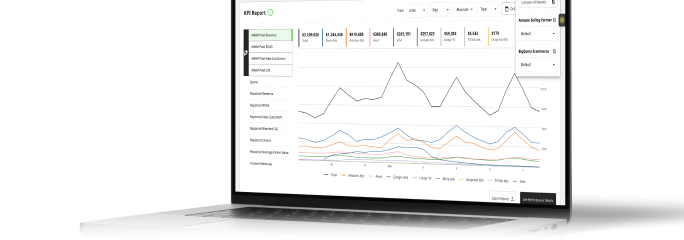
Balancing marketing efficiency and marketing effectiveness gets a lot easier when your measurement can show both at once. Prescient's marketing mix modeling works at the campaign level, not just the channel level, so you can see how a specific marketing campaign performs on cost alongside the incremental revenue it actually drove, including halo effects that land in branded search, organic search, direct traffic, and retail storefronts well after someone first saw the ad. That's a different picture than platform reporting alone can offer, since ad platforms report what happened inside their own walls, not what a campaign contributed to sales and revenue across the whole company.
Daily model updates mean your marketing team isn't waiting on a quarterly review to find out whether a campaign that looked efficient last month is actually paying off in revenue this month, or whether a campaign that looked expensive is building demand that will show up later or somewhere else. Book a demo and we'll walk you through how it works with a live screen and a real brand's anonymized data.
FAQs
What is the difference between effectiveness and efficiency in marketing?
Efficiency measures how cheaply and quickly your marketing efforts get a result, using metrics like cost per acquisition, cost per click, and return on ad spend. Effectiveness measures whether that result actually drives real business outcomes, using metrics like incremental revenue, customer lifetime value, and market share. Efficiency is about doing things right, and effectiveness is about doing the right things. The two aren't interchangeable, and a marketing campaign can score well on one while falling short on the other. Effective marketing strategies measure both instead of leaning on marketing costs alone, since marketing efforts that look cheap in isolation aren't automatically the marketing activities worth repeating. If you only measure one side, you're only getting half the picture.
What is the 3-3-3 rule in marketing?
The 3-3-3 rule doesn't have one universal definition. Depending on the source, it can refer to grabbing attention in three seconds, holding interest for three minutes, and building trust across three touchpoints, or to a messaging framework built around three key messages, three audience segments, and three marketing channels. Both versions share the same underlying idea: keep marketing activities focused on a small number of priorities instead of trying to say everything to everyone at once.
Which comes first, efficiency or effectiveness?
Neither one universally comes first, since it depends on where a marketing campaign or channel is in its lifecycle. Effectiveness usually needs to come first at a strategic level, since there's little point in efficiently scaling something that isn't actually working. Once a marketing effort is proven effective, efficiency work can help your company get more out of it for less. Chasing efficiency before you've established effectiveness just means you're getting cheaper results out of something that might not be worth doing at all.
What is marketing efficiency?
Marketing efficiency is a measure of how well a marketing team uses its resources, marketing budget, time, and effort, to produce a given output. It's typically tracked through metrics like cost per acquisition, cost per click, and return on ad spend, and it tends to be measured over shorter time horizons than effectiveness. High marketing efficiency means you're getting a lot of output for a relatively low input, though it doesn't guarantee that output is actually valuable to the company. That's why the strongest marketing strategies pair efficiency with effectiveness rather than measuring marketing efficiency on its own, and why so many marketing teams end up measuring marketing effectiveness right alongside it.
The Halo
Exclusive insights, every week.
Subscribe to The Halo for sharper marketing thinking.
You're subscribed to The Halo!
Quick question (optional): How familiar are you with MMM?
Thanks for sharing! Enjoy The Halo.
Keep reading
View all
Funnel strategy for digital marketing: How to build one where every stage earns its budget
Read article
How to improve direct mail response rates (& count the responses you're missing)
Read article
How effective is direct mail marketing? What the numbers show and what they miss
Read article
Top of funnel vs bottom of funnel: How they differ and how to balance your budget
Read article
Modern marketers need to be doing marketing scenario planning
Read article
How to actually optimize your ad spend (not just cut waste)
Read article