




How effective is direct mail marketing? What the numbers show and what they miss
How effective is direct mail marketing? See realistic response rates, when direct mail works, common mistakes, and why much of its revenue goes untracked.
Linnea Zielinski · 11 min read
A movie trailer almost never sells a ticket on the spot. You watch it, forget about it, and three weeks later you're streaming that film at home through a service that has no idea the trailer ever reached you. The trailer did its job, and nobody's reporting gave it credit.
Direct mail marketing works the same way. A postcard lands on the kitchen counter, sits there for two weeks, and then someone adds your product to an Amazon cart or grabs it off a shelf at the store. No code gets entered and nothing gets scanned, so the mail piece looks like it did nothing.
Businesses that judge direct mail marketing only by what they can trace—codes redeemed, links clicked—tend to cut or underfund a channel that's paying for itself somewhere else, and the money moves to marketing channels that are simply easier to count.
Key takeaways
- Direct mail marketing still works, but mostly for businesses with a defined target audience, enough margin or lifetime value to cover the cost per piece, and the patience to send more than once.
- Response rates swing widely depending on your mailing lists, so a single "average" isn't a useful target.
- Response rate and effectiveness are different things, since most customers who buy after getting a direct mail piece never scan the code or type in the offer.
- A large share of direct mail's revenue lands in places the mail piece can't follow, like Amazon and retail stores.
- For one omnichannel brand in the Prescient platform, direct mail's own reporting showed a 1.31 ROAS while its Modeled ROAS came in at 8.37.
- Promotions in direct mail campaigns shift when customers buy, so the weeks before and after an offer matter as much as the spike during it.
- Measuring direct mail alongside your other marketing channels shows whether it's worth scaling and how far you can push it.
Is direct mail marketing still effective?
Yes, with conditions. Physical mail has a few built-in advantages over digital advertising right now:
- Less competition. Inboxes, social media feeds, and pop-ups are crowded enough to cause ad fatigue, and a piece of physical mail has far less to compete with.
- It demands attention. Unlike digital ads, a piece of mail has to be picked up and handled, even if it's on its way to the recycling bin.
- Shelf life. A good catalog or postcard can sit on a counter for weeks. That physical presence gives it a shot at being there when the need shows up, and it builds brand recognition in the meantime.
- Easier to process and remember. Research commissioned by Canada Post in 2015 found that direct mail took 21% less mental effort to process than digital media and was easier to recall. The United States Postal Service has funded similar research, and both studies are now a decade old.
The most common pushback is personal: "I throw mine away, so it can't work." There are two problems with that. Your own habits aren't a sample of your target audience. And "responding" to direct mail advertising is the rare path, since most potential customers who are moved by it buy later and somewhere else.
What direct mail response rates can you realistically expect?
It depends almost entirely on who's on your mailing lists, and then on what a response is worth to you.
House lists vs. prospect lists
Mailing lists come in two types, and the split that matters most is whether the people on them already know you. Average response rates from the Association of National Advertisers (ANA) are the most widely quoted, though different editions of the report and the vendors citing them give slightly different figures.
| List type | Who's on it | Commonly cited response range |
| House list | Existing customers, lapsed buyers, and loyalty program members | Roughly 5% to 9% |
| Prospect list | Potential customers who haven't bought from you yet | Roughly 2% to 5% |
Treat these as rough guideposts. Format, offer, and timing all move the number, and a first direct mail campaign to a cold list can land well below the range.
Why response rate alone is a poor scorecard
A response rate only means something next to your printing and distribution costs and what a customer is worth. Here's a quick break-even check for a 10,000-piece postcard drop where each piece of mail costs $0.60, or $6,000 all-in:
| Scenario | Profit per customer | Orders needed to break even | Break-even response rate |
| $90 order, 50% margin, one purchase | $45 | 134 | 1.34% |
| Same customer buys three times in a year | $135 | 45 | 0.45% |
| $20 order, 50% margin, one purchase | $10 | 600 | 6% |
The same 1% response is a win in the second row and a loss in the third. That's why direct mail's cost-effectiveness comes down to profit per piece and repeat purchases, and why response and conversion rates can mislead you on their own.
When direct mail marketing works and when it doesn't
The math above points to a pattern in where direct mail is a cost-effective way to reach customers.
| Situation | Fit | Why |
| Higher-priced or repeat-purchase products with a clear target audience | Strong | Customer value covers the cost per piece |
| Winback and retention direct mail to customers who've bought before | Strong | You already know they buy, and they may have tuned out your emails |
| Triggered direct mail, like a postcard after an abandoned cart | Strong | The piece arrives while the purchase is still on their mind |
| Local businesses mailing nearby households | Moderate | Geography does the targeting, but the offer has to be specific |
| Low-priced products sent to a broad audience | Weak | Break-even response rates climb out of reach |
| A single small send | Weak | Too few pieces and too few touches to learn anything |
What you send matters too, and each direct mail format suits a different job.
| Format | Best for |
| Postcards | Low-cost reach and simple offers, since there's nothing to open |
| Letters | A personal touch for existing customers and higher-value prospects |
| Self-mailers | More room for detail without the cost of an envelope |
| Catalogs | Browsing across a product range |
| Dimensional mailers | Boxes or tubes that get opened, saved for your most valuable prospects |
Common mistakes that make direct mail campaigns look ineffective
Plenty of businesses try direct mail marketing once, see nothing, and write off the channel. The cause is usually one of these:
- Sending once. Direct mail campaigns generally need at least three touches. If you send direct mail to 3,000 households once, you'll usually do worse than mailing 1,000 of them three times.
- Testing too small. At a 1% response, a 200-piece mail campaign produces two orders, which is too few to learn which offers resonate.
- Putting a digital ad on paper. "20% off, visit our site" gives nobody a reason to keep reading, however eye-catching the design. Lead with something useful or specific to the recipient.
- Skimping on mailing lists. Great creative can't rescue direct mailers sent to the wrong target audience.
- Calling it too early. Direct mail takes days to arrive and can sit for weeks before someone acts on it.
- Running it in isolation. Combining direct mail with digital campaigns, like email follow-ups or social media ads shown to the same households, gives customers more than one nudge.
- Counting only redemptions. This one's big enough to need its own section.
Why direct mail marketing is so hard to measure
Digital channels hand you clicks and conversion rates. Physical mail, like broadcast media, has no click to follow, so getting measurable results takes workarounds that each see only part of what happened.
What codes and matchback catch
Most businesses start with one of three tools that track customer engagement with the piece itself, and each has a blind spot.
| Method | What it captures | What it misses |
| Promo codes | Customers who type in the code | Customers who forget the code, use a different one, or pay full price |
| QR codes and custom URLs | Website traffic that comes straight from the direct mail piece | Everyone who opens a search engine and types your name instead |
| Matchback | Customers whose name and address match your mailing list | Sales in stores and on online platforms like Amazon, where you can't see who bought |
Matchback has a second problem: it credits direct mail for every customer on the list who purchased, including those who would've bought anyway.
Where holdout tests help and where they fall short
Holding back a random slice of your list and comparing its purchases against the mailed group is the usual next step, and it's a step up from counting codes. It comes with limits of its own:
- It's a snapshot of one mail campaign, one offer, and one season.
- Most tests run for a few weeks, and direct mail can keep working well past that.
- It only sees purchases you can tie to a person, which leaves out Amazon and most retail sales.
- It can't tell you what happens when you double the size of your direct mail campaigns.
How direct mail promotions shift the timing of sales
If your direct mail piece carries a discount, it changes when customers buy as well as whether they buy. Some who would've ordered next month order now, which pulls demand forward and leaves the following weeks soft. Others who've learned to expect your offers hold off until one arrives, which thins out the weeks before it.
Either way, the spike during the offer window overstates what the promotion added. Compare the weeks on both sides of it before planning your next campaign, and remember that a discount comes out of your margin too.
Where the rest of the direct mail revenue goes
Someone who gets your postcard might search your brand name a week later, click a paid search ad, and buy. They might skip your site and order on Amazon because their card's saved there. They might pick the product up on their next store run. In each case the sale gets credited to another channel—branded search, organic traffic, or a retailer's register—and the direct mail piece gets nothing.
At Prescient, we call this a marketing halo effect: revenue a campaign drives indirectly through another channel. Halo effects aren't limited to marketing campaigns built for brand awareness, but direct mail, with no click at all, is especially prone to them.
What direct mail performance looks like in the Prescient platform
We've seen direct mail perform well for brands in the Prescient platform, and one omnichannel client's recent numbers show how much of that performance can sit outside the channel's own reporting. The figures below cover four weeks for a brand that sells through its own site, Amazon, TikTok Shop, and national retailers.
The gap between reported and modeled revenue
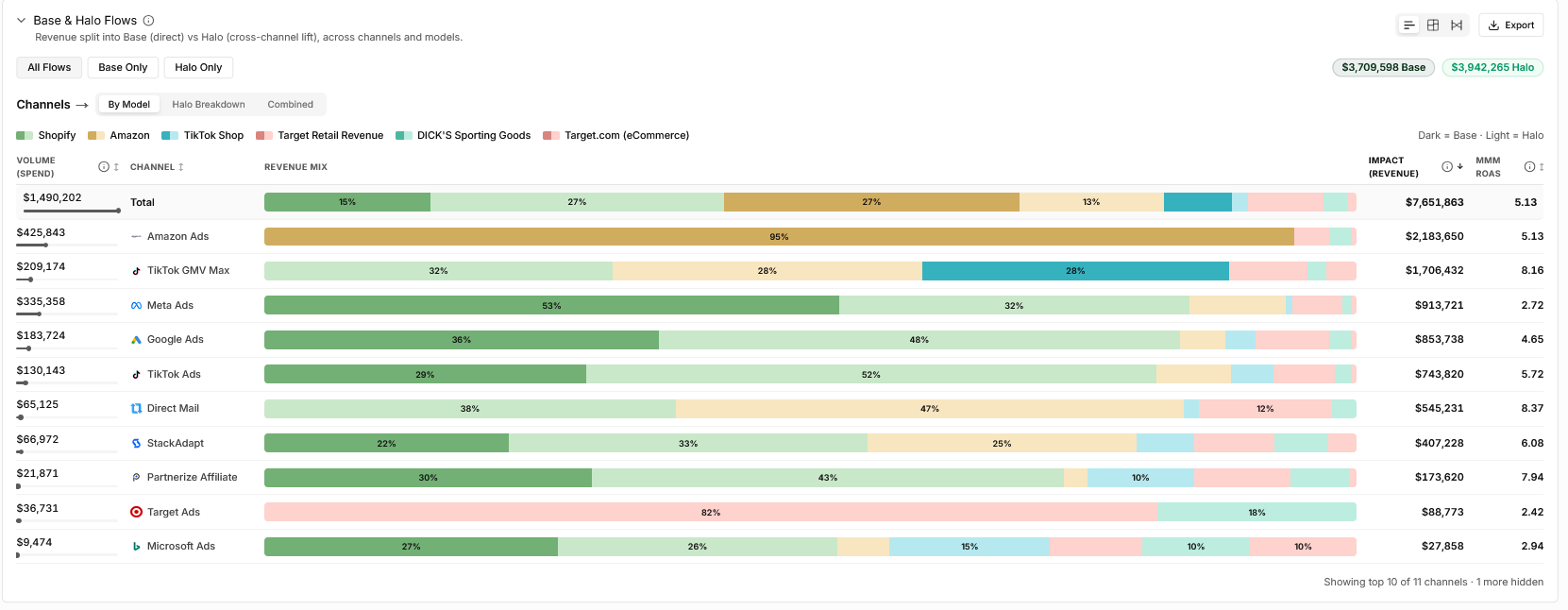
The brand spent $65,125 on direct mail over the period. Here's how the channel's own reporting compared to what Prescient's marketing mix model (MMM) measured:
| Channel-reported | Prescient's model | |
| Revenue | $85,151 | $545,231 |
| ROAS | 1.31 | 8.37 (Modeled ROAS) |
On the reported numbers, this channel barely pays for itself and would be an easy cut. The model measured about 6.4 times more revenue.

Where the revenue landed
In the platform, revenue splits into base revenue, which comes from direct engagement with a campaign, and halo effects. All of direct mail's modeled revenue showed up as halo effects, spread across the places this brand sells:
| Where the sale happened | Share of direct mail's modeled revenue |
| Amazon | 47% |
| The brand's Shopify store | 38% |
| Target stores | 12% |
| DICK'S Sporting Goods and TikTok Shop | About 3% combined |
More than 60% of that revenue landed somewhere a promo code or QR code pointing to the brand's site could never have seen.
How it compared to other marketing channels
Direct mail was a small line in a $1.49 million budget for the period. It took 4.4% of spend and drove 7.1% of the revenue the model attributed to marketing. Its Modeled ROAS was also the highest of the brand's ten largest channels, ahead of its Amazon ads, social media campaigns, and search.
How much room there is to scale
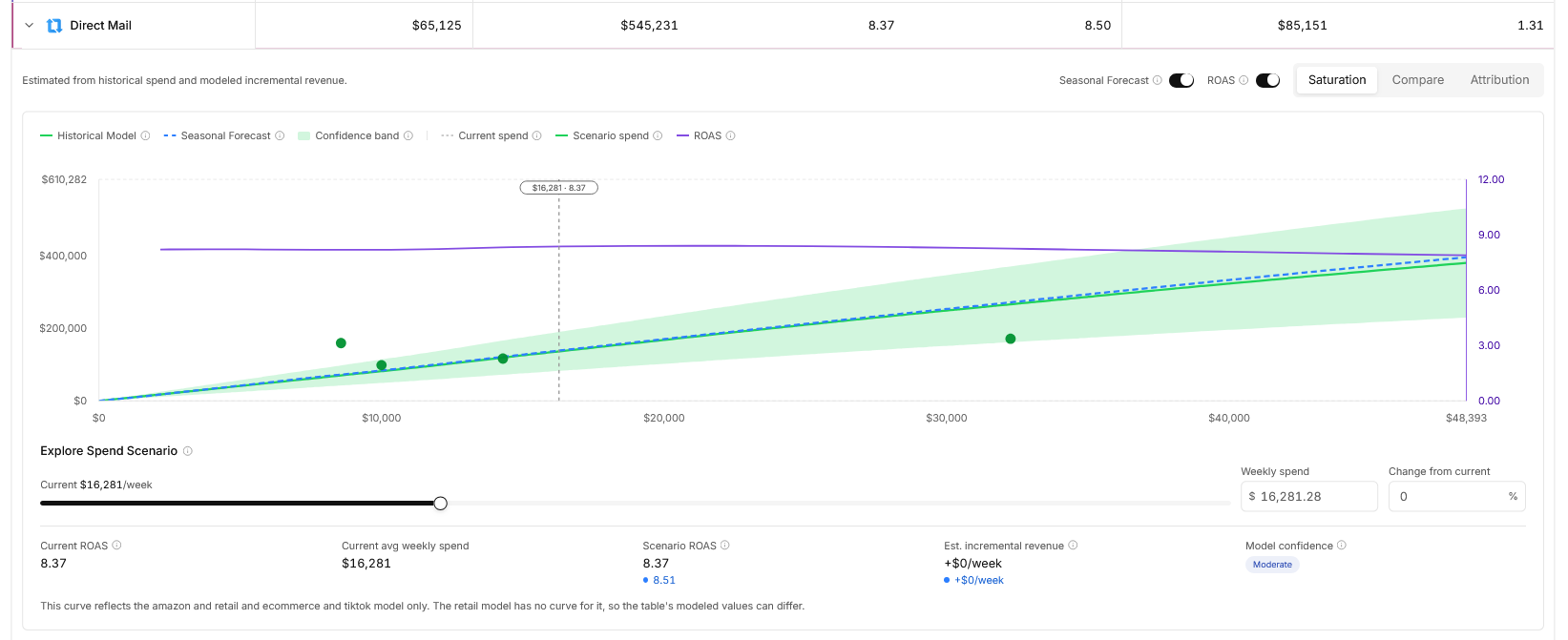
A high return matters less if a channel's already tapped out, so the platform also estimates how returns change as spend grows. This brand averaged $16,281 a week on direct mail, and its marginal ROAS—the estimated return on spend added beyond the current level—was 8.50, slightly above the average. The saturation curve stayed close to a straight line out to roughly three times that weekly spend.
Two things keep that from being a blank check. The confidence band, which is the shaded range around the forecast, widens as spend moves past levels the brand has tried. And the model confidence rating, a separate score for how much weight the estimate can bear, was Moderate for this channel.
One brand over four weeks isn't a benchmark, and results from your own direct mail campaigns will depend on your product, list, and offer. What it does show is how wide the gap can be between what direct mail gets credit for and what it drives.
Where Prescient comes in
Prescient's MMM measures direct mail in the same model as your digital ads, search, and retail media campaigns, across your own site, Amazon, and retail partners. It starts from the sales you can observe in each of those places and estimates what drove them, so a channel with no click gets measured the same way as one with thousands. Results update daily and go down to the campaign level, with base revenue and halo effects broken out for each.
From there, Media Forecaster shows what's likely to happen if you scale your direct mail budget or shift money into it from other channels, along with how confident the model is in that forecast. If you're incorporating direct mail into your marketing strategy and want to see how our platform can reveal what it's driving, book a demo with our team.
FAQs
What is the success rate of direct mail marketing?
Commonly cited benchmarks put response rates at roughly 5% to 9% for direct mail sent to a brand's own customers and 2% to 5% for mail sent to prospects, though figures vary by source, format, and offer. Response rate is only part of the story, since many customers who buy because of direct mailers never use the code or link. A better test of success is whether the revenue a mail campaign drives across every place you sell outweighs what you spent on it.
Is direct mail advertising still effective?
Yes, for the right brand. Direct mail advertising can be a powerful tool when a customer is worth enough to justify a higher cost per contact than digital marketing, when you can identify who to mail, and when you send more than once. Its cost-effectiveness drops quickly for low-priced products mailed to a broad audience.
What are common mistakes when using EDDM?
Every Door Direct Mail (EDDM) is a United States Postal Service program that delivers your direct mail piece to every address on the carrier routes you choose, with no mailing list required. The most common mistakes are choosing routes for convenience over customer fit, using a generic offer, sending a single drop, and having no plan for measuring results. Because EDDM goes to every household without names attached, it's especially hard to trace sales back to it.
What is the 40/40/20 rule in direct mail marketing?
It's a long-standing direct-response guideline that says about 40% of a direct mail campaign's success comes from the list, 40% from the offer, and 20% from the creative. The exact percentages are a rule of thumb, but the priority order holds up: who you mail and what you offer them matter more than an eye-catching mail piece.
How do you measure direct mail ROI?
Start with promo codes, QR codes, and matchback, and treat what they report as a minimum. Then look at total revenue across your site, Amazon, and retail in the weeks after direct mail lands, including the weeks around any promotion. For a fuller answer, measure direct mail in a marketing mix model alongside your other channels, which can pick up the sales that happen with no code and no click.
Is direct mail better than email marketing?
They do different jobs. Email marketing costs almost nothing per send, which makes it the default for staying in touch with customers who already buy from you. Physical mail costs far more per contact, but it gets noticed by loyal customers who've tuned out their inbox and can reach potential customers you have no email address for. A direct mail marketing strategy tends to work better alongside email than as a replacement for it.
The Halo
Exclusive insights, every week.
Subscribe to The Halo for sharper marketing thinking.
You're subscribed to The Halo!
Quick question (optional): How familiar are you with MMM?
Thanks for sharing! Enjoy The Halo.
Keep reading
View all
What is agile marketing? A guide for modern marketing teams
Read article
Your marketing channel strategy is shaped by what you can measure
Read article
Conversion rate marketing: the complete guide for modern brands
Read article
Zero-party data vs first-party data: Understanding the difference and why both matter
Read article
How to actually optimize your ad spend (not just cut waste)
Read article
How to plan a multi-channel marketing campaign that actually works together
Read article