


8 types of data-driven marketing solutions worth adding to your stack in 2026
From CRMs to predictive analytics like Prescient, here's a breakdown of the data-driven marketing solutions worth evaluating for growing your brand in 2026.
Linnea Zielinski · 12 min read
A plant doesn't grow well just because it gets watered. It also needs the right amount of sun and soil with the nutrients it actually needs, not just any dirt on hand. Give it plenty of water but poor soil and it still won't thrive. Understanding each factor on its own only gets you so far. The real payoff comes from understanding how they work together and what that means for the next steps toward a healthier, more productive garden.
Marketing works the same way. Brands collect customer data from a dozen different sources, but data sitting in separate systems doesn't do much for your bottom line on its own. What matters is whether your team can turn all of that information into a clear next move, whether that's a new audience segment, a shift in ad spend, or a change to your marketing strategy heading into next quarter. That's even more critical when the economy looks shaky because the brands that can act on their data fastest tend to be the ones that pull ahead when budgets tighten.
Key takeaways
- Data-driven marketing solutions fall into several categories, from predictive analytics to CRMs, CDPs, and testing platforms, each with its own named tools worth reviewing.
- Most tools stop at reporting on what already happened. Fewer help you plan what to do next with your budget.
- A data driven marketing approach depends on more than software. It also depends on clean data collection, reliable data sources, and a marketing team willing to act on what the data shows.
- Forecasting platforms, including marketing mix models, use your brand's historical marketing data to forecast outcomes before you spend a dollar.
- Scenario planning tools let you model different budget scenarios and compare projected outcomes before committing real ad spend.
- Tracking actual campaign performance against projections helps you build trust in a data driven marketing platform over time.
- Omnichannel brands need tools that account for spillover effects across retail and marketplace channels, not just the channel where an ad ran.
- Choosing the right mix of tools depends on your team's size, your existing systems, and whether you need reporting, forecasting, or both.
What are data-driven marketing solutions?
Data-driven marketing tools are the platforms and technologies that help brands collect, analyze, and act on customer data instead of relying on gut instinct or traditional marketing approaches. That can mean anything from a customer relationship management system that stores purchase history to a marketing mix model that forecasts campaign performance.
The common thread across these platforms is that they replace guesswork with evidence. Instead of assuming your marketing messages are landing with the right audience, you can look at real data points and marketing data to see what's actually happening with customer behavior and campaign performance, for example. That shift is part of why so many marketing teams have made building a data driven culture a priority, even when their existing systems weren't originally built with that in mind.
Why is data driven marketing important right now
Marketing budgets aren't growing the way they used to, and that alone explains why data driven is a term that just keeps coming up in planning meetings. When every dollar of ad spend has to justify itself, teams relying on traditional marketing methods or last year's averages tend to fall behind teams that can point to real data sources for their decisions.
There's also a data quality problem sitting underneath all of this. Third party data providers, cookie deprecation, and shifting data privacy regulations, like the California Consumer Privacy Act and the General Data Protection Regulation, have made some of the data marketers used to lean on less reliable. Building robust data governance practices and prioritizing data accuracy over data volume has become part of the job for marketers, who can't always hand this over to an analytics team.
None of this works without consistent data collection in the first place. A marketing strategy built on data sources that have gaps will always produce shaky insights, no matter how advanced the platform analyzing customer data and performance metrics is. This is the true core of data driven marketing: steady data collection and clean data sources a marketing strategy can actually act on.
8 types of data-driven marketing solutions to know
Not every tool in this space does the same job, and that's exactly why so many marketing teams end up with a patchwork of platforms that don't talk to each other. Here's a breakdown of the main categories worth knowing, along with a couple of named solutions worth reviewing in each.
1. Predictive analytics and marketing mix modeling platforms
These platforms don't just report on what happened. They use machine learning algorithms and past performance data to forecast what's likely to happen next, and, in the case of a marketing mix model, they can point to specific budget changes that would improve your results.
- Prescient AI: Built for omnichannel brands, including those with a meaningful footprint on Target, Walmart, Ulta, and Sephora alongside their direct-to-consumer channels. Rather than analyzing each channel in isolation, Prescient's model looks at how spend on one channel ripples into organic and branded search, direct traffic, and retail or marketplace revenue you might otherwise miss.
- Recast: Another marketing mix modeling provider in the space, worth knowing about if you're comparing options for teams with in-house data science support.
A few features worth understanding if you're evaluating Prescient specifically:
- Saturation curves: These show how each campaign responds to spend at different levels, since not every campaign saturates the same way or at the same point.
- Confidence scores: A metric that helps you understand how much certainty sits behind a given recommendation, based on how much historical data is available for that campaign.
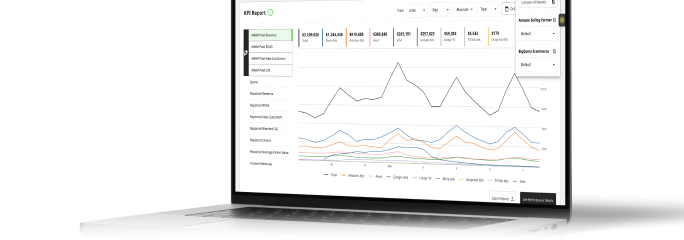
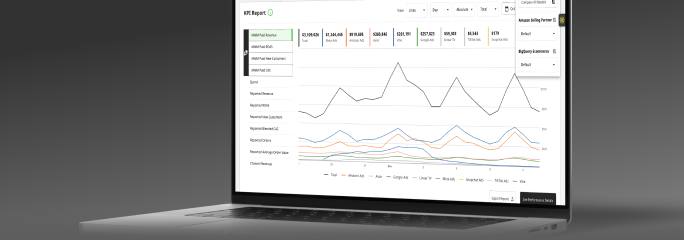
- The Optimizer: This is where scenario planning happens. Using your brand's own historical performance data, the Optimizer feature generates specific recommendations for reallocating or increasing budget across campaigns to help you hit a realistic goal.
The scenario planning piece deserves a closer loo, because it's the part that separates a predictive tool from a descriptive one. Instead of guessing what might happen if you shift budget from one campaign to another, you can model that scenario directly in the platform and see a forecasted outcome before you spend anything. If you decide to act on a recommendation, you're not done once the budget shifts. You can track how actual performance compares to what the platform projected, turning a one-time optimization into an ongoing feedback loop your marketing team can build trust in over time.
No matter which platform you pick, it needs to update in near real-time. A model built on customer behavior and marketing data from a year ago, or even last month, won't reflect how people are responding to your marketing campaigns today, so a data driven marketing platform needs to analyze data on a rolling basis.
2. Customer relationship management systems
A customer relationship management system, or CRM, is usually the foundation of a data driven marketing strategy. These platforms store customer information like purchase history, contact details, and past customer interactions in one place so your marketing team and sales team are working from the same source of truth.
- Salesforce Sales Cloud: A widely used CRM for storing customer records, tracking the sales pipeline, and keeping marketing and sales teams aligned.
- HubSpot CRM: A common choice for growth-stage brands that want a CRM bundled with built-in marketing and sales tools.
3. Customer data platforms
Customer data platforms, or CDPs, take the CRM concept a step further by unifying data from your website analytics, email platform, and social media platforms into a single customer profile. That's useful for building specific customer segments based on customer preferences and behavior, but a CDP on its own doesn't tell you where to spend your next ad dollar. It's a foundation, not a decision-making tool.
- Salesforce Data Cloud: Unifies customer data from across your systems into a single, actionable profile.
- Segment (Twilio Segment): A CDP many marketing teams use to collect customer data once and route it to the rest of their stack.
4. Marketing automation platforms
These platforms power the operational side of marketing, like a workflow that triggers a series of marketing messages based on a shopper's purchase history, or a flow that helps you deliver personalized messages after someone abandons a cart. That kind of automation is useful for customer engagement, and it can even help lower customer acquisition cost over time by making existing marketing channels work harder.
- Klaviyo: Popular with ecommerce brands for triggered email and SMS flows tied to purchase history and browsing behavior.
- Braze: A customer engagement platform used for cross-channel messaging, including push, email, and in-app.
Automation is still focused on execution, though, not on telling you which channels deserve more of your budget in the first place. Tracking customer lifetime value alongside these workflows can help you spot which customer engagement plays are actually worth scaling.
5. Identity resolution and data enrichment platforms
Identity resolution tools connect the dots between different data sources so you can recognize the same customer across devices and channels. (You can check out our guide to identity graphs if you want to understand how this process works.) Data enrichment platforms add another layer by pulling in third party data providers to fill in gaps, like adding demographic or firmographic details to an existing customer base.
- Acxiom Customer Intelligence: Connects identity across data sources and appends demographic detail to existing customer records.
- LiveRamp: An identity resolution and data collaboration platform used to match customer records across systems and partners.
Poor data quality and duplicate records make it hard to trust anything downstream, and these platforms can help solve that problem. But identity resolution is about improving data accuracy, not about telling you what to do with the insights once your data is clean. Data integration across multiple sources is genuinely one of the harder parts of this whole category, and it's what makes every other tool on this list more useful.
6. B2B intent and firmographic data platforms
If your brand sells to other businesses, firmographic and technographic data providers help you understand which companies are showing buying signals before they ever fill out a form. These tools are especially useful for target specific customer segments in industries where the sales cycle is long and the deal sizes are large.
- HG Insights: Provides firmographic and technographic data used to identify B2B buying signals.
- ZoomInfo: A common source for company and contact-level data in B2B prospecting and market research.
The tradeoff is that this category is narrow by design. It's built for B2B marketing operations, so ecommerce and consumer brands generally won't get much value from it.
7. Marketing experimentation and testing platforms
Testing platforms let you isolate one variable, such as pausing a channel in a specific region, to see what happens to conversions. These tests can offer real world data points about how a channel is performing in that moment.
- Optimizely: An experimentation platform used for on-site A/B testing and personalization.
- VWO: Another testing platform brands use to run on-site experiments and compare variations.
The catch is that incrementality tests are a snapshot, not a forecast. They tell you what happened in the specific window and market you tested, but they don't necessarily predict what will happen next quarter or in a different region. They're a helpful data source, but they work best alongside a broader measurement approach rather than as a replacement for one, especially since running enough of them to cover every campaign would eat up marketing efforts better spent elsewhere.
8. Business intelligence and visualization tools
Data visualization tools take marketing data from multiple systems and turn it into dashboards and charts your team can actually read. These platforms are great for spotting trends in campaign performance or website analytics at a glance.
- Tableau: A widely used business intelligence tool for building dashboards across data sources.
- Looker: A BI platform that connects to a brand's data warehouse for ongoing reporting.
Where these tools tend to fall short is depth. A dashboard can show you that a campaign's performance dropped last month, but it usually can't tell you why, or what budget change would fix it. Even the most polished analytics tools on the market are pulling from the same underlying data sources as everything else in your stack, so the quality of your data insights still depends on what's feeding the dashboard. For genuinely meaningful insights you can act on, you need a tool built specifically for prediction, not just visualization, which is why it's worth circling back to the first category on this list.
How to choose the right data-driven marketing tools for your brand
There isn't a single tool that covers every job on this list, and trying to force one platform to do everything usually leads to disappointment. A more useful approach is figuring out which gaps in your current stack are costing you the most, then working backward from there.
A few questions worth asking as you evaluate options:
- Do you need help unifying customer data, or do you already have that and need help acting on it?
- Are you an omnichannel brand with retail or marketplace revenue that your current tools aren't capturing?
- Does your marketing team need forecasting and scenario planning, or is reporting on past performance enough for now?
- How much of your budget planning still relies on averages or last year's numbers instead of a forward-looking model?
- Is your data collection consistent across marketing channels, including social media ads and social media engagement, or are there gaps that would throw off a model?
It's also worth thinking about how each tool fits into your broader business strategy, not just your marketing strategy for the current quarter. A data driven strategy that only covers one channel will always leave blind spots, especially for brands managing marketing campaigns across paid social, retail media, and traditional marketing methods at the same time.
Brands with a mature data driven marketing strategy often end up layering a few of these categories together: a CDP to unify data, a BI tool to monitor day-to-day performance, and a predictive tool to guide where the next dollar of ad spend should go.
Where Prescient comes in
If your team has already invested in CDPs and dashboards but still finds yourselves debating budget allocation with more opinions than evidence, that's usually a sign you're missing the predictive layer. Prescient's marketing mix model uses your brand's own performance data, across every channel you sell on, to forecast results and recommend specific budget moves through the Optimizer feature, then lets you track how closely reality matches those projections over time.
That combination of forecasting, scenario planning, and ongoing tracking is what helps growth-stage and enterprise brands move from reactive reporting to a proactive marketing strategy. Book a demo with our team of experts to see the platform in action with real, anonymized data.
Data driven marketing FAQs
What are data-driven marketing strategies?
Data-driven marketing strategies are approaches to campaign planning and budget allocation that rely on customer data and performance data instead of assumptions. That can include using purchase history and customer behavior to shape marketing messages, or using a predictive tool to decide where to shift ad spend. The strongest data driven marketing strategies pull from multiple data sources, not just one platform, so the resulting marketing strategy reflects the full picture instead of a single channel's view. The goal is to replace guesswork with evidence at every stage of the marketing strategy, from targeting to budget decisions.
What is the 3-3-3 rule in marketing?
The 3-3-3 rule is a general framework some marketers use to keep messaging and content focused. It suggests limiting a message to three key points, delivering it across three main channels, and reinforcing it through three touchpoints before expecting a customer to act. It's less a rigid rule and more a guideline for keeping marketing campaigns from becoming cluttered or trying to say too much at once.
What are the 4 types of data analytics?
The four types of data analytics are descriptive, diagnostic, predictive, and prescriptive. Descriptive analytics explains what happened, diagnostic analytics explains why it happened, predictive analytics forecasts what's likely to happen next, and prescriptive analytics recommends a specific action to take based on that forecast. Most data driven marketing platforms sit somewhere on this spectrum, with tools like dashboards leaning descriptive and tools like marketing mix models leaning predictive or prescriptive.
What are the 5 C's of data?
The 5 C's of data are a commonly referenced framework for evaluating data quality: clean, consistent, complete, current, and compliant. Clean data is free of duplicates and errors, consistent data follows the same format across sources, complete data has minimal gaps, current data reflects up-to-date information, and compliant data meets privacy regulations like the California Consumer Privacy Act or the General Data Protection Regulation. Getting these fundamentals right is part of what makes integrating data across multiple systems actually useful.
The Halo
Exclusive insights, every week.
Subscribe to The Halo for sharper marketing thinking.
You're subscribed to The Halo!
Quick question (optional): How familiar are you with MMM?
Thanks for sharing! Enjoy The Halo.
Keep reading
View all
How to read (and trust) what your data is telling you
Read article
Quality measurement is missing from most marketing campaign management
Read article
Why top-of-funnel spend keeps losing the budget argument (and how to fix it)
Read article
How to measure CTV advertising effectively
Read article
What do marketing mix models show advertisers?
Read article
A marketer’s guide to customer acquisition cost vs. retention cost
Read article