




Marketing channel analysis: what your dashboard isn't telling you
Marketing channel analysis often stops at platform numbers. Here's what that misses, what it costs you, and how to see the full picture across your channel mix.
Linnea Zielinski · 9 min read

Think about hiring a set of contractors for a home renovation. Each one hands you a separate invoice at the end, so it's tempting to judge them purely on their own line item: the electrician's bill, the plumber's bill, the general contractor's bill. But the electrician's wiring work is what let the plumber's fixtures actually function, and the general contractor's scheduling is what kept the whole project from falling apart. Judge each one in isolation and you'll misjudge who actually made the project work.
Marketing channels behave the same way. When you run a marketing channel analysis by looking at each channel's own numbers in a vacuum, you're building your marketing budget on an incomplete picture. That's a problem when the decision on the table is which channels to scale and which to cut, because you can both waste spend and pull money away from a channel that was boosting the efficiency of the rest of your marketing strategy.
Key takeaways
- Channel analysis needs to look past platform-reported numbers, since those can overstate or understate what a channel is actually doing for your business.
- Comparing channels on the wrong metrics (engagement, last-click conversions) is one of the most common reasons marketers misallocate their marketing budget.
- Marketing channels influence each other. A channel with a mediocre standalone ROAS might be feeding conversions, brand awareness, or direct traffic everywhere else.
- A complete channel analysis process tracks trends over time, separates direct impact from spillover impact across multiple channels, and gets revisited on a regular cadence.
- Omnichannel and retail brands have even more blind spots than DTC brands, since a lot of channel impact shows up on marketplaces like Amazon rather than on your own site.
- Marketing mix modeling gives you a way to see channel performance, channel mix, and cross-channel effects in one place instead of stitching together five different reports.
What marketing channel analysis actually involves
At its core, marketing channel analysis is about answering one question: where should your next dollar go? That sounds simple, but most teams end up answering a different question instead, which is "which channel had the best numbers last month?" Those aren't the same thing.
A real channel analysis process needs to look at how each of the different marketing channels in your mix contributes to revenue, how efficiently it's doing that, and how its performance is trending over time. It also needs to hold up across your full channel mix, spanning digital channels like email marketing, search engine marketing, and social media marketing as well as more traditional distribution channels like direct mail or retail placements such as Amazon, and account for how your target audience actually moves between those various channels.
The goal isn't to rank channels against each other in a vacuum. The most effective marketing strategies come from understanding what your marketing budget is actually buying you across multiple channels.
The metrics people default to, and where they fall short
Most channel analysis starts with a familiar trio: return on ad spend (ROAS), customer acquisition cost (CAC), and conversion rate. These are useful starting points, and you shouldn't throw them out, but relying on them alone creates a specific problem, because platform-reported numbers come from the platform itself. There's an incentive to make the platform look good, not to give you an accurate read on incremental impact.
Here's what that looks like in practice: a channel can show a strong platform-reported ROAS while its actual contribution to revenue is moving in the opposite direction, or vice versa. Look at the example below, comparing platform-reported channel ROAS against modeled revenue for the same channel over the same period.
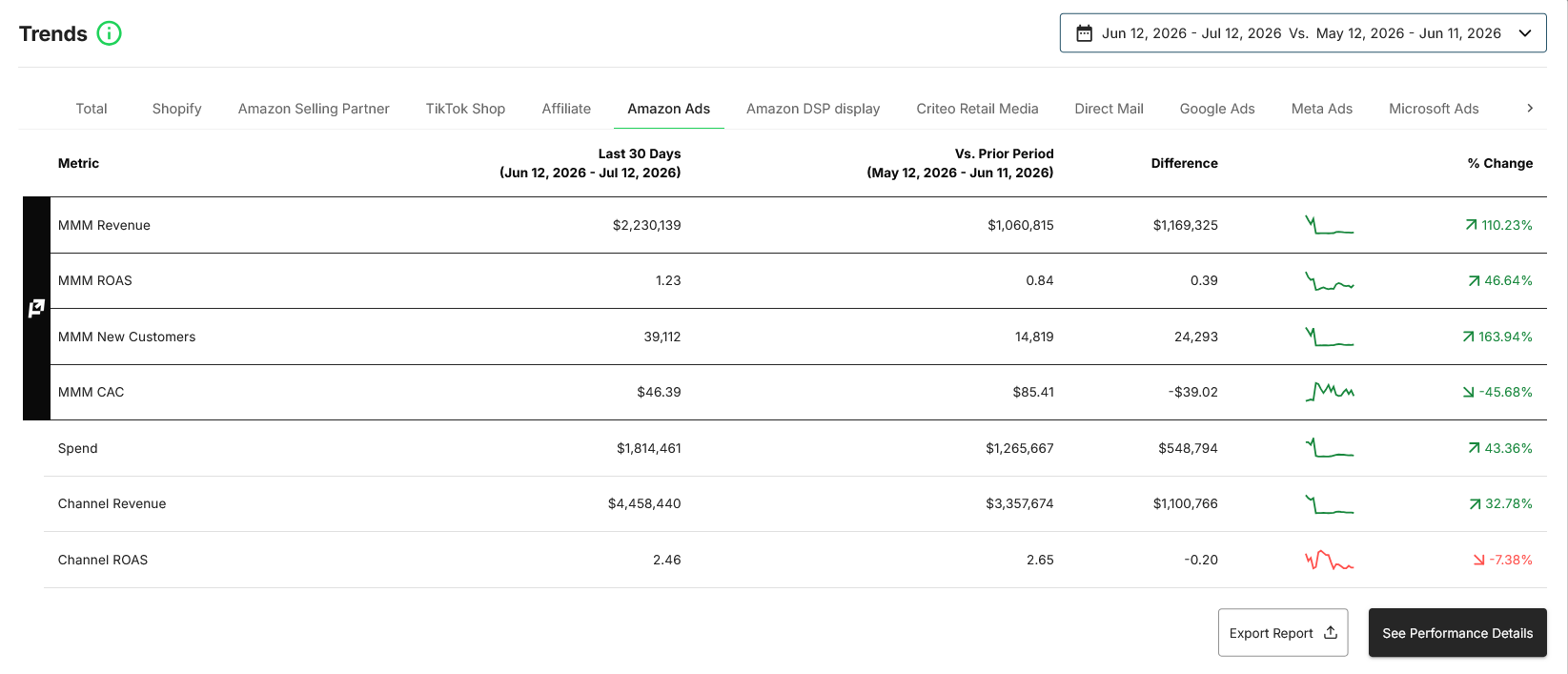
Revenue tied to this channel jumped by more than double over the prior period, and new customers acquired through it nearly tripled. But the platform-reported ROAS for that same channel actually dropped. If you were only looking at that one number, you'd assume the channel was getting less efficient. The fuller performance data tells a different story.
This is also where a common misconception trips people up: using engagement or platform-reported metrics that don't line up with your actual business objective. A channel can look great on clicks or impressions and still not be the thing driving revenue. Before you compare different marketing channels against each other, it's worth double-checking that the key metrics you're comparing on actually reflect the outcome you care about.
If you're still deciding whether a channel is worth trying
Not every channel decision is about analyzing something you're already running. Sometimes you're staring at a marketing channel you've never touched, wondering if it's worth the investment at all. That's a different question than the rest of this article, and it's worth a quick answer before moving on.
Start with the basics: are your potential customers actually spending time there, and does the channel fit how they tend to make purchase decisions? From there, decide what a trial would need to show you before you'd call it worth scaling. Give yourself a small, defined budget and a real timeline, and decide upfront what result would justify turning a test into an actual line item in your marketing budget.
Once you do commit real spend to a new channel, Prescient's models don't start from zero. We warm start the model using patterns from your existing channels and business, so you get a meaningfully faster read on how a new channel is performing instead of waiting months for enough data to build up on its own.
From there, the analysis in the rest of this article picks up.
The mistake most channel analysis makes
We've talked a lot about specific metrics, but the biggest mistake in channel analysis isn't picking the wrong one. Marketing is an ecosystem. Where many marketers go wrong is treating each channel like it operates as an island. They'll look at a channel's individual performance, decide it's underperforming because comparing one-off reports shows it's not one of the most effective marketing channels, and cut it, without asking whether that channel was contributing to results somewhere else in the customer journey.
Yes, we all need to prioritize channels that drive business. We're not arguing otherwise. But your marketing channels are intertwined because your potential customers constantly move between them. If you look at separate reports to judge marketing efforts on a channel, you're giving each one a grade with only part of its performance in front of you. That's a recipe for kneecapping your digital advertising.
Go back to the renovation analogy for a second. If you fired the electrician because their invoice looked high compared to the painter's, you might not realize the electrician's work was what let three other contractors finish their jobs on schedule. Marketing channels work the same way. A channel with an unremarkable standalone ROAS might be feeding your best-performing campaigns, warming potential customers and driving people to search for your brand later, or supporting purchases that happen somewhere else entirely.
Cutting a channel based on its individual numbers alone, without understanding how it connects to the rest of your channel mix, is one of the fastest ways to lose performance you didn't know you had. (We've written a lot about the adstock effect in marketing. It's what makes the effects of your marketing campaigns linger even after you've ended them. They can work wonders for brands, but it also means there's a delay when you cut a channel or campaign driving efficiency elsewhere. By the time its lingering effects have fully faded, you might not be able to connect the slumping performance back to this decision.)
Why channels impact each other more than your dashboard shows
Most channels don't just drive their own conversions. They also create effects, including conversions, that show up in other channels entirely, sometimes called spillover or halo effects. Someone sees a paid social ad, doesn't click, but searches for your brand by name a few days later and buys through organic search or direct traffic instead. On a standard channel report, that sale gets credited to organic or direct. The paid social channel that actually drove it gets none of the credit.
This gets even more pronounced for omnichannel and retail brands. If your products sell through Amazon, Target, Ulta, or similar retail partners, a chunk of your marketing impact is landing on channels you don't fully control and can't fully see in a standard attribution setup. Here's what that split can look like when you break revenue down by how much came from direct engagement with a channel versus how much came from that channel's spillover into other channels, including retail marketplaces.
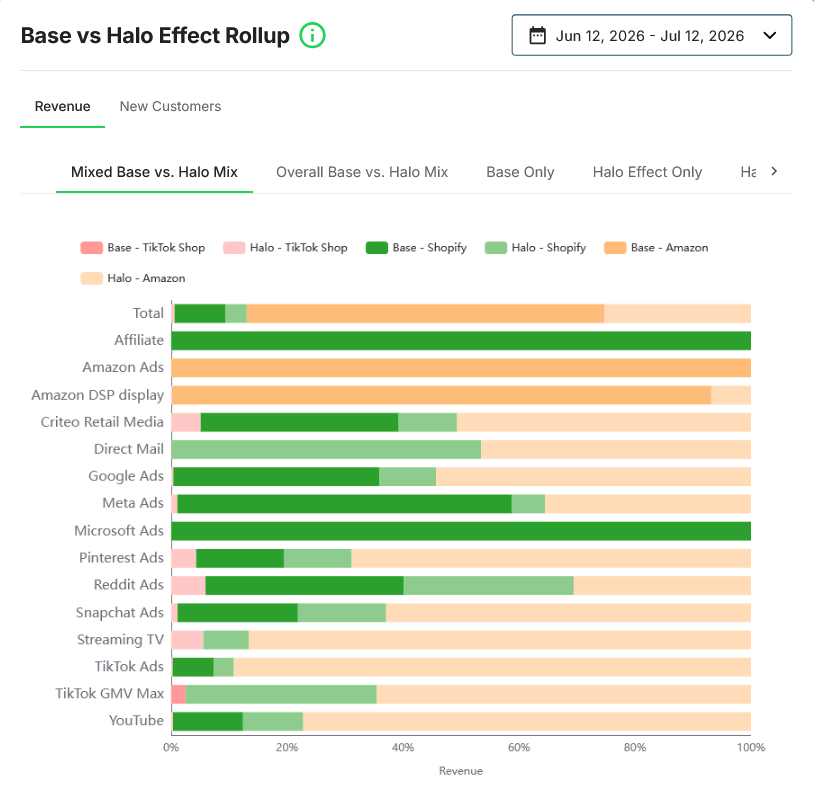
Notice how much of the total is showing up as spillover rather than direct, channel-specific revenue. A channel report that only counts direct, ad-click-to-purchase conversions is going to miss most of that picture. That's a significant blind spot, and its especially harmful for top-of-funnel, click-free channels like CTV. (Prescient clients DECKED and Saatva both found that their awareness campaigns were moving the needle far more than they realized once they started using the Prescient platform.)
Because channels lean on each other this much, it's also worth checking that the message someone sees on one channel actually lines up with what they see on the next. If your retargeting ad says something different than your email flow, you can lose some of that spillover benefit before it ever converts. If you haven't audited that consistency recently, this deeper look at building a cross-channel marketing strategy is a good next read.
What a more complete channel analysis process looks like
Getting a fuller read on marketing channel performance doesn't mean throwing out everything you're already doing. It means adding a few habits to how you evaluate and compare channels:
- Track trends over time instead of judging a channel off a single snapshot, since a marketing channel's efficiency can shift week to week based on market dynamics, seasonality, or what else is running alongside it.
- Separate a channel's direct contribution from its spillover contribution so you're not accidentally crediting or discrediting the wrong channel.
- Tie marketing channel performance back to new customer acquisition, not just revenue, since a channel that turns potential customers into long-term existing customers can look different from one that only drives one-time purchases.
- Revisit channel decisions on a regular cadence rather than making a single call and leaving it in place for months.
- Compare channels using cross-channel marketing analytics that account for your actual customer journey, not just the numbers each platform reports about itself.
Marketing mix modeling (MMM) is built to do most of this automatically, which is where a tool like Prescient comes in.
Where Prescient comes in
Prescient gives you channel-level reporting that goes past what platform dashboards can show on their own, all built on daily-updated marketing mix modeling. Here's what that looks like in practice:
- Channel performance table: spend, modeled revenue, modeled new customers, modeled customer acquisition cost, and channel ROAS side by side for every channel in your mix, so you can compare platform-reported numbers against modeled performance data at a glance.
- Trends view: period-over-period comparisons for each channel, so you can see how a channel is actually moving instead of relying on a single month's numbers.
- Base versus halo effect rollup: how much of a channel's revenue and new customer contribution is direct versus spillover into other channels, broken out by channel across your full mix.
- KPI report: per-channel trend lines you can track over time, across whatever KPI matters most to your team.
The channel performance table below shows what this looks like across a full channel mix at once, and the KPI report next to it tracks that same data over time.
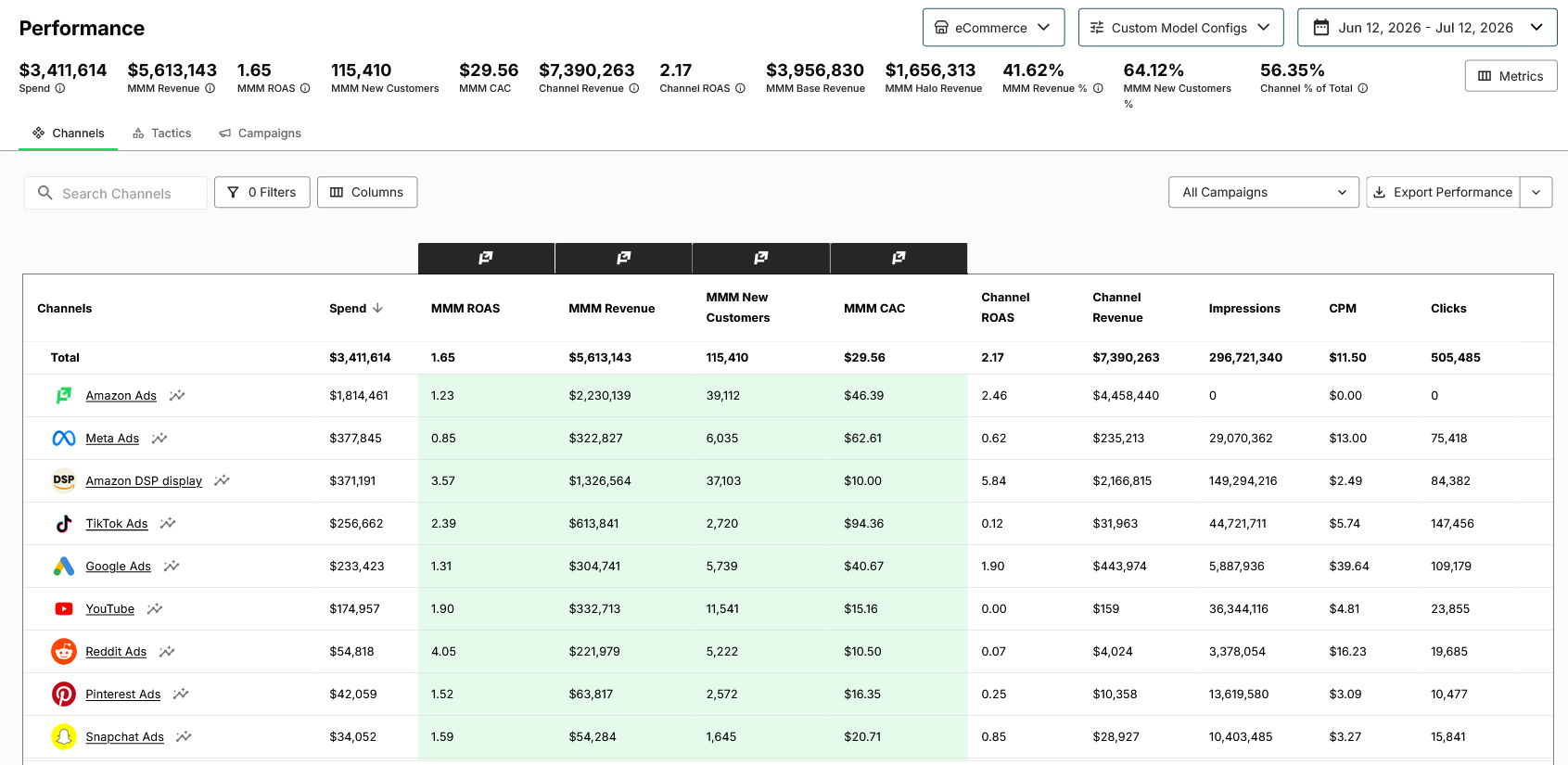
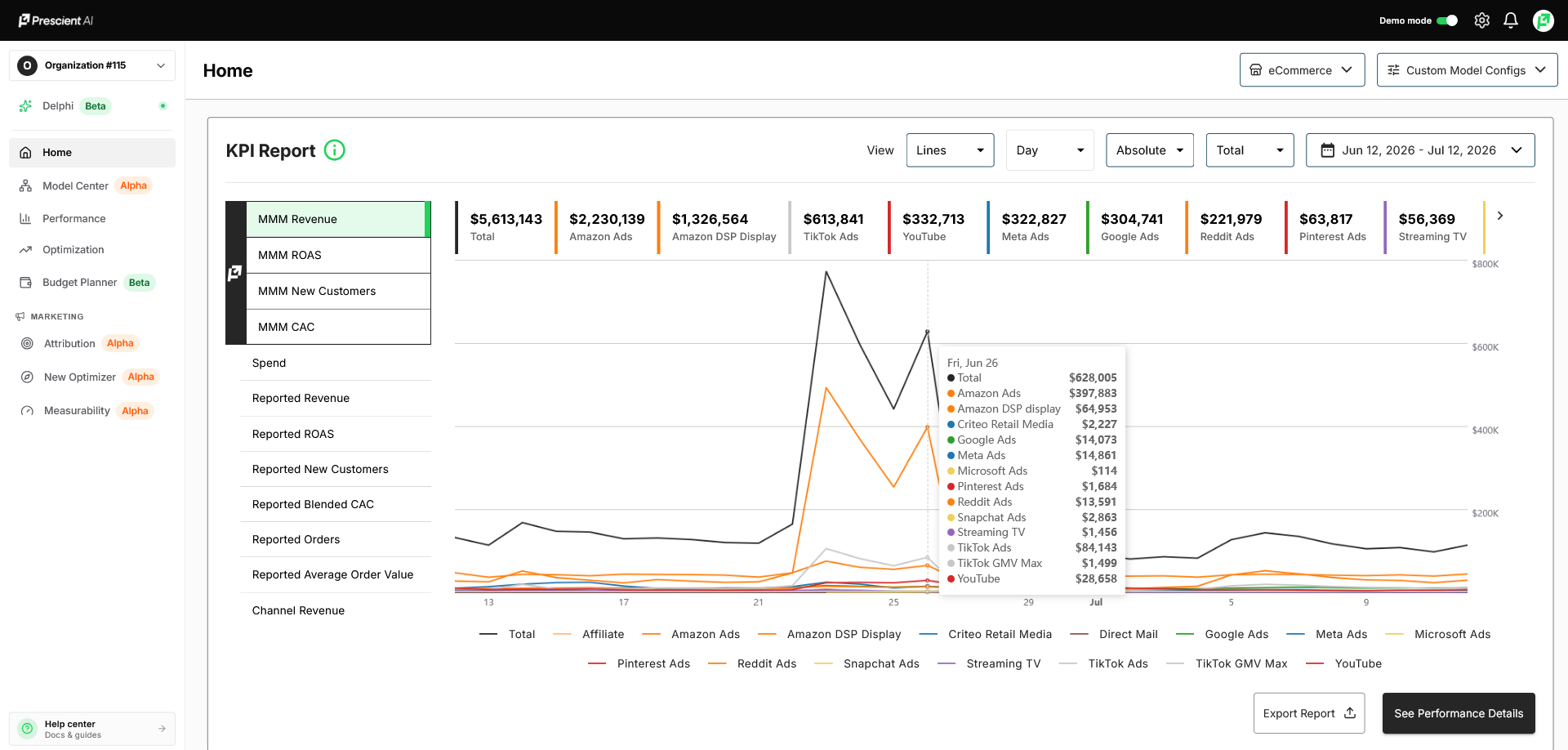
Instead of pulling platform exports from every channel and trying to reconcile them by hand, you get one place that surfaces valuable insights on channel performance, channel mix, and cross-channel marketing effects together, whether you're evaluating always-on spend or individual marketing campaigns. That means fewer decisions based on a single platform's version of events, and more decisions based on what's actually driving revenue across your marketing strategy.
We've included a lot of screenshots here, but we'd love to walk you through the platform with a live screen using a real brand's anonymized data. Book a demo to see all of these features in action.
FAQs
What are the 4 marketing channels?
There's no single official list, since different frameworks group channels differently, but a common way to break it down is paid, owned, earned, and shared channels. Paid covers things like search and social ads, owned covers your website and email list, earned covers organic press or word of mouth, and shared covers social platforms where you don't fully control the distribution. Some frameworks simplify this further into digital and traditional marketing channels, so it's worth checking which version a source is using before you apply it.
What is the 3-3-3 rule in marketing?
The 3-3-3 rule isn't a single standardized framework, and it gets used differently depending on the source, so it's worth confirming the definition behind whatever context you saw it in before applying it to your own marketing strategy. In general, rules like this are meant to simplify decision-making around content or channel testing, but they shouldn't replace looking at your own channel performance data.
What are the 6 C's of channel strategy?
Like the 3-3-3 rule, the 6 C's of channel strategy isn't a universally agreed-upon framework, and different sources define the six C's differently. Rather than memorizing a specific list, it's more useful to focus on the underlying idea: choosing channels based on where your target audience actually is, how they behave, and what each channel can realistically do for your business.
The Halo
Exclusive insights, every week.
Subscribe to The Halo for sharper marketing thinking.
You're subscribed to The Halo!
Quick question (optional): How familiar are you with MMM?
Thanks for sharing! Enjoy The Halo.
Keep reading
View all
A marketer’s guide to in-house MMM builds vs vendor tools
Read article
What causes attribution bias in marketing and how to reduce it
Read article
How many channels can an MMM measure?
Read article
Can MMM measure marketing when customers buy through multiple channels?
Read article
What matchback analysis measures, what it misses, and how to fill the gaps
Read article
Can MMM measure influencer marketing?
Read article