




What halo effects are showing you (and why your other tools miss them)
Learn what halo effects are showing you in the Prescient dashboard, why platform attribution tools miss this revenue, and how to interpret halo data accurately.
Linnea Zielinski · 6 min read
When people stop to admire a great building, they're looking at the facade, the glass, the lobby, the rooftop. Nobody is thinking about the load-bearing columns buried inside the walls, the foundation piers drilled into bedrock, or the steel skeleton holding the entire structure upright. Those elements are doing the most critical work in the building—without them, none of the visible parts would exist—but they'll never appear in an architecture review or make it onto a postcard.
Most marketing attribution tools have the same blind spot. They're built to measure what's visible: the click, the conversion, the last touchpoint before purchase. The campaigns doing the work—the awareness ads that put your brand in someone's head three weeks before they were ready to buy, the prospecting campaigns that drove branded search spikes that Google eventually got credit for—don't show up in platform reporting because click-based tools can only measure what they can track, and a view that didn't end in a click leaves no trace. When your reporting can't see that work, your budget decisions will systematically undervalue it.
Getting the full picture of what your campaigns are actually doing is what Prescient’s halo effects measurement is built for, and the revenue it surfaces often changes the math on budget decisions significantly.
Key takeaways
- Halo effects are the spillover revenue that a paid media campaign drives into channels beyond its direct conversions, including branded search, organic traffic, direct traffic, and Amazon sales.
- Platform attribution tools are pixel-based and built to track direct clicks, which means they can't see revenue a campaign generates in other channels after someone sees an ad but doesn't immediately convert.
- Prescient measures halo effects by modeling the statistical relationship between campaign spend and revenue across all connected channels, so awareness campaigns get credit for the full scope of their impact.
- Halo revenue in Prescient is always a positive figure representing incremental revenue attributed to a campaign's spillover effect; red percentages in the platform indicate period-over-period changes, not negative revenue.
- Amazon halo effects are tracked separately and represent revenue driven to your Amazon storefront by non-Amazon campaigns like Meta or CTV, even when the click path doesn't point to Amazon at all.
- The campaigns with the largest halo effects are often the ones that look weakest in platform reporting, because top-of-funnel and awareness campaigns rarely drive immediate clicks but frequently drive significant downstream revenue.
- Understanding halo data changes how you evaluate budget cuts and scale decisions, because a campaign's true value only becomes visible when you account for what it's driving across your entire revenue ecosystem.
What halo effects actually are
Prescient uses the term "halo effects" to describe spillover effects: the phenomenon where a campaign's impact extends well beyond the conversions that come directly from it. The effect of that campaign spills over into other channels, and Prescient's position is that the campaign deserves credit for that revenue.
The mechanism is straightforward: someone sees your Instagram prospecting ad while scrolling, doesn't click because they're not ready to buy, and goes about their day; a week later, they need what you sell; they remember your brand name and search it directly on Google, or they go straight to Amazon because it's convenient. That conversion happened because your Instagram campaign put your brand in their head, but last-click attribution gives Google or Amazon the credit, and your Instagram campaign looks like it's barely breaking even.
Prescient models the statistical relationship between your campaign spend and revenue across all of your connected channels. When your prospecting spend goes up, if branded search revenue, organic traffic, and direct visits go up with it in a consistent pattern, the model attributes that relationship appropriately. That's halo revenue.

The four channels where halo revenue shows up
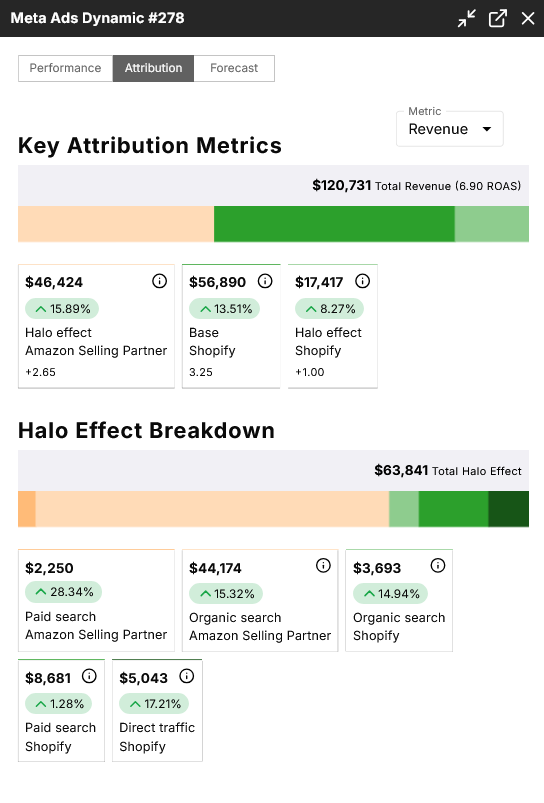
Prescient breaks halo revenue down across four distinct channels. Each one tells a different part of the story of what your campaign is doing beyond the direct conversion window.
Branded search
When a campaign builds awareness, it drives people to search your brand name directly. Branded search halo revenue captures the conversions that came from that search activity and attributes them back to the campaign that created the awareness. This is one of the most direct signals that a top-of-funnel campaign is building real brand equity with your audience. A branded search spike following a prospecting push is your audience remembering you.
Organic traffic
Organic halo revenue captures visitors who came to your site without clicking an ad, often because they remembered your brand from an earlier impression. Unlike branded search, these visitors didn't search for your brand specifically, they found you through organic results or returned directly because your brand was already in their consideration set. Organic halo is a signal that your campaigns are doing long-term brand-building work that compounds over time and that you’re recognized in your category.
Direct traffic
Direct visits—people who type your URL straight into their browser—are often treated as baseline behavior that has nothing to do with paid media. The reality is that direct traffic spikes consistently after awareness campaign activity. Prescient models that relationship and attributes the incremental direct revenue back to the campaigns driving it.
Amazon
This is the channel most likely to be missed entirely by other tools. Even when a campaign's click-through URL doesn't point to Amazon, customers who see your ad frequently go to Amazon to purchase because it's where they prefer to buy. Prescient measures these Amazon halo effects for non-Amazon campaigns like Meta or CTV, which means omnichannel brands get a complete view of what their media spend is actually generating across every storefront.
Why your other tools can't see this
The reason platform attribution misses halo revenue isn't a flaw that any individual platform is working to fix. This is a limitation of how click-based measurement works. Pixel-based tools track clicks. If someone sees an ad and doesn't click, that interaction is invisible to the platform. There's no data point to follow, no path to trace, and no way to connect that impression to a conversion that happens somewhere else three days later.
There's also an inherent incentive issue. Each platform in your stack measures its own channel's performance. None of them have a strong reason to surface revenue that actually converts somewhere else as a result of their channel's work. The result is that every platform reports credit for conversions that multiple campaigns contributed to, and the campaigns doing the most awareness work get the least credit because awareness work rarely ends in an immediate click.
Prescient sidesteps this entirely by working from your actual spend data and revenue data rather than tracking individual click paths. The model looks at what happened to revenue across all your connected channels when spend on a given campaign went up or down, and that relationship is what gets attributed.
How to read halo data in Prescient
Halo effects should be evaluated alongside other Prescient-modeled metrics like MMM Revenue, MMM ROAS, and MMM CAC to get a complete picture of campaign performance. A few comparisons are particularly useful.
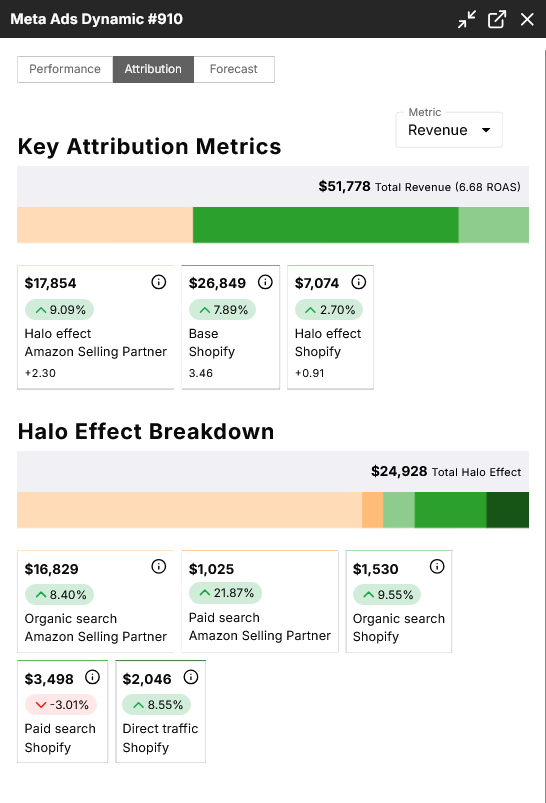
When a campaign shows low base revenue but high halo revenue, that's a top-funnel channel doing significant awareness work. Its direct conversions look modest, but its indirect influence is meaningful. Cutting spend on that campaign is likely to harm performance in other channels more than it saves in budget.
When a campaign shows high base revenue and high halo revenue, that's a channel performing well on both dimensions and is a strong candidate for increased investment.
When comparing channel-reported revenue to MMM Revenue, the size of the gap tells you how much value platform tools are missing. A campaign where MMM Revenue is significantly higher than channel-reported revenue is a campaign that's being systematically undervalued in every conversation that relies on platform data alone.
One important note on the red percentages you may see next to halo figures in the platform: a red percentage doesn't mean the halo revenue is negative. Halo revenue in Prescient is always a positive contribution to revenue. Red indicates a period-over-period change: the campaign drove less halo revenue this period than last. That's directional information worth paying attention to, but it's not the same as a campaign generating no halo value.
Where Prescient comes in
Prescient measures halo effects because the underlying belief is that every campaign deserves credit for every dollar of revenue it contributes. Platform tools aren't built to see across channels, and the gaps in their reporting lead directly to undervaluing the campaigns doing the most important brand-building work. When those campaigns get cut because they look inefficient, the downstream channels that were quietly depending on them tend to weaken too.
If you're already using Prescient and want to learn how to take your halo data into a budget conversation, the companion article on how to use halo data to make the case for top-of-funnel spend internally walks through how to do that. If you're not yet using Prescient, you can see halo effects in action by booking a demo.
The Halo
Exclusive insights, every week.
Subscribe to The Halo for sharper marketing thinking.
You're subscribed to The Halo!
Quick question (optional): How familiar are you with MMM?
Thanks for sharing! Enjoy The Halo.
Keep reading
View all
A marketer's step-by-step framework for how to build an identity graph
Read article
Identity graph companies: How to choose the right provider for your brand
Read article
No, your brand name doesn't just pop into someone's head
Read article
How Prescient Models Branded Search Campaign Attribution
Read article
What is direct traffic (and why it’s not as mysterious as you think)
Read article
12 top marketing attribution software solutions: 2026 comparison guide
Read article