




Attribution vs incrementality: when to use which
Attribution assigns credit to the touchpoints you tracked. Incrementality tests measure lift against a control. Neither tells you where next quarter's budget should go. Here is how to use each, and what to add.
Linnea Zielinski · 13 min read

Monday's budget meeting has three numbers for the same campaign. The ad platform reports a 4x return. The incrementality test your team ran last month says most of those buyers would have bought anyway. Your CFO wants to know which number is real before approving next quarter's spend. Every tool tells you something different, and each one is sure.
The attribution vs incrementality debate is usually framed as a contest: one method is naive, the other is rigorous, pick the rigorous one. That framing is where budgets go wrong. Attribution tells you which touchpoints were present when a conversion you tracked happened. Incrementality tells you how many conversions happened because of the campaign, measured against a group that never saw it. They answer different questions, and treating either as a correction of the other swaps a different question for a better answer.
What follows: what each method measures, where each breaks (with numbers), a decision table for when to use which, and how tests and a marketing mix model fit together for a brand that sells on its own site, on Amazon, and in retail.
Key takeaways
- Attribution assigns credit for conversions you tracked to the touchpoints you observed. Incrementality tests measure the lift a campaign produced against a control group. Different questions, not two answers to one question.
- Attribution breaks where it cannot see: demand that already existed, view-through and privacy-blocked touchpoints, and conversions that land on Amazon, in retail, or in branded search instead of on your site.
- Incrementality tests break where they cannot generalize: one channel, one window, one spend level, usually 2 to 4 weeks against effects that can take 3 to 6 months, and no forecast for a different budget.
- The gap between the two readings is large and channel-specific. In Prescient's published data, most of the revenue from channels like TikTok and CTV lands somewhere platform attribution does not look.
- Use attribution for daily optimization, tests to confirm a channel produces lift, and a marketing mix model to allocate and forecast. The test calibrates the model; it does not overrule it.
What is the difference between attribution and incrementality?
Attribution assigns credit for a tracked conversion to the marketing touchpoints that preceded it. Incrementality measures how many conversions a campaign produced that would not have happened without it, by comparing an exposed group to a control group. Attribution answers "who converted after seeing the ad?" Incrementality answers "would this conversion have happened without the ad?"
Attribution is the practice of assigning credit for conversions or revenue to marketing channels or campaigns. It comes in two forms: multi-touch attribution (MTA), which distributes credit across the touchpoints in a tracked journey, and platform-reported attribution, each ad platform grading its own ads inside its own window. Both start from conversions your systems recorded and the touchpoints they could see.
Incrementality testing is an experiment designed to measure the additional revenue or conversions a specific marketing activity produced. A test group is exposed to the campaign, a control group is withheld from it, and the difference is the lift. Holdout tests split people, geo tests split regions, and matched-market tests pair similar regions and treat one side.
Prescient's incrementality testing guide draws the line in one sentence: attribution says "these touchpoints were involved in the conversion," while incrementality testing says "this campaign caused X additional conversions that wouldn't have happened without it." A recent r/analytics thread asked whether that is "different things or just different math." Different things: one counts credit, the other estimates a counterfactual.
| Attribution | Incrementality | |
|---|---|---|
| Core question | Which touchpoints get credit for a tracked conversion? | How many conversions happened because of the campaign? |
| What it measures | Presence along the path to conversions you recorded | Lift over a control group that did not see the campaign |
| How it gets the number | A rule (last touch, U-shaped) or a model over observed touchpoints | A holdout, geo, or matched-market experiment |
| Best use | Daily campaign and creative optimization | Confirming whether a channel produces lift at all |
One more difference matters for reporting. Attribution assigns credit per order, so it rolls up to a customer and combines with lifetime value. Incrementality is an aggregate estimate for a group, a region, or a channel; it cannot be assigned to an individual buyer, which is why per-customer LTV from attribution and per-channel incremental CAC from a test never quite add up in the same spreadsheet.
How attribution works, and where it breaks
Attribution models split credit for each tracked conversion across the touchpoints a system could see, using a rule (last touch, U-shaped) or a model fitted to observed paths (data-driven). It is fast, always on, and campaign-level, which is why it runs daily optimization. It breaks wherever a touchpoint or a conversion is invisible to the tracker.
Last-touch gives 100% of the credit to the final touchpoint. Position-based (U-shaped) gives 40% to the first touch, 40% to the last, and 20% to the middle. Data-driven models such as the one in Google Analytics weight touchpoints by how often they appear on converting paths (see how attribution models split credit). The models disagree with each other before any of them meets reality. Take one $100 order with four touchpoints in order: a display ad, a paid social click, an organic search visit, and an email click.
| Model | Display | Paid social | Organic search | |
|---|---|---|---|---|
| First-touch | $100 | $0 | $0 | $0 |
| Last-touch | $0 | $0 | $0 | $100 |
| Linear | $25 | $25 | $25 | $25 |
| Position-based (U-shaped) | $40 | $10 | $10 | $40 |
| Time-decay | $10 | $20 | $30 | $40 |
| Data-driven | Weighted by estimated contribution, for example $30 | $20 | $20 | $30 |
Same order, same four touchpoints, six answers. None of the models observed anything the others did not; they only distribute the same credit differently. The rules are not where attribution breaks. The inputs are.
- Demand that already existed: a retargeting click from someone already checking out gets full credit under last touch. No model can tell that click from one that changed a mind.
- Touchpoints the tracker cannot see: Apple's App Tracking Transparency framework, cookie restrictions, and offline exposure (TV, podcasts, out-of-home) remove links from the chain. A model can only credit what it observes.
- Conversions that never enter the path: a shopper who sees a TikTok ad and buys on Amazon, in a store, or via a branded search a week later produces a conversion attribution cannot connect to the ad.
The error runs in one direction. Attribution moves credit toward whatever is closest to the click, so lower-funnel channels collect credit for demand that upper-funnel and offline channels created, and the demand those channels drive goes uncounted rather than misassigned.
Why platform-reported numbers do not add up
Each platform grades its own ads inside its own window, and most count view-through conversions (a purchase after an impression with no click). A shopper who saw a Meta ad, clicked a Google ad, and bought is a conversion in both dashboards. Add the platforms up and the total exceeds your orders. "We're double-counting conversions" is structural, not a reporting bug.
How incrementality tests work, and where they break
An incrementality test withholds a campaign from a control group (people, regions, or matched markets), runs it for the test group, and reads the difference in conversions as lift. It is the most direct way to check whether a channel does anything at all. It breaks when the result is asked to describe conditions the test never ran.
The arithmetic is short. If the test group converts at 15% and the control group at 10%, incremental lift is 50% (the difference over the control rate) and incrementality is 33% (the difference over the test rate): one in three exposed conversions would not have happened without the campaign (the incremental lift formula). The honest scope of any test is one question: what would disappear if we turned this off? A test is a thermometer. It tells you whether the fever is real; it does not tell you what the illness is or how to treat it.
The limits come from what a test is.
- One channel, one window: a test reflects "that one window, not a standing truth." Most tests run 2 to 4 weeks because that is what is affordable, while marketing effects can take 3 to 6 months to land (Law #5). A podcast sponsorship and a retargeting campaign get judged by the same first 100 meters.
- One spend level: "tests at $10,000 monthly spend reveal nothing about what happens at $50,000." Saturation is the one thing a single test cannot see.
- Design and power: no two regions are identical, small effects need large holdouts, and the holdout is revenue you chose not to earn.
- No forecast: a lift number says what happened, not whether to add or cut budget next quarter, or how one channel's lift moves when another channel's spend does. A test cannot tell you what to do next.
Are platform lift studies the same as incrementality tests?
Partly. A conversion-lift study from Meta or Google holds out a slice of users or regions the platform controls, which is a real experiment on that platform's inventory; Google's own documentation describes it as a way to understand ad effectiveness "at a certain point in time." It cannot control your other channels, Amazon, retail, or the shopper's path after the impression, and it counts only conversions the platform can observe. Treat it as a reading of one channel on one surface, produced by the party selling that channel, and confirm it independently before it moves budget.
How big is the gap between attributed and incremental results?
Large, and it depends on the channel and on where the brand sells. In Prescient's published data, most of the revenue from awareness-heavy channels lands somewhere platform attribution does not look: on Amazon, in retail, or in branded search. A test on the same channel sees only the outcome it was designed to count.
Take one channel through all three readings. The platform reports 4x. A holdout test on the DTC site finds that most of those buyers would have bought anyway, so the 4x reported ROAS lands nearer 1.5x incremental ROAS once those conversions are removed. The model, reading DTC and Amazon together, finds that a large share of the channel's revenue landed on Amazon, where neither the platform nor the DTC holdout was looking (the demo account in the figure below shows that shape). Three numbers, one channel, and the only wrong move is picking one and ignoring the other two. The first gap runs one way: attribution flatters whatever sits closest to the purchase.
Retail media networks show the same shape: the network's reported ROAS counts purchases that would have happened either way, so the incremental share is a fraction of the reported figure, and it varies by placement type.
The larger gap runs the other way, and attribution and tests both miss it. Prescient's models, which read every channel and sales destination together, show where channel revenue actually lands. Across the brands in Prescient's July 2025 to June 2026 benchmark, 63.2% of TikTok revenue landed off-platform. For Portland Leather Goods, 70% of TikTok-generated revenue arrived through ecommerce, retail, and Amazon. For Laundry Sauce, 73% of CTV revenue converted off the DTC site. For Global Healing, 64% of YouTube's modeled revenue landed as Amazon purchases. Across the four upper-funnel channels in Zenwise's portfolio, the share of revenue landing away from the channel's own surface ran from 75% to 98%.
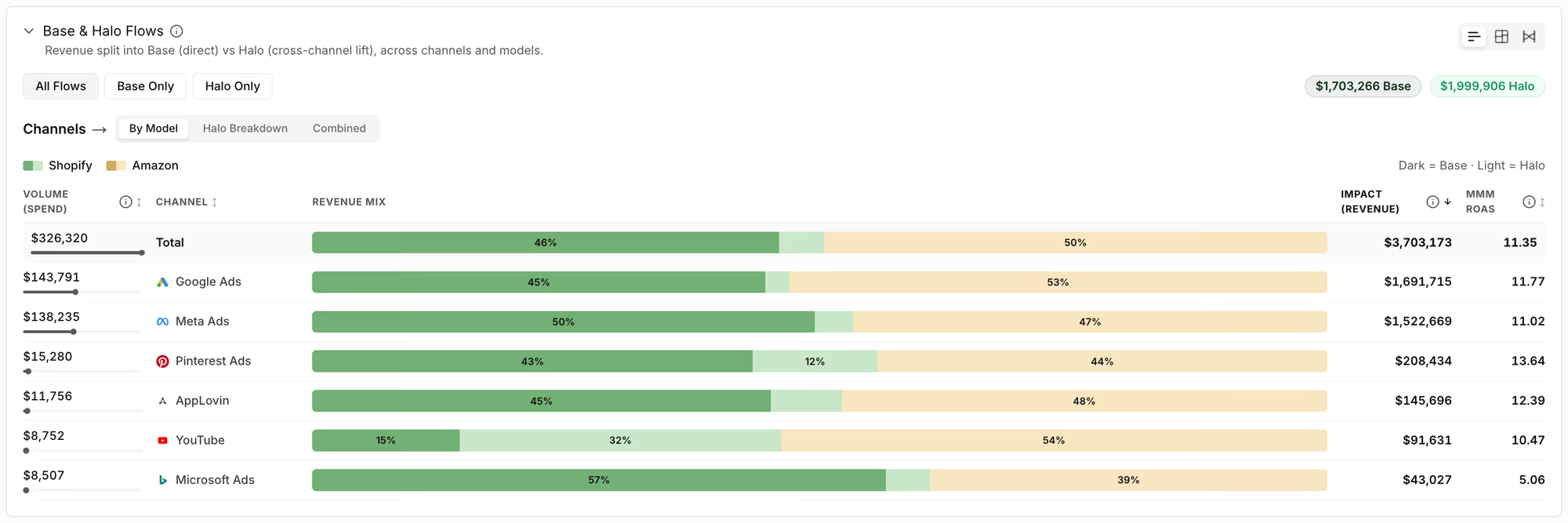
Modeled revenue split into base (direct) and halo (cross-channel) by channel and sales destination, from a demo account. Attribution sees only the dark green segment.
None of those conversions enters an attribution path, because the ad and the purchase happen on different surfaces. A holdout test on the DTC site cannot count them either; DTC conversions are the only outcome it measures. Both methods understate upper-funnel channels in the same direction, so two readings agreeing is not the same as two readings being right. This is the mechanism behind halo effects across channels: awareness spend converts where the tracker is not watching.
When to use attribution vs incrementality (and when you need a marketing mix model)
Match the method to the question. Attribution answers "what should I change today" at campaign level. An incrementality test answers "does this channel produce lift at all." A marketing mix model answers "where should the next dollar go across every channel and sales destination." Asking one method a different method's question is where the wrong budget decision starts.
| The question you are asking | Attribution | Incrementality test | Marketing mix model |
|---|---|---|---|
| Which creative or campaign should we pause this week? | Yes, this is its job, and the signal automated bidding runs on | No, too slow and too coarse | Directionally, at campaign level |
| Is this channel worth its spend at all? | No, it credits presence, not lift | Yes, for that channel, in that window | Yes, as ongoing incremental contribution |
| How much should next quarter's budget be, by channel? | No | No, one channel and one spend level per test | Yes, with saturation curves and a forecast |
| What happens to revenue if we cut TV 20%? | No, TV rarely has a trackable path | Only by running that exact test | Yes, as a scenario forecast |
| How much of our Amazon revenue did paid media drive? | No, the conversion is off-surface | Only with an Amazon-side test design | Yes, if Amazon is a modeled sales destination |
| Did the platform's lift study measure what we think it did? | No | Yes, an independent test can check it and calibrate for the platform's bias | Yes, by comparing the model with and without the study's result |
A marketing mix model belongs in the table because it is the one method that reads every channel and every sales destination in a single system and can forecast what changes when spend moves. It is also the least precise at the level of a single ad, which is why attribution keeps its job.
Three questions settle most cases. Is the outcome tracked on a surface you own? If not, attribution is out. Do you need a verdict on one channel or an allocation across many? Tests give verdicts; allocation needs a model. Do you need to know what did happen or what will happen? Only a model forecasts. A brand running two or three channels into one storefront can get by on attribution plus an occasional test; the value of testing, then modeling, rises with every channel and sales destination added. Prescient's guide to how MMM, MTA, and testing triangulate covers the same logic from the tool side.
How attribution, incrementality, and MMM fit together
They are layers, not rivals. Attribution runs the daily loop, an incrementality test confirms whether a channel is producing lift, and a marketing mix model turns that evidence into an allocation and a forecast. The test result calibrates the model; it does not overrule it, and the model should be checked with and without the test data before either is trusted.
In order:
- Attribution for daily hygiene: pause the creative that stopped working, shift budget between campaigns inside a channel.
- A test when a channel's contribution is in doubt: a new channel, a channel finance wants to cut, a platform lift study you want checked.
- The model for allocation and forecasting: where the next dollar goes, how far a channel scales before saturation, what a 20% cut does across every sales destination.
- The test result fed back as calibration: the lift number becomes a prior the model has to reckon with.
- A backtest: run the model with and without the test data and score both against outcomes it has not seen.
Step four is where teams go wrong in both directions: ignoring a clean test wastes the best evidence you have, and forcing the model to match it treats a snapshot as a standing truth. As Prescient's data science team wrote in The Prescient Perspective, "a lift test rescales an answer but does not change the math that generated it." If the model estimated a channel drove $500K and the test says $800K, you have a scale factor of 1.6x. The shape of the channel's response curve, the thing that decides when to stop spending, is untouched.
That is why test data can help or hurt: tests are "locally accurate but globally inaccurate," and a badly built model calibrated to a good test can look right without being right (test-calibrated MMM). It is also why the check should be independent. A vendor that sells both the test and the model has every incentive to make the two agree, which is grading its own homework. Prescient's Validation Layer takes the opposite stance. It runs the model with and without a client's test data, scores both against held-out outcomes, and lets the team see whether the test improved the forecast before either number is trusted (Validation Layer).
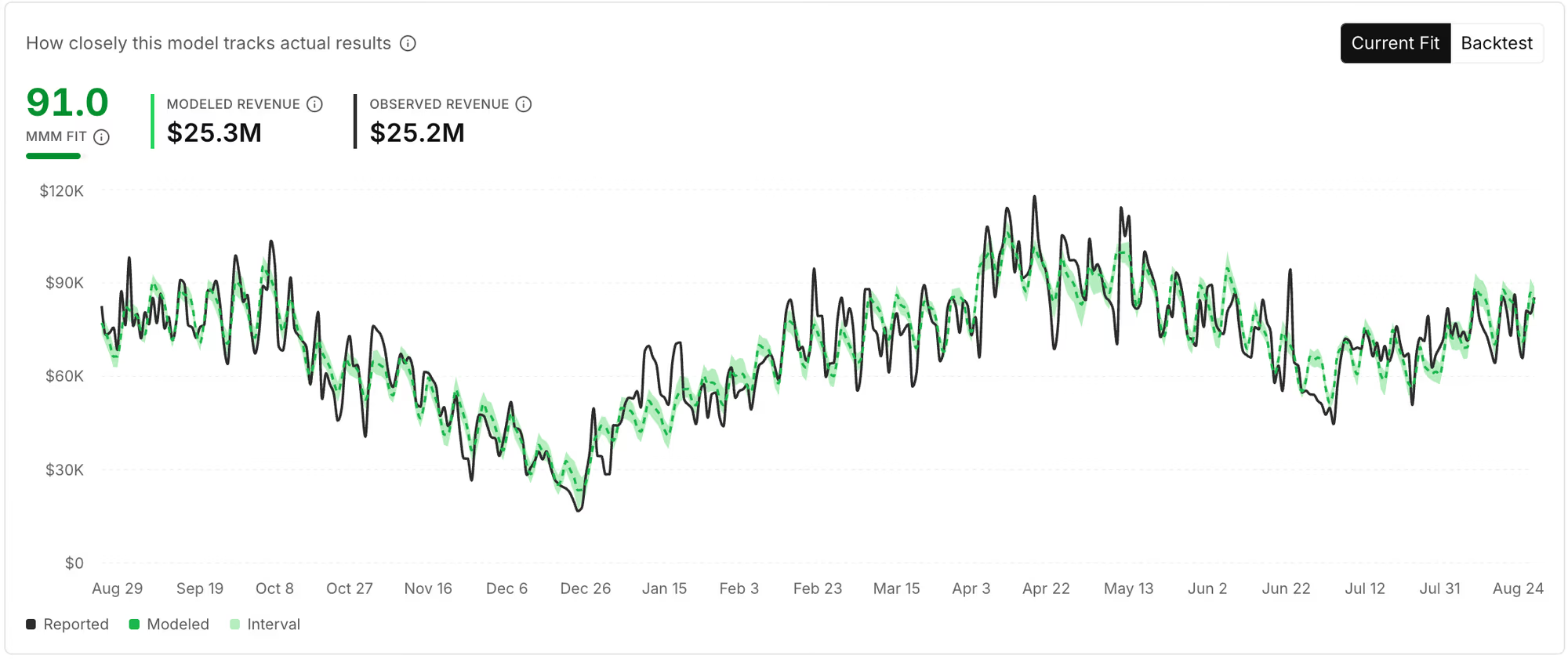
How closely a model tracks reported revenue, from a demo account. The same panel scores a backtest on data the model never trained on.
What to do when attribution and incrementality disagree
Expect them to disagree. They count different things, so matching numbers would be the surprise. When the gap is large, run three checks before anyone moves budget. First, was the test window representative: the same season, creative, and spend level as the period attribution is reporting on? Second, did both methods count the same conversion, or did the test measure DTC orders while the platform counted view-through purchases? Third, is the disagreement concentrated in channels whose revenue lands off your own surfaces, which points to halo effects rather than to either method being wrong? If all three check out, the test's number stands for that channel and that window, and the model is where it gets reconciled with everything else.
Back to Monday's meeting. The platform's 4x, the test's lift, and the model's incremental contribution are three readings of one system. The first says what to tune today, the second says the channel is real, and the third says what to do next quarter. Only the third can.
FAQs
Can attribution and incrementality be used together?
Yes, and they should be. Attribution handles daily campaign decisions; incrementality tests confirm whether a channel produces lift at all. They disagree by design, because they measure different things.
What is the difference between standard attribution and incremental attribution?
Standard attribution credits every tracked conversion to the touchpoints that preceded it. Incremental attribution keeps only the conversions a test or model estimates would not have happened without the campaign.
What are the four types of attribution?
First-touch (all credit to the first interaction), last-touch (all credit to the final one), rule-based multi-touch such as linear or position-based (credit split by a fixed rule), and data-driven (credit weighted by a model fitted to observed paths).
Are attribution and incrementality measuring different things or just different math?
Different things. Attribution counts observed touchpoints on recorded conversions. Incrementality estimates what would have happened without the campaign, using a control group. No arithmetic turns one into the other.
What does incrementality mean in marketing?
Incrementality is the additional revenue or conversions a marketing activity produced beyond what would have happened without it. It is measured by comparing a group exposed to the activity against a control group that was not, and the difference is the incremental lift.
What should you do when attribution and incrementality disagree?
Treat the disagreement as expected, then check whether the test window was representative, whether both methods counted the same conversion, and whether the gap sits in channels whose revenue lands off your own site. A marketing mix model is where the two readings get reconciled across every channel.
Where Prescient comes in
Tests validate; the model decides. Prescient's Marketing Mix Model is built to hold the layer attribution and tests cannot: a daily, campaign-level read of how spend drives revenue across every channel and every sales destination, including the halo effects that land on Amazon, in retail, and in branded search, with a forecast of what changes if the budget moves.
The Validation Layer checks the model with and without your test results, so the test's value is measured, not assumed. Saatva's VP of Digital Marketing, Alex Diesbach: "There is no other tool out there that can help me validate TV."
If you want to see how the model reads your attribution and test results side by side, book a demo.
The Halo
Exclusive insights, every week.
Subscribe to The Halo for sharper marketing thinking.
You're subscribed to The Halo!
Quick question (optional): How familiar are you with MMM?
Thanks for sharing! Enjoy The Halo.
Keep reading
View all
Brand incrementality: Proving what brand spend drives
Read article
What matched market testing can (and can't) tell you about your marketing
Read article
Holdout testing: Understanding the limitations of point-in-time marketing measurement
Read article
Incrementality testing: What it measures, what it misses, and how to use it wisely
Read article
What does incremental mean in marketing? A clear explanation and guide
Read article
Understanding the critical limitations of iROAS
Read article