




How to set up a marketing plan that separates prospecting from retargeting
Learn how to set up a marketing plan that separates prospecting from retargeting, from campaign structure and exclusions to budget and measurement.
Linnea Zielinski · 11 min read
A good bookstore sells books in two ways: the window display catches people walking by who had no plans to stop in, and the clerk near the register helps the browser who's been holding the same hardcover for ten minutes finally make up their mind. If the owner only looked at who rang up each sale, the clerk would look like the whole sales team. Soon the window would go blank, and the clerk would have fewer browsers to help.
Paid media works the same way. Prospecting is the window display, bringing in people who don't know your brand yet, and retargeting is the clerk, nudging people who've already shown interest. When those two tactics run together in your plan and your reporting, budget tends to drift toward whichever one looks best in platform ROAS (almost always retargeting), and the flow of new customers slows down before anyone connects the dots. Keeping them separate protects growth and keeps your budget going where it's actually working, as long as you can measure what prospecting efforts are actually doing.
Key takeaways
- Prospecting and retargeting do different jobs, so they need separate campaigns, audiences, creative, and success metrics.
- Prospecting campaigns drive plenty of conversions on their own, both directly and through halo effects, so they need to be measured on sales and not just reach.
- Decide up front whether "prospecting" means anyone who hasn't purchased or only people who've never engaged with your brand, and report on it the same way every time.
- Retargeting budgets are limited by the size of the audience that qualifies, no matter how strong its ROAS looks.
- Platform-reported ROAS favors retargeting because it credits the campaign that captured demand rather than the one that created it.
- Cutting prospecting shrinks your retargeting pool a few weeks later, which makes both tactics look worse.
- Seeing each tactic's results separately, with credit going to the campaigns that created demand, shows you how much your prospecting is really doing.
What's the difference between prospecting and retargeting?
Prospecting reaches people who haven't interacted with your brand yet and turns them into interested shoppers. Retargeting reaches people who already have, whether they visited your site, viewed a product, added something to their cart, or engaged with a social ad. Here's how the two compare side by side.
| Prospecting | Retargeting | |
| Who it reaches | People who haven't engaged with your brand | People who've visited, browsed, or engaged |
| Main job | Create new demand | Turn existing interest into purchases |
| Typical creative | Introduces the brand and what makes its products different | Reviews, reminders, and answers to concerns like shipping or returns |
| Common metrics | Reach, new customers, cost per new customer, conversions | Conversion rate, revenue, frequency, audience size |
| How platform reporting skews it | Undercounts sales that happen later or in another channel | Overcounts sales from people who were already likely to buy |
Neither tactic is better than the other. A brand that only prospects spends money building interest it then lets slip away, and a brand that only retargets eventually runs out of people to retarget.
Prospecting campaigns drive conversions too
Creating demand is prospecting's main job, but it's far from the only thing it does. Plenty of people click a prospecting ad and buy on the spot. Many more keep scrolling and come back days later some other way. Revenue that a campaign drives through another channel like this is called a halo effect, and prospecting campaigns tend to create a lot of it.
Prospecting conversions commonly show up in places like these:
- Direct purchases from people who clicked the ad
- Branded search, when someone Googles your name after seeing an ad
- Direct traffic, when someone types your URL straight into their browser
- Amazon and other marketplaces
- Retail stores
The trouble is that most of those sales get credited somewhere else, like your Amazon report, search, or retargeting. When prospecting looks like it's only spending money, it's the first thing cut in a budget review. Before you can judge prospecting fairly, you need a way to see and quantify the conversions it drives, both direct and indirect.
How to structure campaigns so prospecting and retargeting stay separate
The way you set up your campaigns decides what you'll be able to measure later. A few choices made at the start will save you from murky reporting down the road.
Decide what counts as prospecting for your brand
"Hasn't bought from us yet" and "has never heard of us" aren't the same group of people. Someone who visited your site yesterday but didn't purchase is a potential new customer, but they're not a stranger. That gives you two reasonable ways to define prospecting:
- New-customer prospecting: Anyone who hasn't purchased before, including past site visitors
- Cold-audience prospecting: People who haven't purchased and haven't engaged with your brand at all
Both definitions work. What matters is picking one, writing it down, and reporting on it consistently so your team isn't comparing apples to oranges from one quarter to the next.
Keep prospecting campaigns consolidated
It's tempting to split prospecting into dozens of tidy interest-based audiences, but that usually spreads your budget thin and gives ad platforms less data to learn from. A better starting point is one main prospecting campaign per platform, with new campaigns added only when there's a real reason, like testing a new product line or a very different message.
It's also worth checking your automated campaigns. Some can mix past site visitors or existing customers in with new audiences, so a "prospecting" campaign might be reaching people who already know you. Review the audience settings and reporting each platform offers.
Build retargeting around intent and recency
Retargeting works best when it's organized by how interested someone seemed and how recently they showed it. The table below gives starting points, not rules.
| Audience | Example window | What the creative should do |
|---|---|---|
| Cart or checkout abandoners | 1–7 days | Remove friction around shipping, returns, or payment |
| Product viewers | 1–14 days | Show reviews, product benefits, or comparisons |
| Other site visitors | 7–30 days | Reinforce what makes your brand different |
| Social or video engagers | 7–30 days | Point them toward a specific product |
| Lapsed high-intent visitors | 30–90 days | Share launches or new reasons to come back |
Your windows should match how long your customers actually take to decide. Someone shopping for a mattress might think it over for weeks, while someone reordering a skincare refill might buy within a day or two. Smaller brands often do better with one or two retargeting audiences and a few creative variations instead of five separate ad sets.
Set exclusions in both directions
Exclusions keep each tactic focused on its own audience, so prospecting isn't spending money on people who are already in your retargeting pool and neither tactic is chasing people who just bought. Here's a simple way to set them up.
| Audience | Prospecting | Retargeting |
|---|---|---|
| Existing customers | Exclude | Exclude, unless you're running a separate retention campaign |
| Recent purchasers | Exclude | Exclude for a set period after purchase |
| Cart abandoners and site visitors | Exclude if you use the cold-audience definition | Include |
| Social engagers | Your call | Include if the engagement was meaningful |
Even with careful setup, exclusions won't be airtight. People switch devices, decline cookies, and show up under different emails, so some overlap will always slip through. Refresh your customer and purchaser lists regularly to keep the leaks small.
Name campaigns so reporting can group them by tactic
Consistent campaign names sound like housekeeping, but they let you pull up all your prospecting or retargeting across every platform at once. A simple naming convention like Platform_Tactic_Product_Audience does the trick. For example, Meta_PRO_Bestsellers_Broad and Meta_RET_Cart_7D tell you everything you need at a glance.
A few habits keep the system working:
- Put the tactic in the same position in every campaign name.
- Use the same abbreviations on every platform.
- Keep names consistent over time so historical comparisons stay clean.
How to split budget between prospecting and retargeting
There's no universal split that works for every brand, and any specific percentage you find online is a starting guess at best. Instead, let a few factors shape your mix:
- Retargeting audience size: Your retargeting pool can only absorb so much budget. Past a certain point, more spend just shows the same people the same ads more often.
- Purchase cycle: Longer decision windows can justify steadier retargeting spend.
- Existing demand: Brands with strong organic traffic, word of mouth, or retail visibility have bigger retargeting pools to work with.
- Growth goals: If you need a lot of new customers, prospecting has to carry more of the budget.
A more useful question than "what percentage goes where?" is "which campaigns should grow, which should get cut back, and what happens to total revenue when budget moves from one tactic to the other?" Answering that requires seeing each tactic's full contribution, which is where measurement comes in.
How to measure prospecting and retargeting separately
Running prospecting and retargeting as separate campaigns is the easy part. Measuring them separately is harder, because the two tactics share a lot of the same customers.
Why platform ROAS makes retargeting look better than it is
Ad platforms tend to credit whichever ad someone saw or clicked right before they bought. Retargeting audiences are already closer to buying, so retargeting collects a lot of that credit by default.
Here's how that plays out: A shopper sees your prospecting video on Monday, visits your site, and leaves. On Thursday, they see a retargeting ad and buy. In platform reporting, retargeting gets the sale. But without that Monday video, the shopper might never have found your brand at all.
What to track for each tactic
Each tactic needs its own scorecard, and prospecting's should include the sales it drives, not just the attention it gets.
| What to watch | Prospecting | Retargeting |
|---|---|---|
| Spend and reach | Essential | Essential |
| Frequency | Useful | Essential, since small pools get oversaturated fast |
| Direct conversions | Essential | Essential |
| Halo effects (Amazon, retail, branded search, direct traffic) | Essential | Useful |
| New customers and cost per new customer | Essential | Useful |
| Audience pool size | Useful | Essential |
| Revenue across all sales channels | Essential | Essential |
Why incrementality tests don't settle the retargeting question
An incrementality test holds back a group of people from seeing your ads, then compares how much that group buys versus the group that did see them. On paper, that sounds like the perfect way to check whether retargeting is earning its credit.
In practice, it doesn't solve the problem. Retargeting audiences are full of people who would have purchased anyway, and a test can't separate those people from the ones the ad actually persuaded. Prescient's view is that incrementality tests are locally accurate but globally inaccurate: they give you a read on one setup at one moment, not on how a tactic performs across your whole marketing mix over time. They're a useful input, but they shouldn't be the final word.
Credit the campaign that created the demand
A marketing mix model (MMM) takes a different approach. Instead of following individual clicks, it starts with the sales that actually happened and works backward, looking at how your spend and impressions line up with your revenue to estimate what drove those sales. Because it isn't tied to whichever ad came last, it can give credit to the campaign that created the demand instead of the one that happened to capture it.
Measured this way, credit often moves from retargeting back to the prospecting campaigns that sparked the interest. Retargeting still gets credit for the sales it truly drives, but you get a real sense of your prospecting's power instead of guessing which campaigns are creating demand that's captured elsewhere.
How prospecting and retargeting affect each other
Even with separate campaigns and reporting, the two tactics are never fully independent. Keep these connections in mind when you make budget decisions:
- Prospecting fills the retargeting pool. More prospecting means more site visitors, product viewers, and cart abandoners for retargeting to work with.
- Retargeting often gets credit for prospecting's work. As in the Monday-to-Thursday example, the tactic that closes the sale usually looks like the hero.
- Cutting prospecting shows up later. When prospecting spend drops, the retargeting pool shrinks over the following weeks and retargeting results slip, even though the real cause happened a month earlier.
- Both tactics create halo effects. Someone might see a retargeting ad, skip the click, and buy on Amazon a few days later. That sale belongs to the retargeting campaign, even though it never touched your site.
The takeaway is to evaluate each tactic on its own and also look at them together. A dip in one often starts with a change in the other.
Common mistakes when separating prospecting from retargeting
Most trouble comes from a handful of habits that seem reasonable in the moment.
| Mistake | Why it hurts | What to do instead |
|---|---|---|
| Judging prospecting on reach alone | Hides the sales it drives and makes it easy to cut | Measure direct conversions and halo effects |
| Moving budget to retargeting because its ROAS is higher | Rewards the tactic that captures demand over the one that creates it | Look at each campaign's full contribution |
| Splitting retargeting into too many audiences | Spreads budget thin and slows learning | Consolidate unless an audience needs different creative |
| Running retargeting windows too long | Wastes spend on people who've lost interest | Match windows to your purchase cycle |
| Using the same creative for both tactics | Ignores what each audience already knows | Introduce in prospecting, reassure in retargeting |
| Forgetting to exclude recent buyers | Wastes money and annoys new customers | Refresh purchaser lists regularly |
| Cutting prospecting after a short ROAS dip | Shrinks your future retargeting pool | Give prospecting enough time and count its halo effects |
Where Prescient comes in
Prescient's marketing mix model reports on prospecting and retargeting separately, so you can see what each tactic contributes, including halo effects on Amazon, in retail, and across your other channels. Because our MMM credits the campaign that created the demand rather than the one that captured it, it regularly moves credit from retargeting back to prospecting. That gives you a clear view of what your prospecting campaigns are really driving.
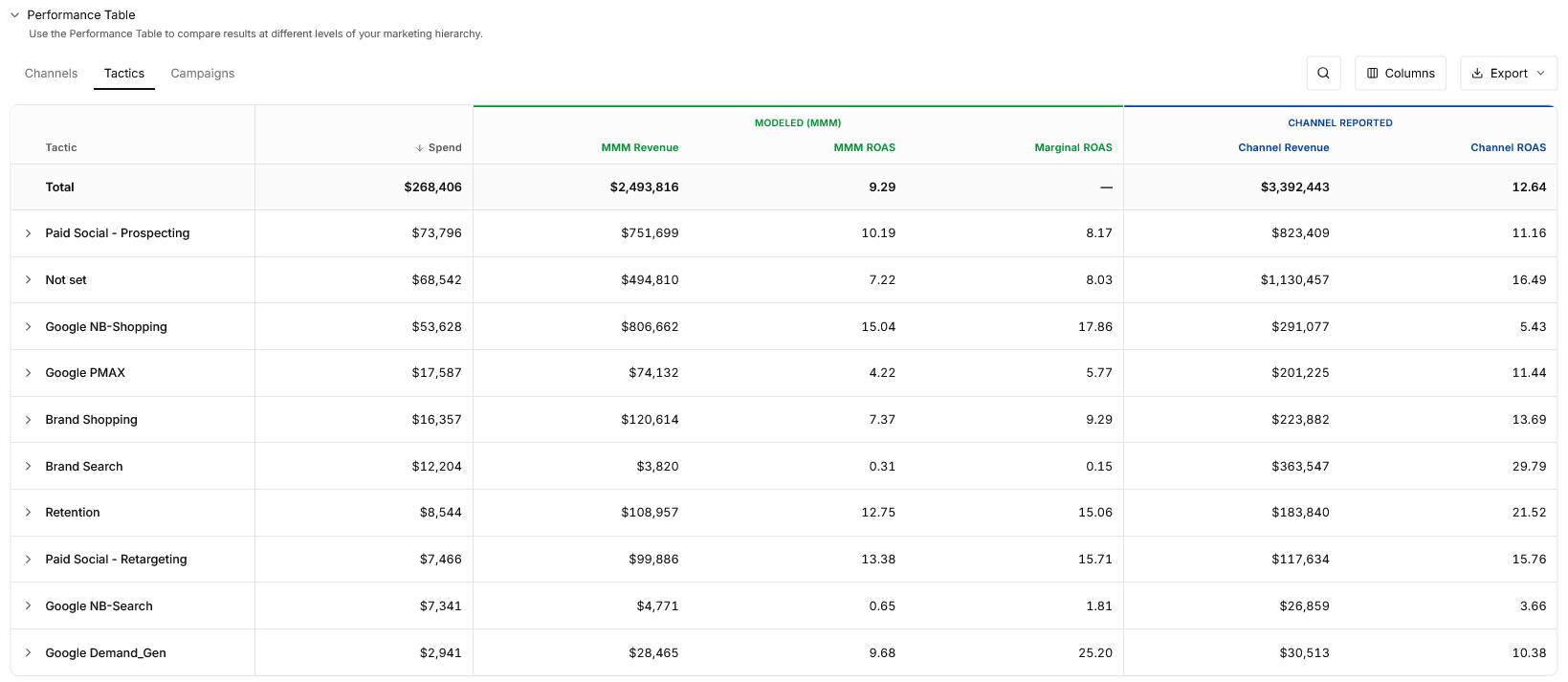
The platform also points out your top channels and campaigns to grow or cut back on. Those recommendations factor in halo effects, so you won't cut a prospecting campaign that looks weak in platform reporting but is driving sales somewhere else. Book a demo to see how your prospecting and retargeting stack up.
FAQs
What percentage of my budget should go to retargeting?
There's no single right answer, because the ideal split depends on your retargeting audience size, purchase cycle, existing demand, and growth goals. Retargeting can only absorb as much budget as its audience pool allows, so many brands put most of their spend into prospecting and size retargeting to fit the pool. The best way to set your split is to look at each campaign's full contribution and adjust based on which ones are worth growing.
Do prospecting campaigns drive conversions?
Yes. Prospecting's main job is creating demand, but many people buy right after clicking a prospecting ad, and many more buy later through branded search, direct traffic, Amazon, or retail stores. Those indirect sales are halo effects, and they often get credited to other channels or to retargeting, which can make prospecting look less effective than it is.
How long should a retargeting window be?
It depends on your purchase cycle. Cart abandoners usually get windows of about a week, while general site visitors might stay in a retargeting audience for up to a month. Brands with longer decision cycles, like furniture or mattresses, can justify longer windows, while quick, low-cost purchases usually call for shorter ones.
Should prospecting campaigns exclude website visitors?
That depends on how you define prospecting. If prospecting means reaching people who've never engaged with your brand, exclude website visitors and social engagers. If it means reaching anyone who hasn't purchased yet, you can include them. Either approach works as long as you choose one and report on it consistently.
Why does retargeting have a higher ROAS than prospecting?
Retargeting reaches people who are already interested in your brand, so they're more likely to buy whether or not they see the ad. Ad platforms also tend to credit the ad someone saw right before purchasing, which is often a retargeting ad, even when a prospecting campaign created the interest. A higher ROAS in platform reporting doesn't automatically mean retargeting deserves more budget.
Can I turn off prospecting and just run retargeting?
You can, but it usually catches up with you. Prospecting fills your retargeting pool, so turning it off shrinks the number of people retargeting can reach over the following weeks. Retargeting results slip, and you lose the direct sales and halo effects prospecting was driving.
The Halo
Exclusive insights, every week.
Subscribe to The Halo for sharper marketing thinking.
You're subscribed to The Halo!
Quick question (optional): How familiar are you with MMM?
Thanks for sharing! Enjoy The Halo.
Keep reading
View all
What is marketing data analysis (and how do you actually use it)?
Read article
How to measure Meta effectively (Ads Manager doesn't tell the whole story)
Read article
What cookieless marketing means for how you measure performance
Read article
Best MMM solutions for retail and omnichannel brands
Read article
Top of Funnel Visibility Loss: New Causes & What to Do
Read article
Brand Campaigns: Goals, Types, & Measuring Them Accurately
Read article