




Your marketing drives retail sales. Now you can prove it.
A car manufacturer spends billions building a brand. Dealerships sell the cars. But the manufacturer still tracks how every ad campaign affects dealership foot traffic, test drives, and sales.
Linnea Zielinski · 6 min read

A car manufacturer spends billions building a brand. Dealerships sell the cars. But the manufacturer still tracks how every ad campaign affects dealership foot traffic, test drives, and sales. They don’t just shrug and say, “We can’t see what happens after the showroom door.” They built the measurement infrastructure to connect the spend to the outcome.
Most consumer brands selling through retail don’t have that luxury yet. They run paid media across Meta, TikTok, Google, and TV, watch DTC conversions tick up, and then wonder how much of their Target and Walmart sell-through is actually coming from those campaigns. They know marketing is driving retail sales. They just can’t prove it, quantify it, or use it to make better budget decisions.
For brands with significant retail distribution, this is more than a reporting gap. When retail accounts for 20, 30, or 40% of your total revenue and it’s invisible to your measurement model, you’re making million-dollar budget calls with an incomplete picture. That tends to show up in misallocated spend, missed growth opportunities, and marketing teams that struggle to demonstrate their full impact to finance and leadership.
That’s the problem Prescient’s newest feature, Multi-Retail Connectors, was built to solve. And closing this measurement gap is one of the most impactful things a growing omnichannel brand can do right now.
Key takeaways
Brands selling through multiple retailers have long faced a blind spot: paid media performance and retail sales data exist in separate silos, making it nearly impossible to connect marketing spend to in-store outcomes.
Multi-Retail Connectors brings sales data from retail partners like Target, Walmart, Ulta, and Sephora directly into Prescient’s marketing mix model, so every revenue channel is reflected in your measurement.
Each retailer gets its own dedicated model, giving you per-retailer attribution instead of one blended number that hides how Meta performs at Target versus Walmart.
Setup takes weeks, not months. Pre-built connectors replace months of custom data engineering, and models refresh weekly so insights stay current.
Retail halo effects are now measurable. You can see which awareness campaigns are quietly driving in-store sales, and factor that into budget decisions.
Budget recommendations become more accurate when retail is included, with brands seeing allocation shifts of 15–30% once retail visibility is added to their model.
Multi-Retail Connectors is designed to scale with your retail footprint. Add a new retail partner through the UI without rebuilding existing models.
Why retail measurement has been so hard to get right
It’s not that brands haven’t tried to solve this. Most teams have some version of a workaround: manual CSV exports from retailer portals, aggregated “total retail” figures uploaded into their model, or geo-tests designed to estimate retail lift. The problem isn’t effort. These approaches have structural limitations that cap how useful the insights can actually be.
Manual exports are time-consuming and create lag. By the time the data is downloaded, reconciled, and loaded, it’s already outdated. Aggregated retail data treats all retailers as one bucket, so you lose the ability to see how Meta performs at Target versus how it performs at Walmart. And geo-testing, while useful, is a point-in-time measurement tool. It tells you what happened in a specific market during a specific window, but it doesn’t give you an ongoing model you can use for budget planning.
Retailer-provided dashboards don’t fill the gap either. They show retail performance, but they don’t connect that performance to your marketing spend. They can tell you that your product sold 12,000 units at Target in Q3. They can’t tell you that your connected TV campaign drove 40% of that.
The result is a growing disconnect. Retail footprints are expanding for many DTC brands. Revenue through retail is climbing as a share of the total. But measurement hasn’t kept up, and teams are left trying to justify retail-influencing media spend with DTC-only data.
Why this matters more now than it did two years ago
The DTC-first era was straightforward from a measurement standpoint. You ran ads. People clicked. People bought. Attribution was imperfect, but the closed loop was tight enough that most brands could operate with reasonable confidence in their data.
That era is over for a lot of brands. Distribution strategies have diversified. Target, Walmart, Sephora, Ulta, and specialty retailers have become meaningful revenue channels, not afterthoughts. Consumer behavior has shifted, too. Shoppers discover brands online but buy in-store. They see a Meta ad on Tuesday and pick up the product at Target on Saturday. That conversion will never show up in your DTC attribution, but the spend that drove it absolutely should show up in your budget model.
At the same time, the bar for marketing efficiency has risen. Brands are under pressure to demonstrate return on every dollar, and leadership teams are asking harder questions about what’s actually driving growth. When retail is a significant and growing part of the business, answering those questions requires measurement infrastructure that reflects the full picture.
What Multi-Retail Connectors actually does
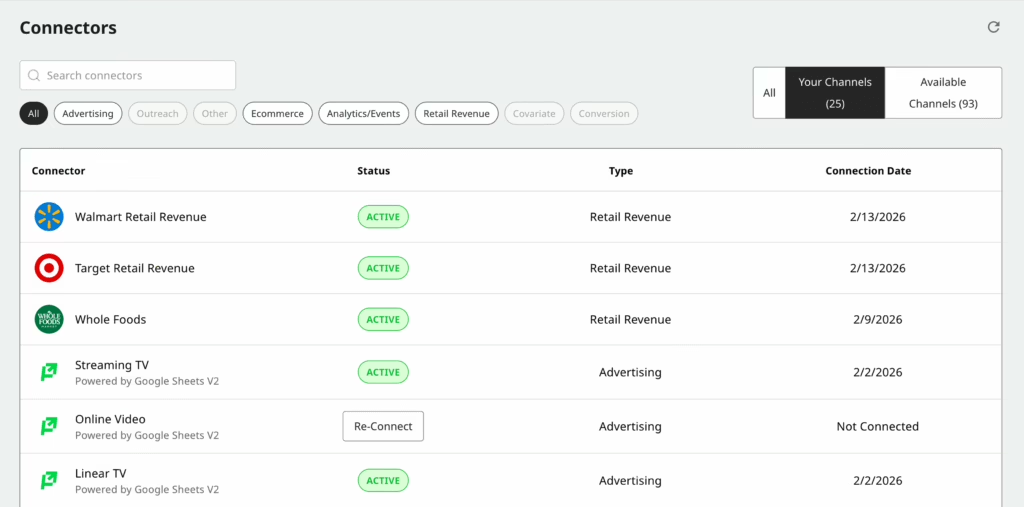
Multi-Retail Connectors brings sales data from your retail partners directly into Prescient’s marketing mix model. Instead of treating retail as an afterthought or a single blended number, it gives each retailer its own dedicated model, built and validated within weeks. Here’s how the process works in practice.
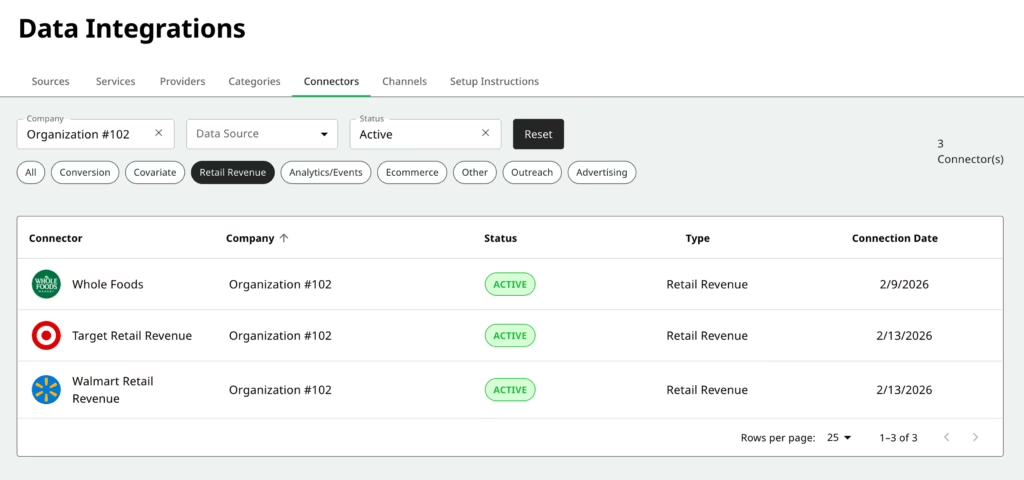
Connect: Link your retail partners through pre-built connectors. Our team handles data validation and schema normalization automatically, so you’re not waiting on a custom data engineering build.
Model: Prescient builds a dedicated MMM for each retail partner, processing historical sales data against your media spend across channels. Models go through QA validation before going live.
Optimize: See which channels drive sales at each retailer, identify retail halo effects, and reallocate budgets accordingly. Models refresh weekly so recommendations stay current, not stale.
A few things worth knowing about how this is built:
Retailers are measured separately, not aggregated. If you sell through Target and Sephora, you get distinct visibility into how your marketing affects each one.
This is physical retail sell-through measurement.
Adding a new retail partner doesn’t require rebuilding your existing models. You add a store, you add a model, and the rest of your measurement keeps running as normal.
What this makes possible for your team
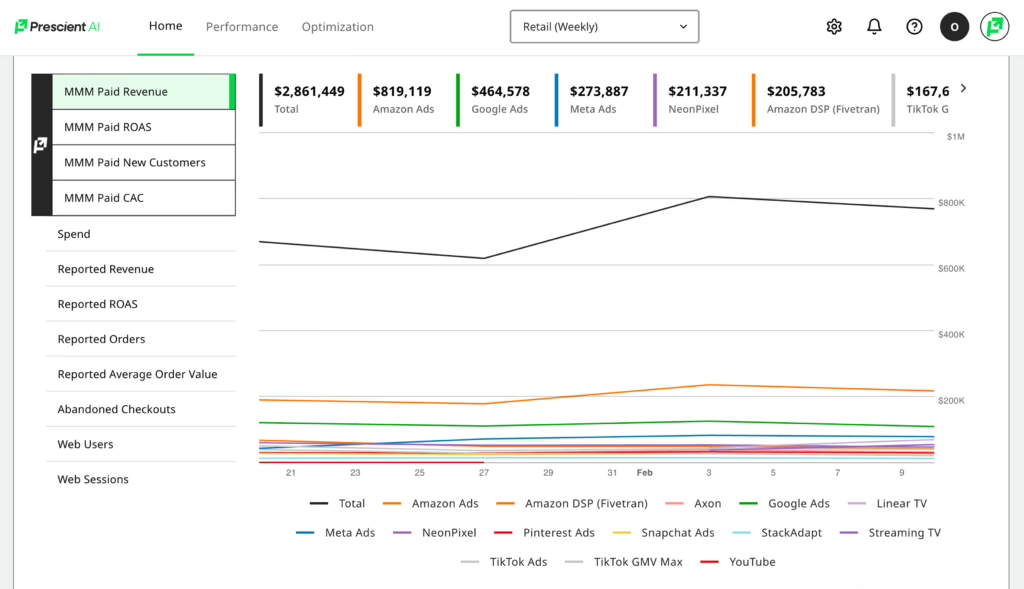
The most immediate shift is visibility. When retail sales are integrated into your MMM, budget recommendations are built on total business impact rather than DTC-only performance. For brands where retail is 20% or more of revenue, this can change allocation recommendations significantly, with some brands seeing 15–30% shifts in how budgets are distributed across channels once retail is included.
Beyond budget allocation, retail halo effects become measurable for the first time. This is a category of impact that has always existed but rarely been quantified:
The awareness campaigns that don’t drive clicks but do drive people into Target.
The connected TV spend that builds brand recognition that shows up in Walmart sell-through weeks later.
Multi-Retail Connectors surfaces these effects in the model, so you can factor them into decisions rather than hoping they exist.
There’s also a significant operational benefit. The manual process of downloading retailer exports, reconciling formats, and uploading data is replaced by automated weekly refreshes. What previously required analyst hours every reporting cycle becomes a background process, freeing your team to actually analyze performance instead of preparing data.
And for teams that regularly need to align with finance on forecasting, retail-inclusive models give you a shared foundation. Instead of marketing projections built on DTC revenue and finance projections that include retail, both teams are working from the same complete picture.
Who this is built for
Multi-Retail Connectors is the right fit for brands where retail is a meaningful and growing part of total revenue. More specifically, it tends to be most valuable when a few conditions are true.
You’re selling through two or more physical retail partners and need to see how marketing drives outcomes at each one separately.
Retail represents 20% or more of total revenue, meaning it’s too significant to leave out of your measurement model.
You’re running paid media across multiple channels and need to see total impact, not just what converts on your own site.
Your team is currently spending meaningful time on manual retail data exports and reconciliation.
You need to answer questions from leadership or finance about how marketing contributes to retail performance.
If retail is less than 10% of revenue or you’re just getting started with a single retail partner, the economics may not make sense yet. We’ll be direct about that in discovery.
What to do next
If you’re already a Prescient customer and retail is a meaningful part of your business, reach out to your account team. We’ll assess your retail data and identify which partners make sense to bring into your model first.
If you’re not yet working with Prescient and you’ve been trying to figure out how your marketing affects retail sales, this is a good time to have a conversation. We can show you exactly how the model works with data that looks like yours and give you a realistic sense of what changes once retail is included in your measurement.
The brands that figure out retail measurement first will have a real advantage in budget planning, retailer negotiations, and overall marketing efficiency. Request a demo to see Multi-Retail Connectors in action.
The Halo
Exclusive insights, every week.
Subscribe to The Halo for sharper marketing thinking.
You're subscribed to The Halo!
Quick question (optional): How familiar are you with MMM?
Thanks for sharing! Enjoy The Halo.
Keep reading
View all
See where every channel earns its budget with our new attribution
Read article
See exactly what your model sees: Introducing Model Center
Read article
Map your own data on your schedule with the Data Center
Read article
One plan, not two: Introducing Media Forecaster
Read article
Introducing Horizons 2026: Six updates built around one idea
Read article
Prescient AI named Predictive Analytics Solution of the Year in the 2026 MarTech Breakthrough Awards
Read article