



What it actually takes to see performance across every channel
Cross-media measurement should show true channel performance, not just deduplicated reach. Here's what most approaches miss and what gets brands closer.
Linnea Zielinski · 11 min read

Every advertising platform hands you back a report card written in its own language. Meta defines a win one way, Google defines it another, and your point-of-sale system at a retail partner measures something else entirely. None of these report cards use the same currency, and if you try to add them together without converting first, the total you get is meaningless. Cross-media measurement is supposed to be the exchange rate: the thing that takes all of those different currencies and turns them into one number advertisers can actually trust.
When the exchange rate is off, you don't just get a slightly wrong number, you make a real budget decision based on a fiction, and that fiction usually costs money in exactly the campaigns, channels, and audiences that were working hard without getting credit for it.
Key takeaways
- Cross-media measurement should combine deduplicated reach and frequency data across every channel and marketing campaign, but many approaches stop at digital platforms and skip retail, streaming, and linear TV entirely.
- Platform-reported metrics are a useful starting point, not a verdict, since different platforms and media owners count digital impressions and conversions using different logic across their own data.
- The most useful cross-media measurement systems account for how channels influence each other and how audiences move between them, not just how each platform or campaign performs in isolation.
- Privacy regulations and differential privacy standards have made deterministic, device ID-based measurement harder to rely on across platforms and media partners.
- Marketing mix modeling has become a more privacy-centric way to build a unified view of media performance across your entire media mix, without depending on individual-level tracking or shrinking data sets.
- The right measurement system should refresh often enough to support informed decisions about campaign and channel performance, not just deliver campaign performance data after the budget is already spent.
- Cross-platform measurement works best when it's built to scale, so adding a new campaign, channel, or media metric doesn't mean starting the whole data and measurement process over.
What cross-media measurement is actually solving for
Cross-media measurement exists to answer one deceptively hard question: how many actual people, across all of your audiences, did your marketing reach, and how did they respond, across every channel and every campaign at once? Every platform you advertise on tracks its own audiences, its own metrics, and its own definition of a conversion, and none of that data was built to talk to the data sitting on another platform.
Deduplicated reach is the piece most people focus on first. If the same person sees your ad on connected TV, then again in a Google search result, and again while scrolling Instagram, a good measurement system counts that as one person reached three times across three channels, not three separate people spread across three platforms. That distinction changes your reach and frequency metrics substantially, and it's critical for knowing your campaigns are reaching new audiences.
The bigger goal, though, is a unified view of performance across media channels, not just a deduplicated headcount. A holistic view means understanding how your different campaigns and different media channels work together to move someone from awareness to purchase, not only how each platform or channel performed inside its own silo. For advertisers running dozens of campaigns across a dozen platforms and channels, that's the whole point: one comprehensive understanding of the business and its data, instead of a dozen partial ones.
Where most cross-media approaches stop short
Most tools on the market handle the basics of cross-media measurement reasonably well, and most can report reach and frequency for a given campaign without much trouble. Where they tend to fall apart, across media, campaigns, and audiences alike, is in the details that don't show up in a product demo.
Digital-only measurement leaves retail and offline channels out
A lot of cross-media measurement systems only reach as far as digital channels. That covers social, search, streaming services, and connected TV reasonably well, but it leaves out linear TV viewing, co-viewing households where more than one person watches the same screen, and any sales that happen at a physical retail counter. For a brand selling through major retail partners alongside its own site, measuring only digital platforms means measuring only part of the business, and it leaves real data gaps in exactly the channels where a lot of revenue lives.
Platform-reported numbers get treated as ground truth
Different platforms and media owners count digital impressions and conversions using different logic, and some are incentivized to count generously. Treating platform-reported ad spend and return figures as an accurate measurement of what actually happened, instead of one input among several, is one of the most common mistakes in cross-media measurement. A modeled return can end up higher or lower than what a platform reports, depending on whether that platform tends to overcount or undercount its own impact, and the gap between the two can be quite large.
Channel-level metrics hide campaign-level differences
Even cross-media measurement systems that do a good job across channels often stop at the channel level. Two marketing campaigns on the same platform can perform completely differently, saturate at different spend levels, and reach different slices of your target audience, but a single channel-level metric smooths all of that campaign data over. Advertisers seek campaign performance data they can actually act on, and a single blended metric per platform rarely gives them enough detail across all their channels and campaigns to know which specific one to scale and which one to cut.
Spillover between channels rarely gets counted
When someone sees an ad on one channel and later converts through another, most measurement systems credit whichever channel happened to close the deal. That misses how audiences actually engage with a brand over time, and it misses how different media channels build on each other rather than working alone. A single moment of brand exposure on video can drive a spike in branded search or direct traffic weeks later, and if your measurement approach can't connect that dot across platforms, you'll systematically undervalue the channels doing the most upper-funnel work. That upper-funnel exposure is often where incremental reach, the audience your other channels weren't already reaching, actually builds.
Snapshot testing instead of continuous measurement
A single incrementality test or a one-time cross-platform reach study can be useful, but it's a snapshot, not a measurement system. Consumer behavior across various platforms shifts with seasonality, competitive activity, and plain old trends, so a measurement approach that doesn't refresh regularly can lead you toward decisions that were informed by last quarter's or last week's reality. A system that requires a full month or quarter to catch a shift in campaign performance isn't giving you enough lead time to protect your media investments.
No sense of confidence attached to the numbers
Even a well-built measurement system produces estimates, not guarantees, and treating a single point estimate as gospel is where a lot of ROI analysis goes wrong. Knowing how confident you should be in a given recommendation matters just as much as the recommendation itself, especially when the cost effectiveness of an entire channel, or an entire quarter of media investments, is on the line.
The main methods, and where each one holds up
Most cross-media measurement approaches lean on one of three underlying methods, and each comes with real tradeoffs across data, channels, and cross-platform measurement worth knowing in more detail before you commit budget or a contract to one.
Deterministic and probabilistic ID matching
Deterministic matching connects device IDs and first-party data across platforms to build a single view of a person's journey across media channels. It can be precise where it works, but privacy regulations and differential privacy standards have made this harder to pull off at scale, since a lot of the underlying data sets it depends on are shrinking or disappearing entirely. Advertisers who lean too heavily on this method often end up with strong data for a shrinking share of their audiences and very little visibility into the rest.
Modeled panels, sometimes called virtual people
Some measurement providers use statistical panels, occasionally referred to as virtual people, to estimate reach and frequency without tracking real individuals. This approach borrows from how linear TV has measured audiences for decades, using metrics like TV GRPs and frequency estimation, and adapts that logic for a world where people watch across devices and co-viewing is common. It's a reasonable workaround for privacy limits, and it can close some data gaps between platforms, but it's still an estimate built on a sample rather than a full accounting of your actual audience.
Incrementality testing
Incrementality tests measure what happened during a specific test window, which makes them useful for a point-in-time read on a single channel or campaign. The tradeoff is that a two-week test can miss effects that build over months, so treating a single test as the final word on a channel's performance tends to lead to expensive decisions later. Incrementality data is most useful when it is validated by a broader measurement system instead of replacing one.
Marketing mix modeling (MMM)
Marketing mix modeling, sometimes called media mix modeling, takes a step back and looks at the full media mix at once: how every channel and every campaign, along with pricing, promotions, and outside factors, contributed to business outcomes over time, using data from across the whole media landscape. Because it doesn't depend on tracking individual devices, marketing mix modeling has held up better under privacy regulations than deterministic methods, and it can support real cross-channel measurement instead of stitching together separate platform reports after the fact. Done well, it gives advertisers data-driven insights into which specific marketing campaigns are actually reaching their target audience and driving results across channels, not just which platform decided to take credit for them. It's also the method most capable of true cross-platform measurement, since it isn't limited to whichever platforms happen to share their data, and it treats every channel's data as part of one system instead of a dozen separate ones.
How cross-media measurement holds up as your channel mix grows
A brand running a handful of platforms and a modest media mix has a much simpler cross-media measurement problem than a brand running dozens of marketing campaigns, audiences, and media dollars across a dozen channels, streaming services, and retail partners at once. Advertising that started as a few digital campaigns tends to expand into connected TV, retail media, influencer, and offline channels over a few years, and each new platform adds one more entry to a growing list of data sources that needs to reconcile with everything already in place.
More channels means more places for data gaps to hide, more platforms reporting their own version of campaign-level performance, and more audiences to deduplicate against one another. Understanding how audiences engage differently across each one matters more, not less, as the mix grows, and a privacy-centric approach to that data becomes more important with every channel you add. This is exactly where channel-level metrics stop being enough, and it's why cross-media audience measurement gets harder as the number of platforms grows.
A system that requires a full rebuild every time you add a channel isn't built for scale, and neither is a set of existing systems that only talk to each other through manual exports. Marketing mix modeling tends to hold up better here, because adding a channel means adding a new input to the model rather than rebuilding a matching system from scratch. That matters for media planning decisions well beyond a single quarter: true cross-media measurement, and true cross-platform measurement in particular, should get more accurate as you add channels, not less, and consistent cross-channel measurement across all of them should give advertisers a clear read on advertising performance and media dollars, or ad spend, across the whole mix instead of a rough average. Done well, it gives you a more holistic view as complexity grows, helps advertisers manage frequency across a widening channel mix, and delivers accurate insights instead of a single blended number. For more detail on how a specific platform fits into a broader model, most measurement providers can walk through campaign-level and channel-level results side by side.
What to look for when evaluating a cross-media measurement approach
Between platform dashboards, testing vendors, and modeling providers, it's easy to end up with a stack of measurement providers whose data, metrics, and cross-media reporting don't agree with each other. A neutral cross-media measurement approach, one that doesn't have an incentive to favor any single platform's numbers, tends to hold up better over time. A few questions can cut through most of the noise before you commit:
- Does it account for retail, streaming, and linear TV, or only digital platforms?
- Does it report at the campaign level, or only as a channel-level average that hides real differences in campaign performance across channels?
- How often does it refresh its data, and does that cadence match how fast advertisers actually make decisions?
- Does it show how media channels and campaigns influence each other, or only how each platform performs alone?
- Does it check its own assumptions against outside data instead of asking you to take its output on faith?
- Does it tell you how confident to be in a given recommendation and campaign-level metric, or just hand you one number and move on?
- Does it hold up as true cross-platform measurement across a growing list of channels, or only across the ones it was originally built for?
Where Prescient comes in
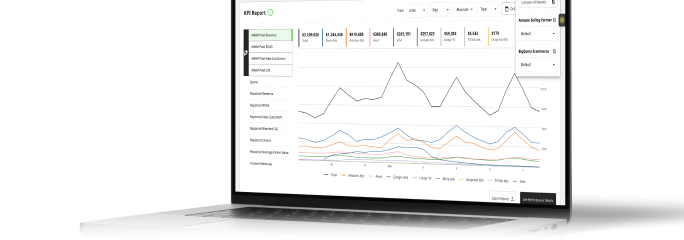
Prescient approaches cross-media measurement through marketing mix modeling built specifically for omnichannel advertisers, refreshed daily, and broken out at the campaign level. That granularity is what makes halo effects visible: the spillover from a single campaign into branded search, organic traffic, direct visits, and other retail platforms like Amazon.
If you want to see what cross-media measurement looks like when it accounts for retail, spillover effects, and saturation all at once, we'd love to walk you through it when you book a demo.
FAQs
What's the difference between cross-media measurement and multi-touch attribution?
Multi-touch attribution tracks individual touchpoints along a single customer's path and assigns credit to each one, which depends heavily on device-level tracking that privacy regulations have made less reliable. Cross-media measurement is a broader goal: getting one deduplicated, unified view of how all your channels, platforms, and campaigns performed together across every audience segment, which can be built through multi-touch attribution, marketing mix modeling, testing, or some combination of the three.
How is cross-media measurement different from marketing mix modeling?
Cross-media measurement describes the outcome advertisers are after: a single, unified view of performance across every media channel and campaign. Marketing mix modeling is one method for getting there, and it tends to hold up better than device-based approaches because it doesn't require tracking individual audiences or devices to understand how campaigns and channels are performing together across all of your data.
How often should cross-media measurement data be refreshed?
It depends on how often advertisers actually make decisions, but for most brands running always-on campaigns across several platforms, monthly or quarterly reporting is too slow to catch problems before they get expensive. A measurement system that refreshes daily or weekly gives you enough lead time to shift media investments before a full reporting cycle closes.
Does cross-media measurement work for brands that sell through retail stores, not just online?
It can, but only if the measurement approach was built to include retail and offline channels in the first place. A lot of cross-media measurement tools are designed around digital platforms alone, so it's worth confirming a provider actually accounts for retail partners, in-store sales, and the audiences behind them before assuming your full business, and all the data behind it, is covered.
The Halo
Exclusive insights, every week.
Subscribe to The Halo for sharper marketing thinking.
You're subscribed to The Halo!
Quick question (optional): How familiar are you with MMM?
Thanks for sharing! Enjoy The Halo.
Keep reading
View all
Can MMM measure marketing when customers buy through multiple channels?
Read article
What matchback analysis measures, what it misses, and how to fill the gaps
Read article
Can MMM measure influencer marketing?
Read article
Can MMM measure branded vs. non-branded search?
Read article
Can MMMs measure campaigns, or only channels?
Read article
How do MMMs work? What happens between your data and your budget recommendation
Read article