


How to measure effectiveness of awareness campaign performance
Learn how to measure the effectiveness of an awareness campaign, from brand awareness metrics to halo effects across Amazon, retail, and search.
Linnea Zielinski · 10 min read
Checking clicks to judge an awareness campaign is like reading a rain gauge in your backyard to figure out how much rain fell on a mountain. Most of that water has already run downhill and filled a river three towns over, and your gauge never saw it.
Awareness ads work the same way. Someone sees your brand in a video, keeps scrolling, and later shows up through a Google search, a direct visit, an Amazon order, or a shelf at Target. If your reports only check the backyard, you'll undervalue the media campaigns that are filling the river, and you might cut them right when your other marketing campaigns need them most. That's why measuring brand awareness well shapes your budget decisions as much as your reporting, and why it's worth getting right before your next planning meeting.
Key takeaways
- Judge a brand awareness campaign by the revenue it drives across every channel, not by reach alone. And, yes, awareness campaigns drive revenue.
- Early metrics like impressions, engagement, and branded searches show whether people noticed you, but they can't show what that attention was worth.
- Surveys and brand lift studies capture what people remember, which often isn't the campaign that first planted the seed.
- Marketing halo effects show up in organic search, direct traffic, branded searches, your Amazon storefront, and retail stores like Target and Walmart.
- Quantifying halo effects moves credit from bottom-of-funnel campaigns to the awareness campaigns that created the demand.
- Set benchmarks for each metric before launch so you know what success looks like, and give results a window that fits how long your customers take to buy.
Start with what success looks like
Before you pull a single report, decide how you'll measure success for this campaign. Awareness is an investment rather than an instant sale, so the goals you set decide which metrics matter when measuring brand awareness. Here's what to lock in first:
- Campaign goals: Tie each one to revenue outcomes and pick metrics that show progress, such as reaching potential customers in a new target audience, lifting purchase intent, or growing branded searches.
- A benchmark: Record your awareness levels before launch so you have something fair to compare against.
- A time window: Match it to your customer journey. A quick-purchase product might show results in days, while a big purchase can take months.
- Where to look: List every place customers can buy, like your website, Amazon, and retail partners, since that's where results will land.
Write these down as your measurement strategy, along with the metrics you'll report. It gives your marketing teams a fair yardstick, and it keeps "we liked the creative" from becoming your definition of success.
Brand awareness metrics worth tracking (and what each one misses)
Start with the early metrics, since they move first and cost the least to watch. This table shows what each of these metrics tells you and where it runs out.
| Metric | What it shows | What it misses |
| Impressions and reach | How many people saw your ads | Whether anyone remembered or cared |
| Branded search volume | Whether more people are searching for your brand name | Which campaign sparked the spike |
| Share of voice | How much of the conversation you own compared with competitors | Whether that conversation turns into sales |
| Social engagement | Likes, shares, comments, and saves | Purchase intent, since people engage with plenty they'll never buy |
| Brand mentions and sentiment | How often people talk about your brand, and whether they're positive | Conversations happening offline or in private messages |
| Direct and referral website traffic | Visitors who arrive without a search or through other sites | Why they came, and what happened on Amazon or in stores |
| User behavior in web analytics | Session depth, time on page, and returning visitors | Whether that interest turns into buying |
Content engagement from content marketing, like blog posts and videos, is another sign of real interest. It's useful, but like every metric in the table, it sits one step away from revenue.
Branded searches are your fastest signal
Of everything in the table, branded searches tend to move first. When people search for your brand name after seeing an ad, you'll often spot the bump in branded search volume well before survey results come back. The right tools make this easy to watch. Google Trends is a great tool for tracking search interest over time, Google Search Console shows the branded search queries bringing people to your site from search engines, and Google Analytics shows what those visitors do next. These common tools are free, and together with other web analytics reports, they give you a solid early read on brand awareness.
Watch out for vanity metrics
Big absolute numbers feel great, but they only mean something next to a benchmark and the right target audience. Ten million impressions on people who'll never buy is still a miss. Digital metrics like these tell you just what happened on the surface, so treat vanity metrics as directional and keep asking what they did for revenue.
Surveys, focus groups, and brand lift studies: Helpful, but flawed
Surveys are the classic way of measuring brand awareness, and they earn a spot in your toolkit. Brand lift studies compare people who saw your ads with people who didn't. Pre and post surveys check brand recall (do you remember this brand?) and brand recognition (do you know it when you see it?). Focus groups add the qualitative impact that numbers can't, like brand perception and brand associations.
They're good for that, but they're a shaky way to prove campaign effectiveness, for three reasons:
- Recall is a low-stakes memory. Nobody stores where they first noticed a brand, so answers come out fuzzy.
- People remember the wrong touchpoint. Before a shopper can name your brand and want it, they usually need enough exposures to shift from background noise to something they consciously recognize. The early ads—the ones that did the real work—fade from memory, and respondents point to whatever they remember from after that shift.
- The samples and windows are limited. Small panels can struggle to reach statistical significance, and a study run over a few weeks misses effects that build over months. Holdout tests that compare one region with another have the same problem, since no two regions behave alike and external factors like weather, seasonality, and competitor promotions muddy the comparison.
Treat survey results as helpful context, and check them against revenue data from multiple methods before you shape strategy or make big calls.
Halo effects are where awareness campaigns really show up
Ads that build brand awareness rarely ask for the click. A connected TV spot has no call to action button at all, so click-based metrics only tell part of the whole story, especially when media campaigns reach shoppers in different channels over time. A halo effect—the spillover from a campaign onto channels where it never earned a click—is where a lot of the value hides, and we believe the campaign deserves credit for it. Here's where it typically lands:
- Organic search: Shoppers search your product category and your brand appears in organic results. They click because your name now feels familiar.
- Direct traffic: They type your URL straight in after seeing your ad, with no click to trace.
- Branded searches: They search your brand name plus a product, then click a branded ad or listing. Some of that revenue belongs to the brand awareness campaign that planted your brand name.
- Your Amazon storefront: Even when an ad links elsewhere, plenty of people buy on Amazon because it's convenient.
- Retail stores: Shoppers pick you up at Walmart or Target, at Sephora or Ulta if you're a beauty brand, or at Dick's Sporting Goods if you're a sporting brand. We call these retail halo effects.
If you sell across these channels, awareness campaigns can drive sales in every one of them, because the customer journey rarely follows a straight line. You can't follow a shopper from an ad to a store shelf, so quantifying this means working backward from sales you can see and modeling what drove them. If you aren't quantifying it, you're only measuring the sales that came from a click, and you'll walk away with a skewed idea of whether your brand awareness campaigns are doing anything.
Why measuring halo effects changes who gets credit
Once you count halo effects, some credit moves. Retargeting, branded search ads, and last-click channels collect direct conversions from demand that awareness campaigns created, so quantifying halo effects takes part of that credit back. That changes how you compare brand awareness campaigns with bottom-of-funnel campaigns, and it's a strategy conversation worth having before budgets get set.
What this looks like in Prescient
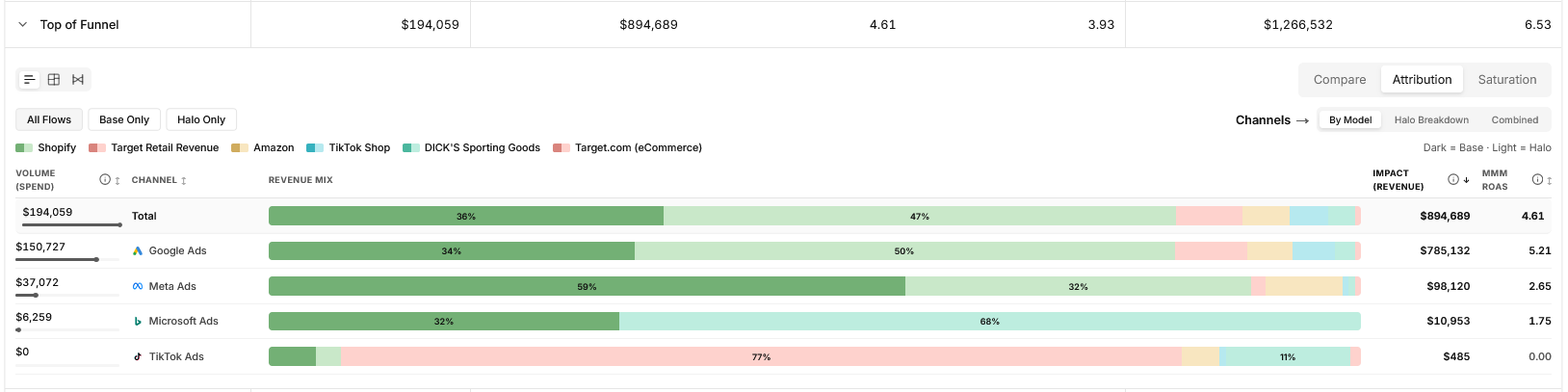
If you're running campaigns at every stage of the funnel, you can review performance in Prescient by tactic or by individual campaign, with Modeled ROAS sitting next to what each platform reports. Here's a sample from the Performance Table:
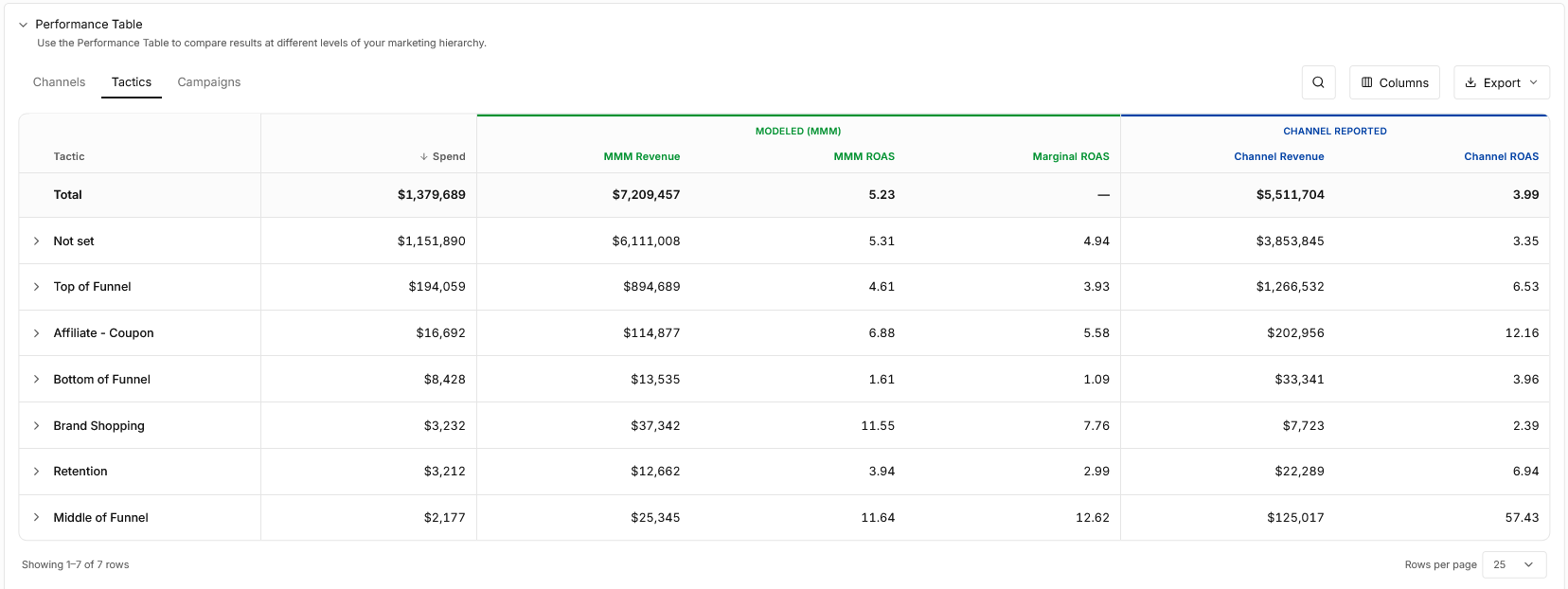
| Level | Spend | Modeled ROAS | Platform-reported ROAS |
| Top of Funnel (tactic) | $194,059 | 4.61 | 6.53 |
| Bottom of Funnel (tactic) | $8,428 | 1.61 | 3.96 |
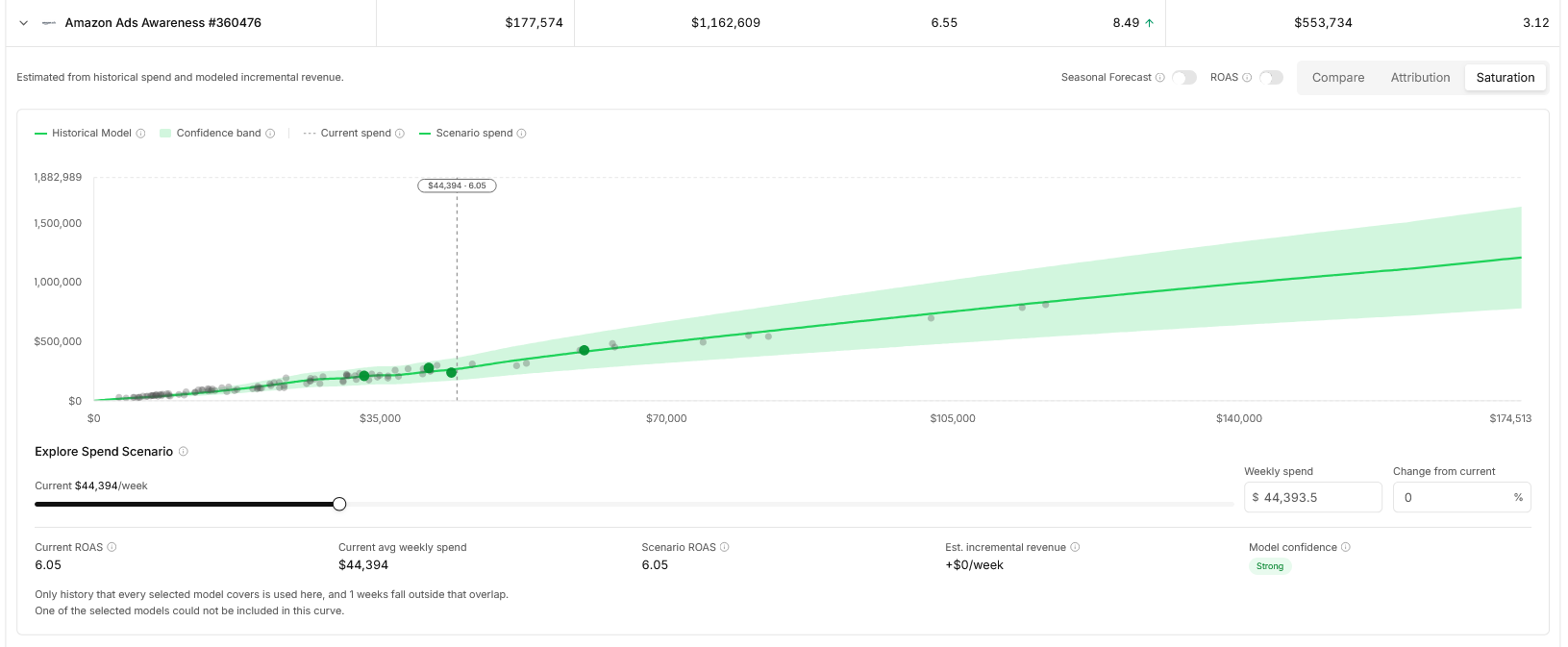
| Amazon Ads Awareness (campaign) | $177,574 | 6.55 | 3.12 |
The gaps run in both directions. Each platform reports its own conversions, so numbers can overlap and lean high or low. The Bottom of Funnel tactic reports 3.96 but models at 1.61, while the Amazon Ads Awareness campaign reports 3.12 and models at 6.55.
The Attribution view shows where a tactic's revenue lands. Dark shades show base revenue, and light shades show halo effects across Shopify, Amazon, TikTok Shop, Target Retail Revenue, Target.com, and Dick's Sporting Goods. In this example, only about a third of Top of Funnel revenue is base revenue, and the rest arrives as halo effects.
The Saturation view adds a forecast. For Amazon Ads Awareness, Marginal ROAS (8.49) sits above its average Modeled ROAS (6.55), and model confidence reads Strong. That points to possible room to spend more before returns flatten, though the confidence band widens as spend climbs, so it makes sense to scale in steps.
A step-by-step way to measure awareness campaign effectiveness
Here's a simple process for picking the right metrics and reading them, from setup to budget decisions.
- Set goals and benchmarks for your target audience before launch.
- Track early metrics like branded search volume, brand mentions, and social engagement.
- Use surveys for context, especially brand recognition and brand perception, and keep expectations modest about what they prove.
- Quantify halo effects across your website, Amazon, and retail partners.
- Compare Modeled ROAS with platform-reported ROAS for each campaign and tactic.
- Adjust budgets in steps, then recheck as results build over your buying cycle.
Bring in your CRM data and organic marketing efforts, such as content marketing and email marketing, when you compare periods so you can rule out other sources of growth. Knowing where awareness lands can also guide channel selection, since a campaign that's lifting Amazon sales may deserve a bigger role than its clicks suggest. Together, these campaign results give you a complete picture, and they make your strategy and marketing decisions easier to defend.
Common misconceptions about measuring brand awareness
A few myths come up again and again when teams start measuring brand awareness.
- "Awareness can't be measured." You can't measure it with clicks alone, but you can model where it shows up in sales, search, and retail.
- "If it didn't convert, it failed." Awareness media campaigns build demand that other channels collect, so judging campaign outcomes on direct conversions alone sets them up to lose.
- "One measurement approach is enough." Surveys, search data, and revenue modeling each catch different things.
- "A clear story is enough." Stories help in budget meetings, but dollars help more, and you can put a number on the impact.
Where Prescient comes in
Prescient's marketing mix model measures halo effects for each of your campaigns, including their effect on organic search, direct traffic, branded searches, your Amazon storefront, and retail sales at partners like Target, Walmart, Ulta, and Sephora. It works from the sales you can already see and models what drove them, so you get campaign-level answers without tracking individual shoppers, refreshed daily. That gives you a comprehensive understanding of what each campaign really drives.
It also means your brand awareness campaigns get credit for the demand they create, and your other marketing campaigns get an honest read on what they've earned, so your strategy rests on real numbers. If you'd like to judge the effectiveness of your awareness campaigns across every channel you sell in, book a demo. We'd love to walk you through the platform.
FAQs
What's the best metric for measuring an awareness campaign?
There isn't a single best metric, but the closest thing is revenue across every channel, including halo effects. Metrics like reach, branded search volume, and brand recall show whether people noticed you, and Prescient's Modeled ROAS shows what that attention was worth. Use the early metrics for direction and revenue for the verdict.
How long does it take to see results from an awareness campaign?
Branded search volume often moves first, sometimes within days or weeks, followed by organic traffic from search engines and direct visits. Conversion campaigns tend to perform better after that, once more people know who you are. The full effect can take several months, especially for higher-priced products, so match your window to how long customers take to buy.
How do you calculate ROI on an awareness campaign?
Add up the revenue the campaign drove across every channel, including halo effects on organic search, direct visits, branded searches, Amazon, and retail. Divide that revenue by your spend to get ROAS. For a simple ROI, subtract spend from revenue and divide by spend. Counting only click-based sales will understate the return.
Can you measure an awareness campaign without surveys or brand lift studies?
Yes. Branded search volume from Google Trends and Search Console, direct visits and returning visitors in web analytics tools like Google Analytics, and revenue modeling all work without a single survey. Survey metrics add qualitative context like brand perception, but they aren't required, and their results tend to arrive late.
How do brand awareness campaigns affect Amazon and in-store sales?
Shoppers who see an ad often buy wherever it's most convenient, which might be your Amazon storefront or a retail store instead of your website. Those sales don't show up as click-through conversions, so they're easy to miss. Quantifying halo effects, including retail halo effects at partners like Walmart, Target, Sephora, and Ulta, is how you see them.
What is a halo effect in marketing?
A halo effect is the spillover impact of a campaign beyond the conversions that come directly from it. An awareness ad might never get a click, yet it can lift organic search, direct traffic, branded searches, and sales on Amazon or in stores. Prescient measures these effects so brand awareness campaigns get credit for the demand they create.
The Halo
Exclusive insights, every week.
Subscribe to The Halo for sharper marketing thinking.
You're subscribed to The Halo!
Quick question (optional): How familiar are you with MMM?
Thanks for sharing! Enjoy The Halo.
Keep reading
View all
What matchback analysis measures, what it misses, and how to fill the gaps
Read article
Can MMM measure influencer marketing?
Read article
Can MMMs measure campaigns, or only channels?
Read article
How do MMMs work? What happens between your data and your budget recommendation
Read article
Prescient vs. last-click: What your attribution model can't see
Read article
How retargeting pixels work and what they can't tell you
Read article