




Your digital campaigns are driving retail sales. Here's how you measure them.
Omnichannel brands lose visibility every time a customer moves from seeing an ad to buying in a physical store. Here's how retail halo effects close that gap.
Linnea Zielinski · 6 min read
Think about the last time you picked a restaurant off Yelp. You read the reviews, looked at the photos, maybe checked the menu twice, and then you got in your car and drove there. Yelp did its job; it got you in the door. But nothing about that dinner ever shows up in Yelp's own numbers, so there’s no signal that the research actually turned into a real visit. The moment you moved from your phone to the physical world, the trail went cold.
Omnichannel brands run into this same problem every day, and it's costing them their best campaigns. A shopper sees a CTV ad or scrolls past a paid social campaign, then drives to a store that weekend to buy the product in person. That sale happened because of the campaign, but nothing in the platform's reporting ties the two together. If a brand can't prove that connection, the campaign often gets read as underperforming, and underperforming campaigns are the first ones to lose their budget.
Key takeaways
- Platform-reported ROAS only counts revenue that happens on that platform, so it misses sales that move from an ad into a physical store or a retailer's own site.
- Top-of-funnel campaigns often look weak next to bottom-of-funnel campaigns, not because they're actually less efficient, but because their real impact is invisible to standard reporting.
- This creates a trap where the campaigns doing the most work to build demand are also the ones that get cut first, since brands can only defend what they can measure.
- Channels that are naturally harder to track, like linear TV and CTV, take the brunt of this problem and often struggle to get funded at all.
- Halo effects, the revenue a campaign earns without a direct click, can land in a retailer's online shop, a retailer's physical location, or both.
- Measuring halo-effect revenue alongside base revenue gives a much more accurate read on which campaigns are actually working.
- Brands with a retail presence need measurement built for that reality, not e-commerce tools that were never designed to see a physical storefront.
Where platform-reported ROAS stops looking
Every ad platform is good at one thing: telling you what happened on that platform. If someone clicks your ad and buys on the spot, that's what shows up as your reported ROAS. This is what we'd call base revenue, the revenue that comes from someone directly engaging with an ad and converting.
The problem is that a lot of real buying behavior doesn't work that cleanly. Someone sees your ad, thinks about it, and buys later, somewhere else entirely. That later purchase, the one your ad helped create but didn't directly close, is a halo effect. For brands selling only online, halo effects tend to show up in places like branded search, organic search, and direct traffic. For brands with a retail presence, that same halo effect can also show up in a store.
The Yelp problem, but for your marketing
The Yelp example holds up here because it captures exactly what's happening. A customer's decision starts online, in the same place your campaigns live, and then finishes somewhere your reporting can't follow. They see your product on social, think about it for a few days, and then pick it up the next time they're at the store anyway.
That leap from digital to physical is where a lot of marketing value disappears from your reporting. It's not that the campaign failed to do its job. It's that the tools measuring it were never built to follow a customer from a screen into a physical aisle.
Why bottom-of-funnel always looks like the safer bet
This measurement gap creates a trap that a lot of omnichannel brands fall into without realizing it. Bottom-of-funnel campaigns, the ones capturing demand that already exists, tend to have a direct, easy-to-track path from click to purchase. Top-of-funnel campaigns, the ones actually creating that demand in the first place, often don't.
Since bottom-of-funnel keeps showing efficient numbers and top-of-funnel keeps showing weak ones, budget naturally drifts toward the channels that already look safe and effective. Meanwhile, the campaigns actually building new demand, once you factor in the halo-effect revenue they're driving into both online and retail sales, may be some of the most efficient spend in the entire budget. The brand just can't see it.
This is especially hard on channels like linear TV and CTV. These channels are almost never the reason someone clicks and buys immediately, so they lean almost entirely on halo effects to prove their value. Without a way to measure that, they end up permanently hard to justify, even when they're working.
Where halo-effect revenue actually lands
For a brand selling through retail partners, halo-effect revenue doesn't just show up in branded search or direct traffic. It can also show up in a retailer's online shop or in a customer walking into a physical store and buying the product in person.

That means a single campaign might be driving revenue across several places at once: some through a direct click, some through a retailer's e-commerce site, and some through in-store purchases that have no digital trail back to the campaign at all. Measuring only the first piece and calling that the campaign's full performance is how strong campaigns get cut.
Where Prescient comes in
Prescient's model measures base revenue and halo-effect revenue together, including halo effects that land in a retailer's own online shop and in their physical retail locations. Instead of stopping at what a platform can directly track, the model looks at the full pattern of how spend, seasonality, and demand move through your entire business, including the parts that happen offline.
You can see the breakdown of halo effects for each of your campaigns (as seen in the platform image above). Or you can look at each of your retail locations and see which digital channels contribute most to halo effect-driven revenue that happens there (as seen below).
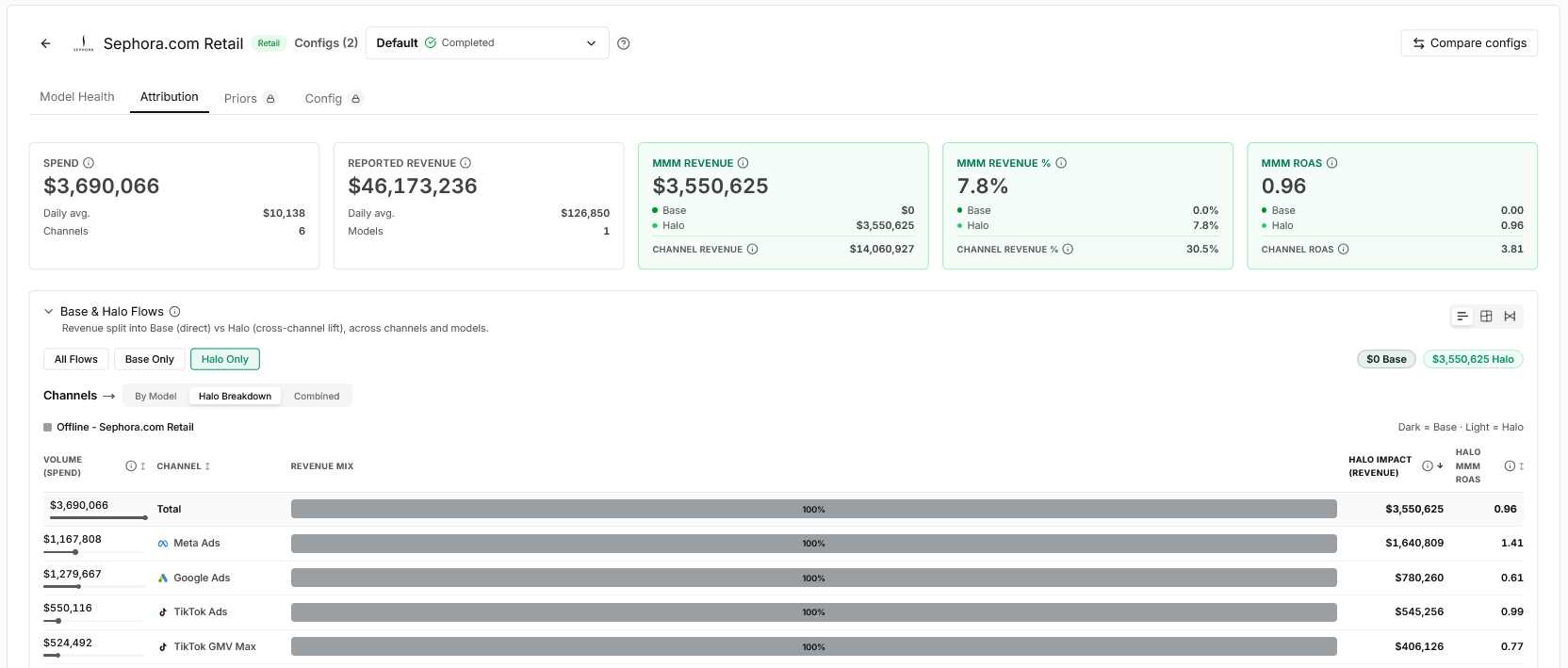
That means a campaign driving people into a store doesn't just disappear from the picture. It shows up as revenue, with a Modeled ROAS that reflects what the campaign is actually doing, not just the part a pixel happened to catch. If you want to see what your top-of-funnel spend is really earning across every channel where you sell, book a demo.
FAQs
What are halo effects in retail marketing?
Halo effects are the revenue a campaign generates without someone directly clicking and buying on the spot. For retail brands, this often means someone sees an ad, then later buys the product either through a retailer's website or in the physical store, without ever clicking back through to the original campaign.
Why does platform-reported ROAS make top-of-funnel campaigns look inefficient?
Platform-reported ROAS only counts sales it can directly track, usually a click that leads straight to a purchase. Top-of-funnel campaigns are built to create demand rather than capture it immediately, so a lot of the revenue they generate happens later and somewhere else, which platform reporting simply doesn't see.
Can halo-effect measurement actually tell if someone bought in a physical store?
Halo-effect modeling looks at the relationship between campaign spend and revenue across every place a brand sells, including retail locations. Rather than tracking an individual shopper, it identifies the pattern of how spend on one channel moves revenue in another, including into a physical store.
Should we stop investing in channels like linear TV or CTV if we can't directly measure them?
Not necessarily. These channels tend to work almost entirely through halo effects rather than direct clicks, so judging them by platform-reported numbers alone will almost always make them look weaker than they actually are. Measuring their halo-effect revenue gives a much clearer picture of whether they're worth the investment.
How is halo-effect revenue different from base revenue?
Base revenue comes from someone directly engaging with an ad and converting right away. Halo-effect revenue comes from the same campaign, but the resulting sale happens later, through a different channel, like a retailer's website or a physical store, without a direct click connecting the two.
The Halo
Exclusive insights, every week.
Subscribe to The Halo for sharper marketing thinking.
You're subscribed to The Halo!
Quick question (optional): How familiar are you with MMM?
Thanks for sharing! Enjoy The Halo.
Keep reading
View all
What retail media attribution measures and what it misses
Read article
Commerce media is promising, but its measurement lags behind
Read article
A practical guide to omnichannel measurement for multi-channel brands
Read article
This measurement blind spot is costing beauty brands credit for their media spend
Read article
A marketer’s guide to in-house MMM builds vs vendor tools
Read article
What causes attribution bias in marketing and how to reduce it
Read article