




How to assess your risk tolerance for big swings
Learn how to assess your brand's risk tolerance before making budget swings in the Prescient platform, using confidence scores alongside your business context.
Linnea Zielinski · 6 min read
Two hikers check the same trail conditions app before heading out. One sees "moderate difficulty, 30% chance of afternoon rain" and decides to go for it. The other looks at the same forecast and opts to wait for a clearer day. Neither decision is wrong. The difference is what each person is willing to risk if things don't go as planned.
Budget decisions in Prescient work the same way. When you're looking at a scenario that recommends shifting spend significantly across campaigns, the confidence score tells you how much reliable data the model has to work with, not how likely the outcome is to succeed. A low score means Prescient has limited historical data to model predictions accurately for that campaign at that spend level. It doesn't mean the forecast is wrong. But the score still can't tell you how much runway you have if the bet doesn't land, how close you are to a critical revenue period, or how much organizational pressure is riding on this cycle's performance. That context is yours to bring. Knowing how to assess your own risk tolerance is what turns a confidence score from a number into a decision.
Key takeaways
- Risk tolerance for big swings isn't a fixed trait; it's a function of your current business situation, and it can shift from one planning cycle to the next.
- Prescient's confidence scores reflect data reliability, not the probability of success; a low score means the model has limited data to work with, not that the forecast is unlikely to play out
- Because confidence scores measure data reliability rather than likelihood of success, they're designed to be read alongside your risk tolerance, not instead of it. A 60% Medium might be a clear go for one brand and a clear wait for another
- The size of the swing relative to your total budget is one of the most practical risk signals available to you in the platform.
- Proximity to high-stakes revenue periods like BFCM changes the calculus significantly. The same confidence score that's comfortable in spring may not be in October.
- Whether you're in a learning phase or an optimization phase affects what counts as a reasonable threshold to act on.
- New campaigns with lower confidence scores aren't inherently riskier than established ones. They're just in a different stage of data accumulation.
- Acting on a lower-confidence recommendation with a clear success criterion and a check-back window turns a big swing into a deliberate test. Without that structure, even a high-confidence recommendation can drift into ambiguity.
Why risk tolerance is a separate question from confidence
Prescient's confidence score is built from three inputs:
- the volume of historical data available for a campaign at a given spend level
- the width of the outcome range the model has observed
- how recently your brand has actually spent at the level being recommended
Together, those inputs tell you how reliably the model can predict performance in this territory, not whether the outcome is guaranteed. If you want a deeper breakdown of what each input is actually measuring, this article on how to read a confidence score walks through all three.
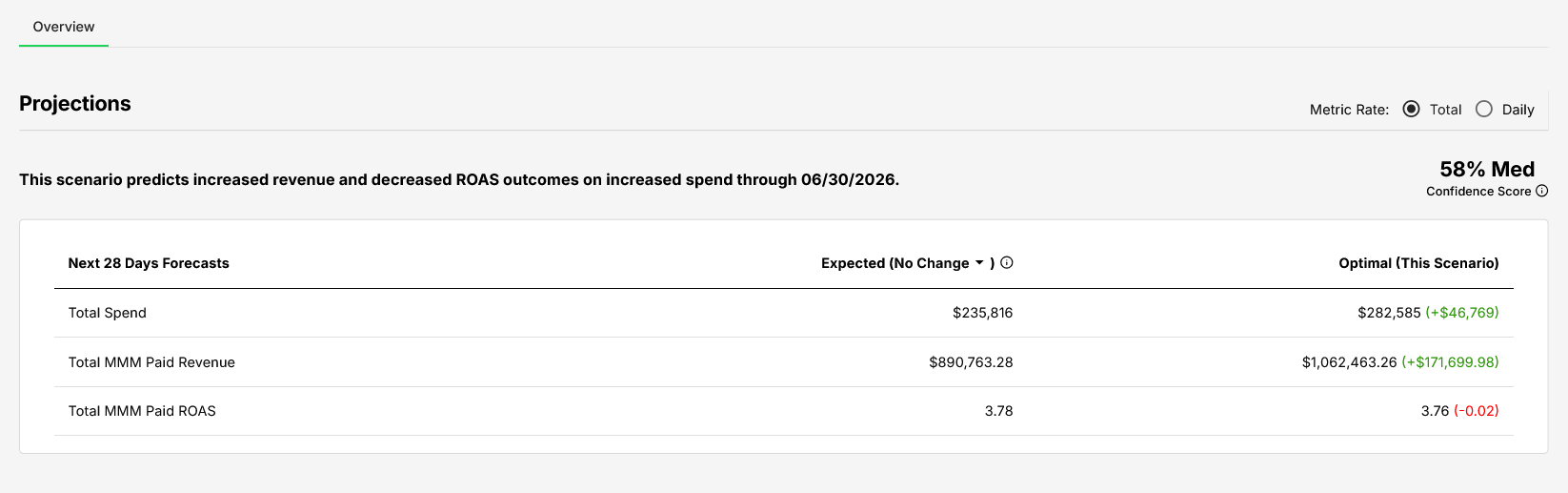
What the confidence score can't tell you is how a miss would land for your brand right now. A 55% Med on a scenario that represents 8% of your monthly budget hits differently than a 55% Med on a scenario that represents 40% of it. Both have the same score, but the risk is not the same.
That's why assessing your risk tolerance is its own step. Doing it before you look at a scenario's confidence score tends to produce cleaner decisions than the other way around.
Three questions to assess your risk tolerance
Before acting on any big swing in Prescient, these three questions help you build a quick picture of where your brand is right now and how much uncertainty is reasonable to take on.
How much can you absorb if this doesn't perform as projected?
Start with the practical math: what percentage of your total budget is this scenario touching? A swing that represents a small share of your overall spend gives you more cushion to learn from a miss. A swing that's moving a significant portion of your budget demands a higher threshold before you move.
Timing matters here too. Brands with several months before their next high-stakes revenue period, like a seasonal spike, a major promotion, or a key retail moment, have more room to test and course-correct. Brands that are a few weeks out from something they can't afford to get wrong should hold to a higher confidence standard, or scope down the swing so the downside is manageable if the scenario underperforms.
Are you in a learning phase or an optimization phase?
Put plainly, these two phases call for different confidence thresholds.
A brand that's newer to Prescient, or running campaigns that haven't accumulated much spend history at the levels being recommended, is in a learning phase. Lower confidence scores in this context are expected. They reflect the data accumulation stage, not campaign weakness. Acting on a modestly confident recommendation with a smaller budget move is exactly how you build the history that lifts confidence over time. Conservative big swings are appropriate here not because the model is uncertain, but because you're still building the foundation.
A brand that's been in the platform for multiple cycles and has well-established campaigns is in a different position. Higher confidence is achievable, and low confidence on an established campaign is a more meaningful signal worth digging into before you act. This is the phase where the confidence score and your risk tolerance can do the most productive work together.
Do you have a clear success criterion and a check-back window?
This is the risk management lever available to you regardless of where you are on the other two questions. You’re aiming for a test, not a simple change.
Before you act on a scenario, write down what you expect: a revenue lift percentage, an efficiency improvement, or a specific ROAS outcome over your chosen forecast window (7, 14, or 28 days). Then set a date to revisit it. When you accept a recommendation in Prescient and set an implementation date, the platform tracks actual performance against your scenario projections, so when you come back to check, you have the data to evaluate whether the move performed as expected, and to inform your next decision from there.
This structure does two things. It protects you from second-guessing a decision mid-cycle based on noise rather than signal, and it builds a record of how your brand's confidence thresholds translate to actual outcomes over time.
A practical starting point by phase
Your answers to the three questions above matter more than any single number, but if you're looking for a starting point:
- Brands in a learning phase can reasonably act on Low to Medium confidence scores (roughly 40–60%), provided the swing is sized conservatively and you have a success criterion in place. Lower confidence is expected at this stage, and waiting for a higher score may mean waiting longer than your brand can afford to stand still.
- Brands in an optimization phase with established campaigns should generally look for Medium confidence (51–69%) at minimum before committing to a large swing, and ideally Medium-High (70–79%) or above. Below the Medium threshold, it's worth asking which input is driving the lower score before you move. A data volume issue reads differently than a spend consistency issue.
- Brands within six weeks of a high-stakes revenue period should be more conservative regardless of phase. This isn't the moment to learn what happens when a scenario misses. If confidence is below Medium-High on a swing that's meaningful to your budget, sizing down or looping in your customer success rep to pressure-test the scenario is the right call.
If you're unsure where you land or what a confidence score is telling you about a specific campaign, your CS rep is the right person to talk through it. They have visibility into your data history and can help you assess whether the score reflects something structural or something that's likely to resolve with more spend history.
Wrapping it up…
Prescient surfaces confidence scores alongside every scenario recommendation because the goal is to give you the information you need to decide how much weight to put on it. The model does the work of quantifying uncertainty. Your job is to meet that with a clear-eyed read of your own situation so that every big swing is a decision that can be measured, not a guess.
If you're not yet using Prescient and want to see how confidence scores and scenario forecasting work together in practice, book a demo. We’d love to walk you through the platform.
The Halo
Exclusive insights, every week.
Subscribe to The Halo for sharper marketing thinking.
You're subscribed to The Halo!
Quick question (optional): How familiar are you with MMM?
Thanks for sharing! Enjoy The Halo.
Keep reading
View all
How effective is direct mail marketing? What the numbers show and what they miss
Read article
How to actually optimize your ad spend (not just cut waste)
Read article
How to allocate marketing budget across channels
Read article
How to run a successful marketing campaign
Read article
How to allocate budget for digital marketing
Read article
A guide to digital media planning for modern marketers
Read article