




A marketer's practical guide to integrated marketing campaigns
A practical guide to planning, launching, and measuring an integrated marketing campaign, plus the mistakes that undermine all your hard work.
Linnea Zielinski · 9 min read
Think about a home renovation where the electrician, the plumber, and the drywall crew all show up on separate days and never talk to each other. Each one does solid, technically correct work, but the electrician puts an outlet where the plumber needs pipe access, and drywall goes up before the wiring gets finished. Nothing is broken exactly, but nothing fits together either, and the homeowner is the one who ends up paying for the rework.
Most marketing strategies work the same way. A brand runs paid social media, email, PR, and TV ads that are all fine on their own, but nobody built them around one target audience or one plan. That's the gap an integrated marketing campaign is meant to close, and it's about more than brand polish. When channels aren't coordinated, marketing budget gets duplicated, brand messaging gets diluted, and it becomes hard to tell which parts of the campaign are actually moving the business forward.
Key takeaways
- An integrated marketing campaign aligns messaging and goals across multiple channels so they work as one system instead of separate marketing efforts.
- Cross channel marketing and integrated marketing campaigns aren't the same thing, and mixing them up leads to messaging that shows up everywhere but connects nowhere.
- The building blocks are a shared business objective, a defined target audience, one core brand message, and a deliberate mix of paid, owned, and earned media.
- Successful integrated marketing strategies come from a clear, step by step process, not from copying a framework and hoping it translates to your team.
- The biggest failure points are adding channels too fast, skipping cross-team alignment, and treating every lead the same regardless of how many touchpoints they've had.
- Platform-level reporting can't show you what integration is actually doing, because it reports each channel in a silo instead of how the channels influence each other.
What is an integrated marketing campaign?
An integrated marketing campaign aligns messaging, creative, and goals across every channel a brand uses, so a customer gets the same core brand message whether they see a TV ad, open an email, or scroll past a social media post. Rather than treating each channel as its own campaign, an integrated marketing approach treats them as different expressions of one plan built around a single target audience.
It's worth pausing on how this differs from cross channel marketing, because the two terms sometimes get used interchangeably. Cross channel marketing just means a brand shows up on more than one channel. It says nothing about whether those channels are actually working together. A brand can run ads on social media, send email marketing campaigns, and buy traditional advertising and still have each one built around a different message, timeline, and audience. That's cross channel marketing without integration. An integrated marketing campaign requires all of those marketing channels to share the same target audience insight, consistent messaging, and the same campaign goals, coordinated well enough that a person encountering more than one touchpoint gets a consistent brand message instead of a handful of disconnected ones.
This kind of coordination is also sometimes called integrated marketing communication, and the label matters less than the outcome: a customer journey and a customer experience that feel like one coherent story instead of several marketing efforts competing for the same person's attention. Brands that get this right tend to see it show up as brand recognition and brand recall over time. Basically, the pay off can be more than a short-term bump.
The building blocks of an integrated marketing campaign
Every successful integrated marketing campaign is built from the same handful of key elements, even when the channels and creative look completely different from brand to brand. Here's what those building blocks look like in practice:
- A shared business objective: A specific, measurable goal, like launching a new product or increasing brand awareness in a new market, that every channel works toward instead of just a general sense of "more marketing."
- A defined target audience: Customer personas built from real data, including where they spend time and what stage of the customer journey they're in, so messaging can be tailored across channels without becoming inconsistent.
- One core brand message, adapted per channel: The message doesn't get restated word for word everywhere. A TV ad, an email, and a social media post can each carry it differently while still reinforcing the same brand voice and brand values.
- A mix of paid, owned, and earned media: Paid media (TV ads, paid social, sponsorships), owned media (your website, email list, organic social), and earned media (PR, word of mouth, user generated content) each play a different role, and integration works best when they're chosen deliberately instead of just added on.
Once these pieces are in place, the harder part is sequencing them across your marketing channels, which is where most teams actually get stuck.
How to build an integrated marketing campaign step by step
Frameworks like SOSTAC or PESO are useful for understanding the theory behind an integrated marketing strategy, but they don't always translate into an actual to-do list. Here's a more concrete sequence for turning marketing strategies into a campaign you can actually launch.
Start with the target audience
It's tempting to build a campaign around a new feature or product launch and figure out the target audience later, but that order tends to produce marketing efforts that talk at people instead of to them. Start by identifying who you're trying to reach and what they actually care about. A small agency drowning in tools needs a different brand message than an enterprise buyer weighing a dozen stakeholders, even if you're selling the same product to both. Building audience personas first makes every decision after this point easier, from the core message down to which of the various marketing channels you actually need.
Build a simple messaging house before touching channels
Before any channel gets involved, write down the core message, two or three supporting points, and the tone you want across everything. This doesn't need to be an elaborate document. A single page that everyone on the team can point to is usually enough to keep a consistent brand message as different people create content for different channels and different marketing campaigns.
Pick a few channels and get them working together first
One of the more common mistakes is trying to launch across ten channels at once because that feels like what "integrated" is supposed to mean. It's more effective to choose two or three marketing channels that reach your target audience, get the coordination and handoffs right, and expand from there once that foundation is solid. A brand's first integrated campaign might be as simple as PR and niche publications for awareness, LinkedIn for education, and email marketing for the people who've already engaged, without needing a bigger budget than that.
Coordinate timing and handoffs across teams
Integration breaks down fast when one channel launches weeks ahead of another, or when a lead who's engaged with three different touchpoints gets treated the same as someone who's seen a single ad. Map out a rough timeline for when each channel goes live, and make sure the handoff to sales accounts for how much of the campaign a lead has actually seen. Someone who's read a blog post, opened three emails, and clicked a retargeting ad deserves a different first conversation than someone who just landed on the site, and that difference is part of what a good customer experience across multiple channels actually looks like.
Get stakeholders aligned before launch, not after
Cross-departmental alignment is often the actual bottleneck, more than any tool or channel choice. Loop in product marketing, content, and sales before the campaign goes live, not after leadership asks why the messaging doesn't match what sales is telling prospects. A short recurring check-in during planning tends to prevent most of the "wait, why did we say that" moments that show up after launch and undercut an otherwise consistent brand experience.
Mistakes that break an otherwise good integrated marketing campaign
A lot of these mistakes don't show up as one obvious failure. They show up as a campaign that technically launched but never quite worked the way an integrated marketing campaign should. A few patterns come up over and over:
- Adding more marketing channels before the first few are actually coordinated, which spreads the team thin without improving campaign performance.
- Treating every lead the same regardless of how many touchpoints they've had, which wastes the personalization that integration is supposed to make possible.
- Skipping cross-team alignment until launch is close, which leads to messaging mismatches between what marketing built and what sales is saying.
- Assuming integration requires an enterprise budget, when a well-coordinated three-channel campaign usually outperforms a disconnected ten-channel one.
- Measuring each channel's performance in isolation, which makes it hard to see how the channels are actually influencing each other.
That last point deserves its own section, because it's the one most guides to integrated marketing campaigns skip.
How do you know if it's actually working?
Most guidance on integrated marketing stops at launch, but measuring campaign performance across multiple channels is where a lot of the actual value gets lost. Standard analytics tools report website traffic, social media engagement, and email opens as separate line items, which is fine for tracking activity but doesn't tell you much about how an integrated marketing strategy is performing as a whole.
The problem is that a well-integrated campaign is designed to create spillover between channels. A TV ad or a PR placement might not drive a single direct click, but it can still increase branded search volume, direct traffic, and even in-store or Amazon sales days or weeks later. If your customer data is siloed by platform, that lift shows up as unrelated to the campaign that actually caused it, and a brand can end up cutting the marketing channel responsible for it.
This is also where a lot of brands run into a version of the same problem with customer loyalty and brand recall. An integrated campaign that consistently reinforces the same message across multiple channels tends to increase brand awareness and improve customer loyalty in ways that show up gradually across repeat purchase rate and branded search, rather than in any single channel's dashboard. If you're only looking at each channel's platform-reported numbers, that kind of cumulative brand experience is nearly invisible, even though it's often the whole point of running an integrated marketing campaign.
Where Prescient comes in
This is exactly the kind of spillover that Prescient's marketing mix model is built to measure. Instead of reporting each channel's performance in isolation, Prescient tracks halo effects: the revenue that shows up in branded search, organic traffic, direct visits, and retail channels like Amazon or Target as a result of campaigns that never got direct credit for it.
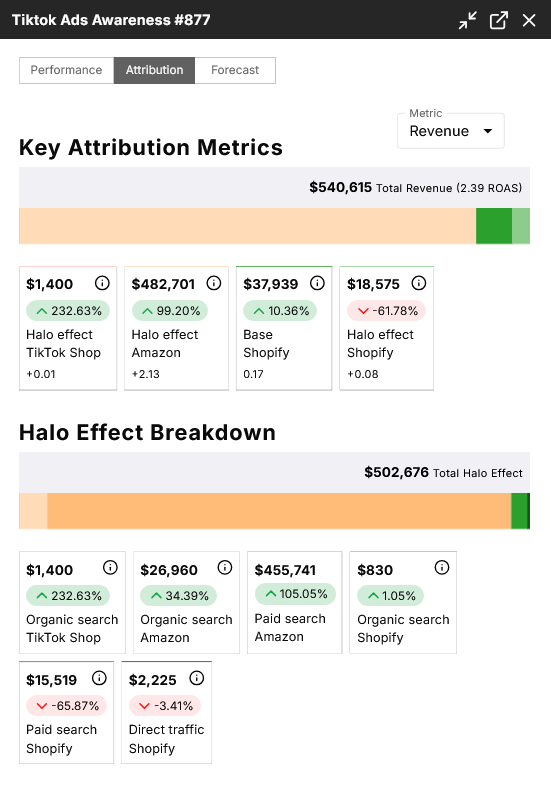
Because the model looks at campaign performance across all of a brand's marketing channels together instead of one platform at a time, it can show which pieces of an integrated marketing campaign are doing more than their own dashboard gives them credit for. That's often the piece missing from an otherwise well-built integration effort: not more channels or better creative, but a way to see how the channels you already have are actually working together.
Ready to see what your channels are really doing together?
Building an integrated marketing campaign takes real coordination, and once it's live, the marketing channels working together are exactly what makes it hard to measure with tools built to report on one platform at a time. Prescient's marketing mix model was built for that gap, giving marketing teams a daily-updated, campaign-level view of how paid media, organic channels, and retail all move together instead of separately.
See how the Prescient platform can reveal how much of your integrated marketing campaign performance is currently hiding in channels that aren't getting credit for it when you book a demo.
FAQs
What are integrated marketing campaigns?
Integrated marketing campaigns are coordinated marketing efforts that align messaging, creative, and goals across multiple channels, like paid media, email marketing, PR, and social media, so a customer gets a consistent brand experience no matter where they encounter the brand. The goal is for all of those touchpoints to work as one connected campaign rather than separate initiatives running at the same time.
What is an example of an integrated marketing campaign event?
A product launch event is a common example. A brand might build awareness with PR and influencer content ahead of the event, run paid social and email marketing to drive registration, cover the event live on social media, and follow up with retargeting ads and email nurture sequences afterward. Each channel plays a different role, but all of it reinforces the same core message and pushes toward the same campaign goals.
What is an example of an integrated campaign?
Coca-Cola's "Share a Coke" campaign is a widely cited example, since it replaced the brand's logo with popular names across packaging, social media, and out-of-home advertising, then invited people to share their own experience with the campaign online. The consistency across every touchpoint, paired with a message simple enough to translate across channels, is what made it work as an integrated campaign rather than just a clever packaging idea.
What are the major components of an integrated marketing campaign?
The core components are a shared business objective, a clearly defined target audience, one core brand message adapted for each channel, and a deliberate mix of paid, owned, and earned media. Some breakdowns expand this into eight or more components by separating out things like content strategy, analytics tools, and cross-team coordination, but all of them build on that same foundation of shared goals and consistent messaging across marketing channels.
The Halo
Exclusive insights, every week.
Subscribe to The Halo for sharper marketing thinking.
You're subscribed to The Halo!
Quick question (optional): How familiar are you with MMM?
Thanks for sharing! Enjoy The Halo.
Keep reading
View all
How effective is direct mail marketing? What the numbers show and what they miss
Read article
How to actually optimize your ad spend (not just cut waste)
Read article
How to plan a multi-channel marketing campaign that actually works together
Read article
The real advantages of market segmentation, and how to prove they're working
Read article
How to allocate marketing budget across channels
Read article
How to run a successful marketing campaign
Read article