




What Is AppLovin, & How Can It Drive Your Brand Growth?
AppLovin is breaking into DTC advertising with strong results. Learn how it works, what the data shows on its halo effects, and how to scale it with confidence.
Linnea Zielinski · 8 min read
You've probably walked past a display at a trade show, seen a banner on a newsletter, or heard a podcast ad...and thought nothing of it. Then three days later, you bought the product. Not because of the last thing you clicked, but because of everything that came before it. That's how advertising actually works, and it's also the reason AppLovin is making so many DTC marketers sit up and pay attention.
AppLovin built its ad network inside mobile games, a context so different from traditional social feeds that most DTC brands overlooked it entirely. But while those brands were busy fighting over the same Meta audiences, AppLovin was quietly reaching over a billion users in a high-engagement, low-distraction environment. Now that it has opened its platform to ecommerce advertisers, the results are hard to ignore. Getting the measurement right from the start, though, is what separates brands that scale confidently from those that leave money on the table.
Key takeaways
- AppLovin is a global ad network that connects advertisers with over 1.4 billion users primarily through mobile gaming apps, and has recently expanded into DTC and ecommerce advertising.
- Its Axon AI engine uses machine learning to optimize ad targeting and campaign performance, delivering results that top brands are comparing favorably to Meta.
- Across Prescient's customer base, top AppLovin spenders are allocating an average of ~10% of their weekly marketing mix to the channel, and many are growing their total budgets rather than simply shifting dollars from other channels.
- AppLovin's halo effects—revenue driven by ad exposure rather than direct clicks—started lower than other core channels but climbed significantly over time, nearly matching Meta during the BFCM period in 2024.
- For brands with Amazon revenue, AppLovin's halo contribution is especially large: for MaryRuth Organics, 87% of Amazon sales tied to AppLovin campaigns came from halo effects.
- Saturation on AppLovin doesn't behave the way most marketers expect: the curve can show a second efficiency peak at higher spend levels, which means pulling back early can cost brands real revenue.
- Measuring AppLovin with click-based tools alone will systematically undercount its true impact; an MMM that captures cross-channel halo effects is the only way to see the full picture.
What is AppLovin?
AppLovin is a mobile technology company and advertising platform that helps app developers—particularly in the mobile gaming industry—grow their user bases and monetize their apps through AI-driven advertising. Founded in 2012 and headquartered in Palo Alto, it operates one of the largest advertising networks in the world, connecting advertisers with a 1.4-billion-user network that spans thousands of mobile gaming apps and other digital properties.
For most of its history, AppLovin's core customers were game developers and app publishers using its tools for user acquisition and to maximize revenue from their own apps. The company's MAX product handles in-app bidding and real-time ad auctions on behalf of publishers, while Lion Studios—its own games label—helped the company build deep expertise in what makes mobile advertising work at scale.
That expertise is now being pointed at ecommerce. And for DTC brands paying attention, the timing matters.
From mobile gaming to DTC
The engine behind AppLovin's advertising platform is Axon, a machine learning engine built to optimize ad targeting and campaign performance at scale. Axon analyzes user behavior across AppLovin's network to serve ads to the people most likely to convert, and it's been refined over years of operating inside one of the most performance-sensitive environments in digital advertising: mobile gaming, where user acquisition costs are scrutinized down to the cent.
AppLovin's expansion into ecommerce is still relatively recent, and its self-serve platform for DTC brands has been in a closed beta that's gradually opening to more advertisers. Formats for ad creatives support vertical video and static creatives, meaning brands can often repurpose top-performing assets from Meta or TikTok without rebuilding from scratch.
Why DTC brands are paying attention
The user context on AppLovin is genuinely different from social platforms. Someone in the middle of a mobile game isn't doom-scrolling through bad news or catching up on a stressful inbox. They're focused, engaged, and often in a reward state, especially right after completing a level or hitting a milestone. That's when AppLovin surfaces your ad. The psychology of that moment matters. Ads that show up as a welcome break rather than an interruption tend to perform differently.
The reach is also substantial. Over 200 million U.S. adults play mobile games weekly, and AppLovin's network gives advertisers access across that entire footprint, a significant pool that sits largely outside the saturated social ad ecosystem where most DTC brands compete.
How AppLovin performs in the real world
The hype around a new advertising platform is always easy to find. The data is harder. Prescient has been measuring AppLovin performance across its customer base since the platform opened to ecommerce advertisers, and the patterns that have emerged tell a more nuanced story than most of what's circulating in marketing forums and Slack groups.
What Prescient's MMM data shows about spending patterns
Across Prescient's measured cohort, Meta continues to dominate budgets at 60%+ of spend. But AppLovin has moved quickly. Top-spending brands are consistently putting around 10% of their weekly marketing mix into AppLovin, a level that already equals or exceeds what many brands spend on Google, Amazon Ads, and TikTok. Some top brands have reached ~20%+ of their total mix on AppLovin, with individual daily spend exceeding $75,000.
Critically, most of those top spenders aren't shifting dollars away from their core channels. Instead, they're growing overall budgets. That's a meaningful signal. It suggests AppLovin is reaching genuinely new audiences rather than cannibalizing existing demand, the difference between a channel that competes with your current mix and one that adds to it. Budget shifts, where they do happen, tend to come from longer-tail channels like podcasts, influencers, and Pinterest rather than from Meta or Google.
The metric most AppLovin campaigns are missing
Halo effects in marketing are the revenue that happens because someone saw your ad, not because they clicked it. Someone watches your AppLovin video during a game break, keeps scrolling, and searches your brand name three days later. That branded search conversion doesn't trace back to AppLovin in any click-based system. But it should.
When Prescient first began measuring AppLovin, halo effects came in lower than most other core channels: around 15% of modeled revenue on average, compared to roughly 30% for Meta and Google. That gap has closed significantly. By our second analysis, AppLovin's halo rate had climbed to ~22%, putting it in line with Google (~23%) and just behind TikTok (~25%). During BF/CM 2024, AppLovin's halo effects nearly matched Meta's, and it was the only core channel in that period to see halo rates increase relative to the 30-day average.
This all means that brands measuring AppLovin campaigns on clicks and direct conversions alone are likely undercounting its contribution by a meaningful margin. The channel is developing awareness value that takes time to show up, and won't show up at all in attribution tools that aren't built to capture it.
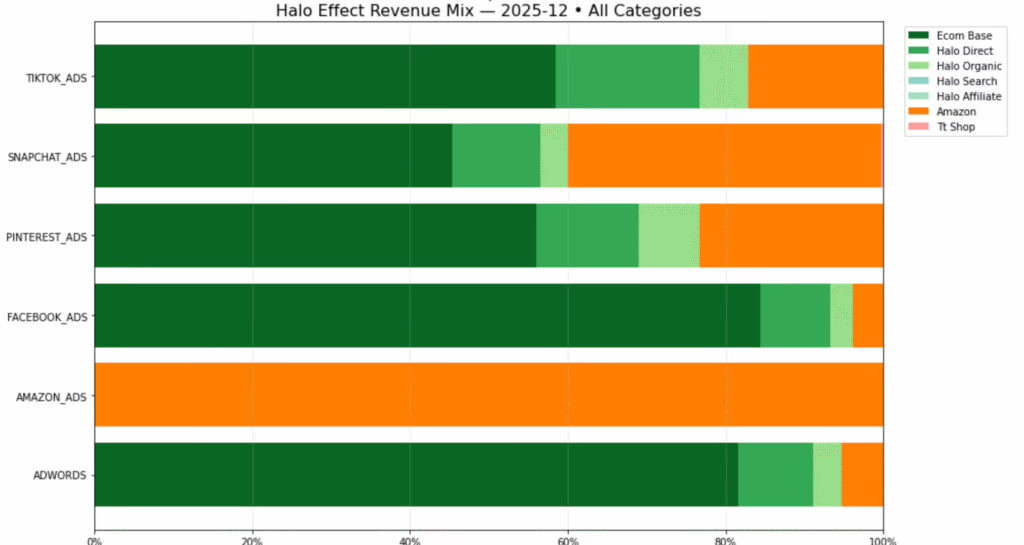
Image Caption: NOTE: The green and red arrows represent month-over-month changes in performance, not gains or losses in revenue since all halo figures shown are positive revenue contributions.
The Amazon angle, and why it changes the math
For brands with a meaningful Amazon presence, the AppLovin picture looks even better. Prescient's data shows that brands with ~60%+ of sales on Amazon and higher average order values see significantly stronger halo effects from AppLovin than the broader cohort average. The hypothesis: AppLovin's targeting is reaching high-intent shoppers with their precise ad targeting who see the ad in-app and convert later on Amazon, the channel they already trust for purchasing.
MaryRuth Organics is a strong example of what this looks like in practice. After measuring their AppLovin campaigns through Prescient's MMM, they found that 87% of AppLovin's Amazon contribution was coming from halo effects, revenue their platform-reported data wasn't capturing at all. Once the full picture was in view, they efficiently scaled AppLovin investment by 40%.
That kind of lift doesn't show up in platform-reported data. It only appears when you're measuring the full revenue picture, including what spills over into channels AppLovin never directly touched.
How to find your optimal spend range on AppLovin
AppLovin works. The data is consistent on that point. But scaling it intelligently requires understanding how the channel behaves at different spend levels, and the pattern is more interesting than the simple "it saturates fast" narrative that circulates among cautious marketers.
Saturation doesn't behave the way you'd expect
Most marketers assume a channel follows a simple efficiency curve: returns are strong early, then gradually diminish as you spend more. Pull back before you hit the flat part of the curve. That's the conventional logic.
AppLovin's saturation behavior is more complex. Prescient's campaign-level data shows that the efficiency curve can have a second peak at higher spend levels, meaning brands that pull back after seeing initial signs of declining returns may be stopping just before a new zone of efficiency opens up. Campaigns that look saturated at one spend level can perform differently at a higher one, particularly as AppLovin's algorithm has more data and budget to work with. The predicted ROAS and predicted revenue can both keep climbing at higher daily spend levels, rather than following a simple downward slope.
That doesn't mean spend without limits. Prescient's data does show that for top 25% spenders, new customer acquisition credit starts to plateau over time at very high spend levels, suggesting a point of audience saturation exists for brands that push aggressively into the channel relative to their overall mix. The sweet spot for most brands appears to be around 10–17% of total marketing spend as a second major channel, with Meta still anchoring the mix.
What you're missing without the right measurement
The challenge with AppLovin isn't just what click-based tools fail to measure; it's also the decisions that get made based on incomplete data. A brand relying on platform-reported analytics for AppLovin campaigns will see a fraction of the true return. They'll pause campaigns that are driving significant Amazon revenue. They'll conclude the channel doesn't scale when the issue is actually the measurement.
AppLovin has been deliberate about building relationships with third-party measurement providers precisely because it knows this gap exists. Brands that bring MMM into the picture from the start are in a fundamentally different position: they can see the full revenue contribution across DTC, Amazon, branded search, and organic traffic, and make scaling decisions based on what's actually happening.
Where Prescient comes in
Prescient's marketing mix model measures AppLovin performance at the campaign level, capturing both base revenue from direct conversions and halo effects across every connected revenue channel, including Amazon Selling Partner, branded and non-branded search, organic traffic, and more. That's how MaryRuth discovered that AppLovin's Amazon contribution was coming from halo effects, and why their ROAS looked so different once the full picture was in view. For brands spending on AppLovin and operating across DTC and Amazon, that gap between what click-based tools see and what MMM sees is often the difference between scaling confidently and leaving a strong channel on the table.
If you're running AppLovin campaigns—or thinking about it—seeing the full revenue picture from day one is how you get the most out of it. Book a demo to see how Prescient can reveal what your AppLovin campaigns are actually driving.
The Halo
Exclusive insights, every week.
Subscribe to The Halo for sharper marketing thinking.
You're subscribed to The Halo!
Quick question (optional): How familiar are you with MMM?
Thanks for sharing! Enjoy The Halo.
Keep reading
View all
How effective is direct mail marketing? What the numbers show and what they miss
Read article
How to plan a multi-channel marketing campaign that actually works together
Read article
Top of Funnel Visibility Loss: New Causes & What to Do
Read article
Brand Campaigns: Goals, Types, & Measuring Them Accurately
Read article
What is agile marketing? A guide for modern marketing teams
Read article
Your marketing channel strategy is shaped by what you can measure
Read article