




Is YouTube an overlooked powerhouse in your marketing mix?
If you don’t measure the halo effects of YouTube campaigns, then you may be leaving your best player on the bench.
Will Holtz · 3 min read

If you don’t measure the halo effects of YouTube campaigns, then you may be leaving your best player on the bench.
YouTube may be considered a legacy player in digital media, but it remains one of the most challenging to scale. Success requires mastering its unique creative demands and accurately measuring the true business impact—something platform reporting and click-based attribution often fail to do. Like linear and connected TV (CTV), a significant portion of YouTube’s value often comes indirectly, via halo effects that influence downstream conversions. But, YouTube also delivers direct-response opportunities through its social-like engagement and targeting capabilities.
While YouTube currently represents around 3% of the total media mix, spending patterns can vary greatly. Consumer electronics brands often scale YouTube during promotions, peaking at up to 60% of their media mix before pulling back sharply. In contrast, Health and Wellness and Beauty and Personal Care brands consistently make up around 20–30% of all YouTube spend—using the platform to drive both awareness and conversions year-round. Across all categories, Prescient’s measurement shows that when halo effects are included, YouTube emerges as a consistent high-performer for growth brands.
In this report, we analyze brands that collectively generated $5B+ in annual GMV and spent $49M+ in advertising on YouTube and Demand Gen campaigns during the past twelve months.
YouTube consistently performs 2-3x better than what platform measurement reports
Prescient’s MMM analysis reveals YouTube’s CAC is 70% lower andROAS is 2.2x higher on average than Google reports—sometimes up to 12x higher for brands that have optimized spend allocation and dialed-in their creative strategy. The gap in performance reporting comes from in-platform metrics missing halo effects: the sales lift that happens on other channels or over time after exposure to a YouTube ad.
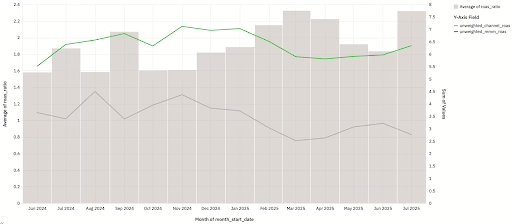
*Comparison of MMM ROAS and Channel Reported ROAS
Halo effects are the key to unlocking YouTube’s full value
As a stand alone channel, halo effects are responsible for an average of 40% (and up to 70%) of YouTube’s impact across DTC and Amazon sales. While this percentage is lower than what is generally seen for traditional video channels like Linear and CTV, it’s higher than top paid social channels, including Meta, TikTok, Snap, AppLovin, and Pinterest.
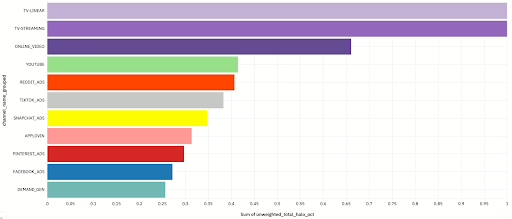
*Halo effects as a percent of overall revenue contribution by channel
Like many other digital platforms today, Google is encouraging advertisers to move from manual distribution of spend across ad properties to investing in options like PMAX or Demand Gen, which rely on the ad platform to determine the best allocation of budget. To support this effort, Google is phasing out Video Action campaigns, which has caused Demand Gen to increase to 70% of the total spend on YouTube.
YouTube runs as part of a Google Demand Gen campaign, Prescient AI data shows that while halo contributions drop significantly—likely because other Google properties in the mix are prone to faster, more direct conversions—campaign returns are closer to those of more full-funnel peers like Meta.
YouTube outperforms video peers on halo-adjusted ROAS
When Halo Effects are factored in, YouTube has a more efficient ROAS over the last three months than its pure-play video peers—TV Streaming (~1.1x), TV Linear (~1.3x), and Online Video (~1.6x).
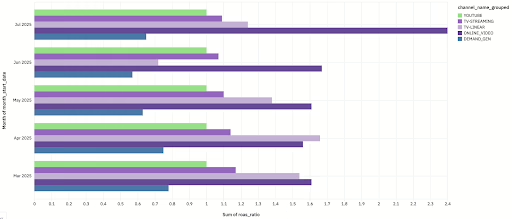
*Comparison of MMM ROAS across TV peers and core paid social channels
The bottom line: Underinvestment is the biggest miss
YouTube remains underinvested relative to its halo-adjusted returns, even as Demand Gen adoption drives more spend to the platform. Brands relying solely on platform-reported metrics risk missing substantial incremental revenue and customer growth opportunities—across both high-investment bursts and steady, always-on periods.
Get the measurement right, and YouTube’s potential isn’t just bigger—it’s game-changing.
The Halo
Exclusive insights, every week.
Subscribe to The Halo for sharper marketing thinking.
You're subscribed to The Halo!
Quick question (optional): How familiar are you with MMM?
Thanks for sharing! Enjoy The Halo.
Keep reading
View all
Brands selling on Amazon need to be advertising on this channel
Read article
The best halo contributing channels for 2026
Read article
Q4 Holiday marketing trends: Your complete planning guide
Read article
YouTube MMM benchmarks
Read article
A marketer’s guide to in-house MMM builds vs vendor tools
Read article
Consideration marketing: How to win the shortlist and prove it's paying off
Read article